Analysis: The Psychological Connection of Rey and Kylo Ren in Star Wars: Episode VII — The Force Awakens

In my current Write a Worthy Nemesis class, we have been exploring Carl Jung’s theory of the shadow. Here is an extended excerpt from Lecture 2: Shadow vs. Light:
Let me present to you what may be a startling concept, one that suggests a Nemesis — who they are, how they are, what they are — is intimately connected to the Protagonist’s psyche state. Indeed one way of looking at the Nemesis is as a physicalization of the Protagonist’s shadow, a projection come to life.
Parsing that language, the psyche represents the totality of the human persona, conscious and unconscious states, thoughts and feelings. Projection occurs when an individual ascribes aspects of their psyche onto someone else. Finally the shadow is one key facet of the psyche, an idea promulgated by the noted analytical psychologist Carl Jung:
Unfortunately there can be no doubt that man is, on the whole, less good than he imagines himself or wants to be. Everyone carries a shadow, and the less it is embodied in the individual’s conscious life, the blacker and denser it is. If an inferiority is conscious, one always has a chance to correct it. Furthermore, it is constantly in contact with other interests, so that it is continually subjected to modifications. But if it is repressed and isolated from consciousness, it never gets corrected. — “Psychology and Religion” (1938).
The shadow is all aspects of an individual’s psyche that exist outside the light of consciousness. While there can be positive energy associated with it, more often than not the shadow expresses itself as a negative dynamic, deriving from the least desirable facets of a person’s psyche:
It is a frightening thought that man also has a shadow side to him, consisting not just of little weaknesses and foibles, but of a positively demonic dynamism. The individual seldom knows anything of this; to him, as an individual, it is incredible that he should ever in any circumstances go beyond himself. But let these harmless creatures form a mass, and there emerges a raging monster; and each individual is only one tiny cell in the monster’s body, so that for better or worse he must accompany it on its bloody rampages and even assist it to the utmost. — “On the Psychology of the Unconscious” (1912).
Positively demonic dynamism… emerges a raging monster… bloody rampages. If we project these attributes into the realm of story, doesn’t it sound like a Nemesis at work? Furthermore the presence of a character’s shadow suggests a direction for the narrative:
The hero’s main feat is to overcome the monster of darkness: it is the long-hoped-for and expected triumph of consciousness over the unconscious. The coming of consciousness was probably the most tremendous experience of primeval times, for with it a world came into being whose existence no one had suspected before. “And God said, ‘Let there be light”’ is the projection of that immemorial experience of the separation of consciousness from the unconscious. — “The Psychology of the Child Archetype” (1940).
In a story’s Internal World, the psychological and emotional realm, the Hero’s Journey is about engaging the shadow, bringing it into the light of consciousness, then subduing it or diffusing its negative power by acknowledging and understanding it.
In a story’s External World, the realm of action and events, this dynamic almost always plays itself out as a confrontation between Protagonist and Nemesis, the latter a physicalization of the Protagonist’s darkest, most repressed desires and feelings.
This means that to the degree the Nemesis reflects key attributes of the Protagonist’s shadow, a story will have a natural sense of unity and an organic synergy between these two critical characters: Shadow vs. Light.
With that as a frame, a question arose in my Nemesis class: In Star Wars: Episode VII — The Force Awakens, is Kylo Ren related in some way to the Rey’s shadow as the protagonist?
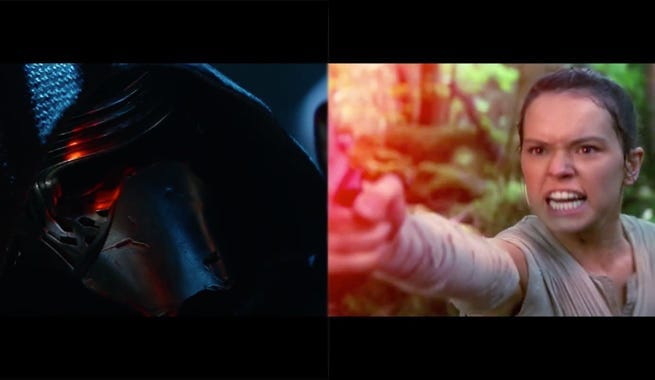
For a deeper exploration of this question — SPOILER ALERT!!! — click on More and read my analysis of the relationship between Rey and Kylo Ren… then switch Protagonists and look at the story from Kylo Ren’s perspective and his connection to Rey.
Here is my response to the question posed in my Write a Worthy Nemesis class:
There is perhaps no movie franchise to which this concept — the Nemesis is the physicalization of the Protagonist’s shadow — applies more aptly than Star Wars. Whereas I get the feeling in many movies, the psychological connection between the P-N is more of an organic offshoot of the creative process, with SW, it is a clear and conscious choice. From the very beginning with Luke and Darth Vader in Ep. IV and the very idea of the Light and Dark Side of the Force, that radical duality and a key part of Luke’s Disunity to Unity journey, it is there up front and center. Indeed as I argued here, Darth Vader has his own journey from Dark to at least a brief flickering of Light going from Nemesis (IV) to Trickster (V) to Attractor (VI) in terms of his narrative function with regard to Luke in each of those movies.
With that as a frame and acknowledging that Ep. VII draws liberally from IV and V, we find in Rey and Kylo Ren a similar construction as Luke and Darth Vader in IV: She is drawn toward the Light Side of the Force while Kylo Ren is deeply immersed in the Dark Side. Their Final Struggle is part of their collective narrative imperative, made personal when Rey witnesses Kylo Ren murder Han Solo.

While Rey’s journey in VII is more like Luke’s in IV — attaining the knowledge of her own Jedi nature and learning how to use the Force and her Jedi Knight instincts — interestingly Kylo Ren has more of a storyline like Luke in V and Darth Vader in VI: struggling with both Dark and Light sides of the Force (in V, Vader attempts to lure Luke to the Dark Side by fueling Luke’s rage; in VI, Luke directly reaches out to Vader’s humanity, his Inner Father, and it’s that which prevails in the end, killing Emperor Palpatine, saving Luke’s life, and offering Vader a path toward ‘salvation’).
In VII, Kylo Ren’s tears just before he kills his own father (Han Solo) are perfect representations of the struggle he feels, aspects of his Disunity. He should be firmly in the camp of the Dark Side, yet he is torn. To me, Kylo Ren is like a juvenile / adolescent version of Darth Vader, more prone to emotional outbursts whereas Vader is more ‘mature’ in understanding who he is (at least he thinks so until his final moments in VI prove otherwise).
To wit: When Kylo Ren gets angry, he has violent outbursts and — illogically — destroys a bunch of equipment. When Darth Vader gets angry, as in IV and V, he suffocates Empire soldiers using the Force as a demonstration of his dissatisfaction with their work performance which in turns serves a purpose: To compel those who take over to do a better job. Again broadly speaking: Kylo Ren — -> Adolescent / Darth Vader — -> Adult.
Circling back to your specific question, Kylo Ren does, I think, function as a projection of Rey’s shadow, but my guess is that this is a subject to be explored much more fully in future episodes. In VII, we see very little of what I imagine is a layer of anger / rage about how she had her parents wrenched away from her or worse, how she was abandoned by them. What she accesses about that trauma in her past is sadness. Those tears from Kylo Ren in his interaction with Han Solo are more of an apt point of psychological connection between them from Rey’s POV. As I said, her journey is more about attaining the knowledge she has Jedi blood coursing through her veins, to access that and use it in her journey. Kylo Ren exists largely as a symbolic representative of the Dark Side of the Force which Rey only experiences for the first time in her interactions with Kylo Ren, demonstrated most viscerally when he kills Han Solo which, as I suggested, is what makes their Final Struggle more personal (from her POV).
However if we engage in the Switch Protagonist exercise and look at the world through Kylo Ren’s eyes as the story’s P (which he is not, this is just an exercise), Rey is very definitely a projection of his own shadow which — ironically — represents his pull toward humanity, empathy, and the Light Side of the Force. It’s there in him. As I noted, he is not as far along in his journey toward Darkness as Darth Vader was, so it seems to me Kylo Ren is closer to his humanity than Vader was. We see this not only with his tears re Han Solo, but also in the scene where he interrogates Rey. If memory serves correct, this is the very first time he takes off his helmet and we see his human face, as if to say in the face of another human being, this degree of proximity, he is willing to shed his mask and reveal his own face. And in this scene, there is some clear subtext, even emerging up top in his behavior which suggests he is drawn toward Rey — maybe some of it physical, even sexual, but I would argue equally if not more about her Goodness. She can be seen to be the physicalization of his own Inner Humanity and he is drawn toward, fearful of, and angered by Rey.
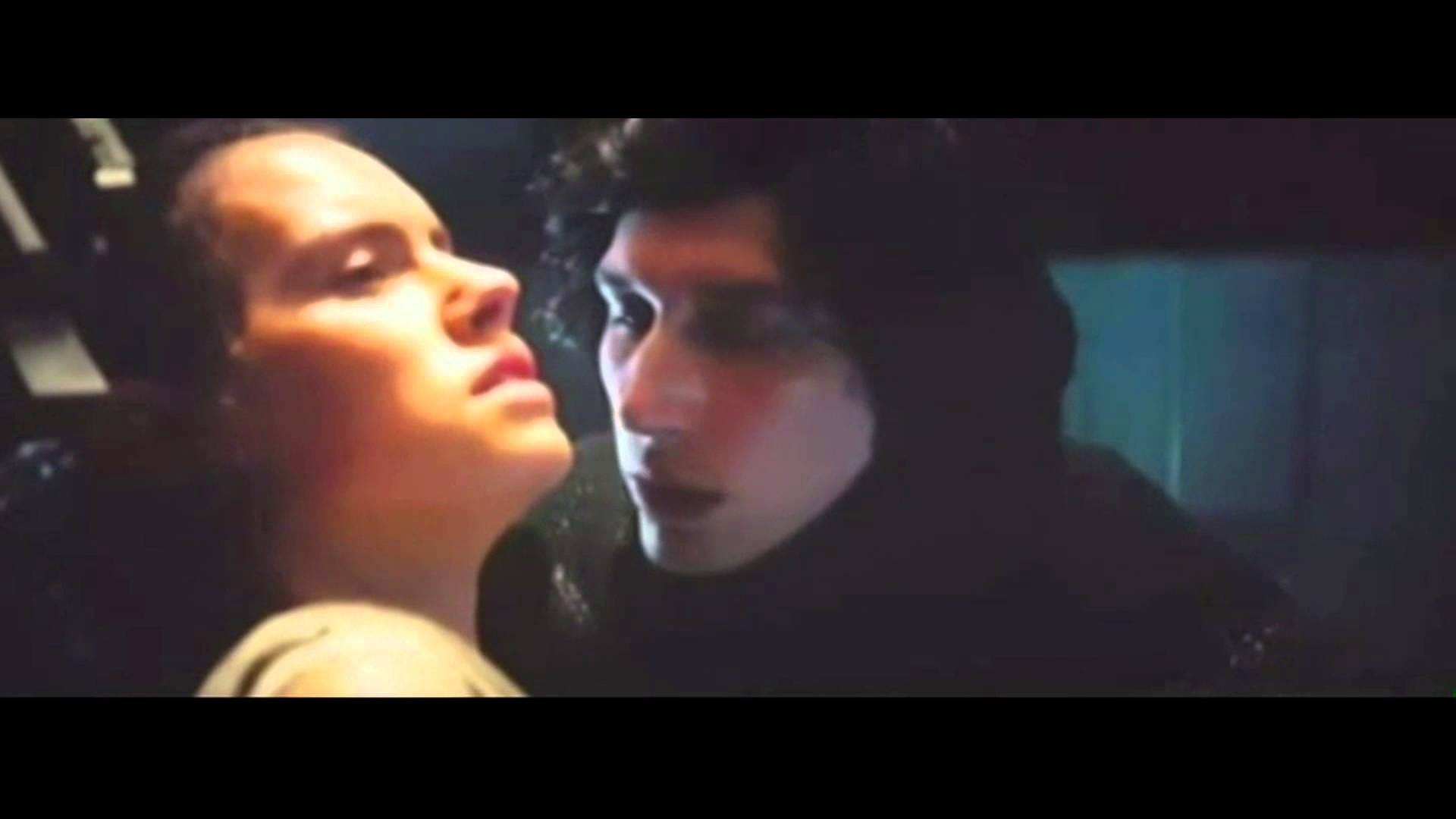
So in a way, I think the actual psychological connection of one character being the projection of the other’s shadow is stronger going from Kylo Ren to Rey in VII than it is from Rey to Kylo Ren. However, as I said, Kylo Ren does represent the Dark Side of the Force which any Jedi has to confront in their training and journey, something I suspect Rey will deal with in future episodes.
That’s my take. Obviously the story is open to endless different interpretations. What do you think?
Takeaway: One key to crafting a strong Nemesis character is to explore the psychological connection between the Protagonist and Nemesis. Often the antagonist figure can be seen as a projection of the Protagonist’s shadow dynamic. This understanding helps to focus the nature of your story’s central relationship and can help you construct a narrative which builds to a Final Struggle which is not only the culmination of the events of the Plotline, but also an event which is infused with emotional, symbolic, and psychological meaning.