Archetypes: The Wizard of Oz (Part One)
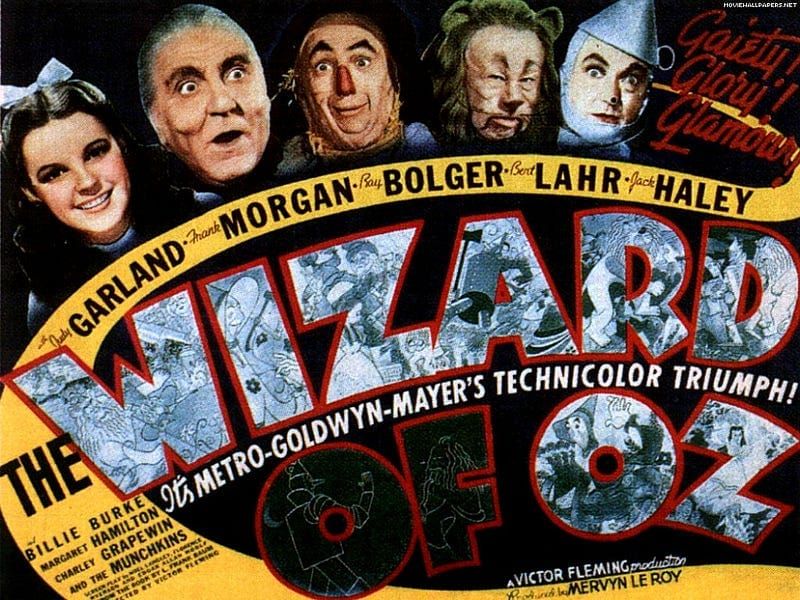
I’ve always thought The Wizard of Oz (1938) to be a classic example of The Hero’s Journey, following the cyclical paradigm of “The Odyssey” — starting at home (Kansas), traveling to an extraordinary world of adventure (Oz), then returning home. But I gained an even deeper appreciation for the symbolic, psychological, and emotional life of the movie when I analyzed it using five primary character archetypes: Protagonist, Nemesis, Attractor, Mentor, Trickster. Here are some of my thoughts about this much beloved movie.
[For more background on character archetypes, you can go here.]
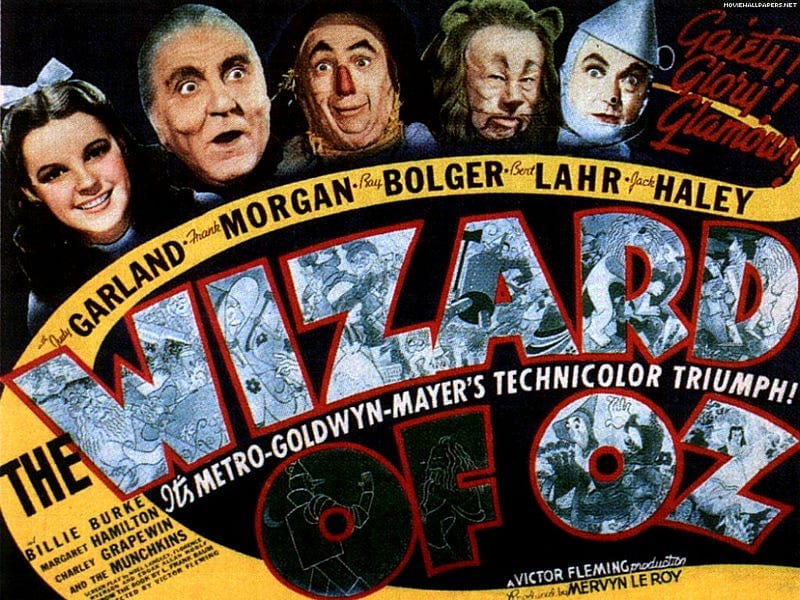
Protagonist — Dorothy Gale (Judy Garland)
Clearly Dorothy is the story’s Protagonist:
- The story is told through her perspective.
- It’s her journey / the plot revolves around her.
- Her character goes through the most significant transformation.
Goal:
- What does she want (External World)? Once she’s in Oz, Dorothy wants to go home.
- What does she need (Internal World)? She needs to feel like her home in Kansas is her home.
This is a critical point, one demonstrated when Dorothy sings “Somewhere Over the Rainbow” and in particular with these lines [emphasis added]:
“Someday I’ll wish upon a star
And wake up where the clouds are far
Behind me.
Where troubles melt like lemon drops
Away above the chimney tops
That’s where you’ll find me.”
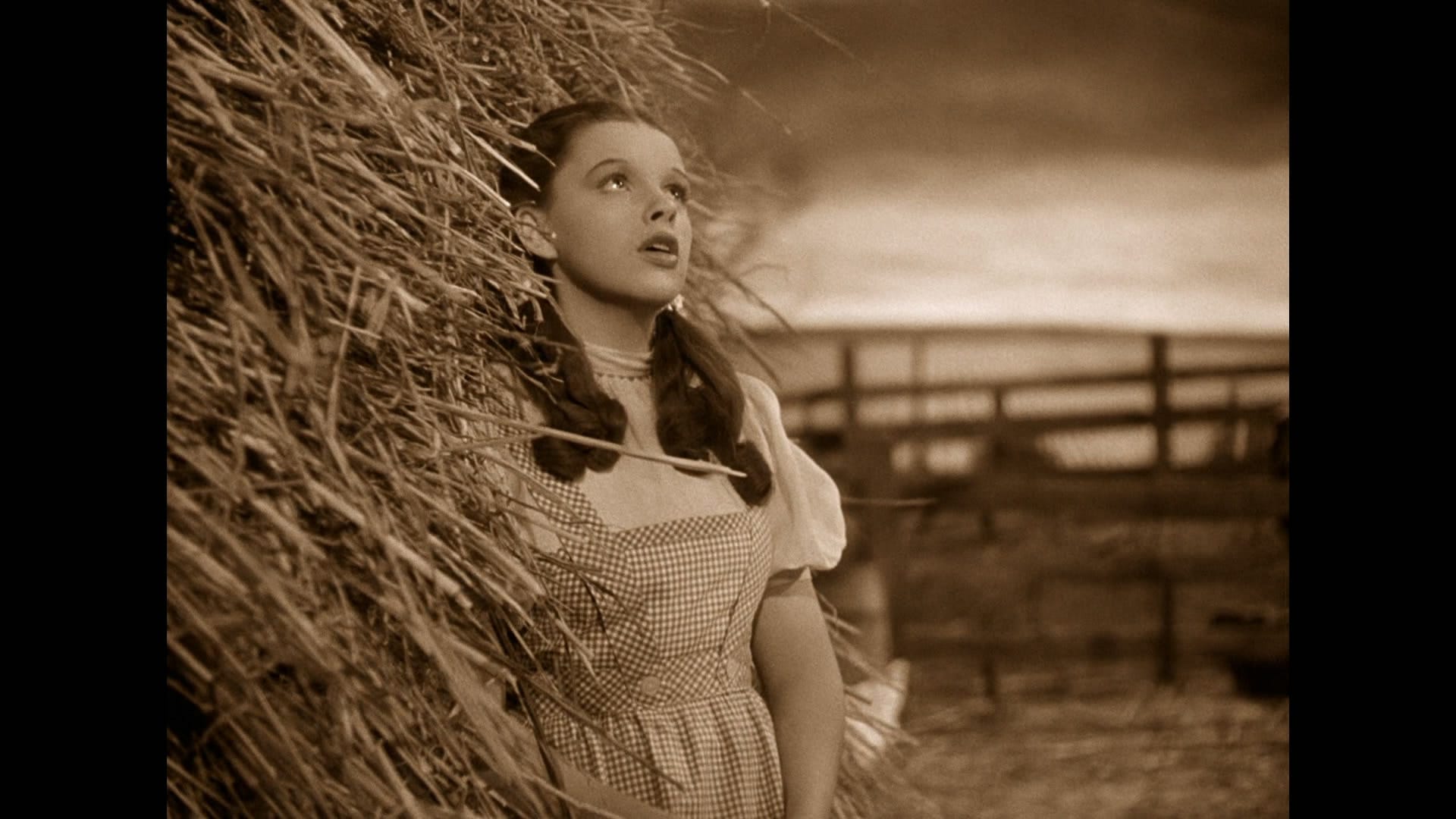
What are Dorothy’s ‘clouds?’ What are her ‘troubles?’ Clearly, she has an issue with Miss Gulch, that’s how the movie begins, yet another incident in an ongoing struggle between the “old witch” and Dorothy’s dog, Toto. But the subtext of the song and the emotion which drives Dorothy as she sings it comes from something else: Fundamentally, I think she feels a sense of alienation, like in some very real way, she doesn’t belong where she lives.
- She’s a young girl surrounded by people older than she (in the Kansas scenes, there are seven other humans and each of them is an adult).
- Everyone on the farm — from her Auntie Em and Uncle Henry to the hired help Hunk, Zeke, and Hickory — has a specific job. Apparently Dorothy does not.
- Nor does she have anyone (other than Toto) to play with, one reason she gets into trouble while “walking along the railing between the pig pens” and falling in, necessitating Zeke to rescue her (this incident reinforces how she just doesn’t fit in with the ways of the farm).
- She even dresses differently than everyone else in a crisp blue-and-white dress whereas the others wear work clothes.
But I think the single biggest contributing factor for Dorothy’s sense of alienation is the fact that she has no living parents. Uncle Henry alludes to this factor:
UNCLE HENRY
Poor little orphan, and her Miss Gulch
troubles. Gosh all hemlock - you know, she
ought to have somebody to play with.AUNT EM
I know, but we all got to work out our own
problems, Henry.
So the Protagonist Dorothy starts the story in a state of Disunity: She's living in a home that doesn't feel like home, the absence of her parents casting a shadow over her. She yearns to "fly away" to some dream-like place "over the rainbow" where her feelings of alienation will give way to a sense of belonging. Indeed, it takes a magical trek through Oz with all of its challenges and complications, allies and enemies to help Dorothy transform from an alienated young girl into her Unity state, someone who feels about the farm and its people -- "there's no place like home."
Nemesis - Miss Gulch / Wicked Witch of the West (Margaret Hamilton)
If Dorothy's alienation leaves her feeling powerless, that vacuum of power is filled by Miss Gulch. Remember this line [emphasis added]:
AUNT EM
Almira Gulch, just because you own half the
county doesn't mean you have the power to
run the rest of us! For twenty-three years,
I've been dying to tell you what I thought
of you! And now -- well, being a Christian
woman, I can't say it!
But in fact, Miss Gulch does have the power, even to get her way with that nuisance of a dog Toto with threats:
MISS GULCH
If you don't hand over that dog, I'll bring
a damage suit that'll take your whole farm!
There's a law protecting folks against dogs
that bite!
She even has the law on her side:
MISS GULCH
Well, that's for the Sheriff to decide.
Here's his order allowing me to take him.
Unless you want to go against the law.
So when Miss Gulch has convinced Uncle Henry and Auntie Em they have no choice but to hand over the dog, it's understandable why Dorothy responds the way she does:
DOROTHY
You wicked old witch! Uncle Henry, Auntie
Em, don't let 'em take Toto! Don't let her
take him -- please!
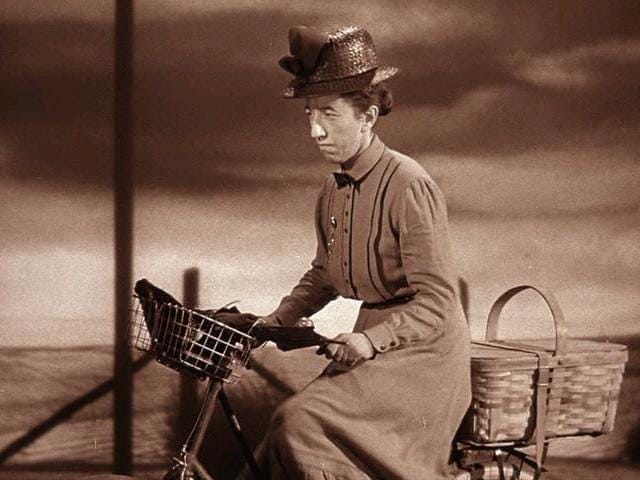
Now everything is in place for Miss Gulch to change into the persona of the Wicked Witch of the West once Dorothy reaches Oz and do what all good Nemesis characters do -- provide opposition to the Protagonist in achieving their goal.
Attractor - Hunk / Scarecrow (Ray Bolger), Hickory / Tin Man (Jack Haley), and Zeke / Cowardly Lion (Bert Lahr)
In Kansas, the three hired hands -- Hunk, Hickory, and Zeke -- are as close to being 'friends' as Dorothy has (aside from Toto). After Auntie Em shoos Dorothy away, she heads directly to the trio to get their advice about Miss Gulch -- and each one provides their own two cents:
HUNK
Now lookit, Dorothy, you ain't using your
head about Miss Gulch. Think you didn't
have any brains at all.HICKORY
Listen, Dorothy, don't let Hunk kid you
about Miss Gulch. She's just a poor
sour-faced old maid that -- she ain't got
no heart left. You know, you should have a
little more heart yourself, and have pity
on her.ZEKE
She ain't nothing to be afraid of. Have a
little courage, that's all.
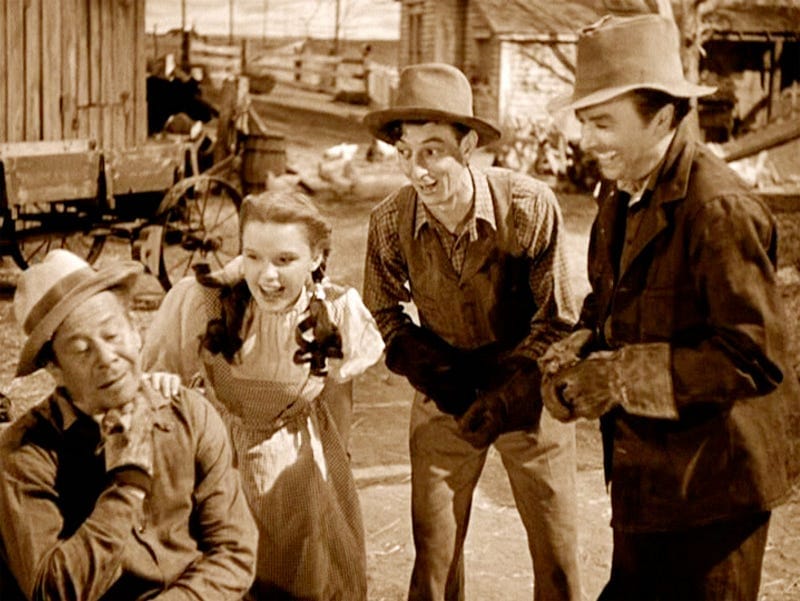
Of course, once Dorothy journeys to Oz, these three 'friends' accompany her there in the form of Scarecrow, Tin Man, and the Cowardly Lion. And as we'll see, while they become her allies along the way, they also play a critical role in Dorothy's change of heart about her home back in Kansas -- befitting their roles as Attractor characters.
Note: Auntie Em and to a lesser degree Uncle Henry function as Attractor characters, too, but to a lesser degree because they don't make the 'journey' to Oz (with the exception of one beat in the witch's tower room where Dorothy sees her aunt in the magic crystal).
Mentor -- Glinda (Billie Burke)
Glinda (the Witch of the North) is a paradigmatic Mentor character, supporting the Protagonist by dispensing key pieces of 'wisdom':
- After Dorothy's house lands in Oz, it's Glinda who arrives on the scene and tells Dorothy about Oz, the Witches, and the Munchkins.
- She knows about the ruby slippers and tells Dorothy "remember, never let those ruby slippers off your feet for a moment, or you will be at the mercy of the Wicked Witch of the West."
- Because Dorothy's become an enemy of the Wicked Witch of the West, Glinda advises Dorothy, "The sooner you get out of Oz altogether, the safer you'll sleep, my dear."
- She tells Dorothy about the Wizard of Oz, how he might be able to tell her how to get back to Kansas.
- She also gives Dorothy this piece of advice:
GLINDA
It's always best to start at the beginning
-- and all you do is follow the Yellow Brick
Road.
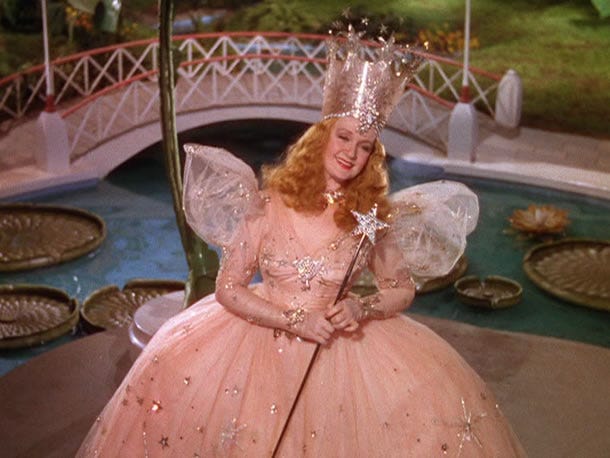
Of course, much later in the story, Glinda provides Dorothy the key for her to get home. All that is the stuff of a Mentor character.
Trickster -- Professor Marvel / The Doorman / The Guard Who Cries / The Carriage Driver / The Wizard of Oz (Frank Morgan)
The simple fact that actor Frank Morgan plays all five of these roles suggests a Trickster at work as they often shapeshift to test the Protagonist:
- When we first meet Professor Marvel, he tests Dorothy's resolve to run away. And how does he do it? By getting Dorothy to close her eyes, so he can sneak a peek at a photograph of home Dorothy is carrying with her, then pretending to 'see' Auntie Em:
DOROTHY
That's right. What's she doing?PROFESSOR
Well, I -- I can't quite see. Why, she's crying.DOROTHY
Oh --PROFESSOR
Someone has hurt her -- someone has just
about broken her heart.DOROTHY
Me?
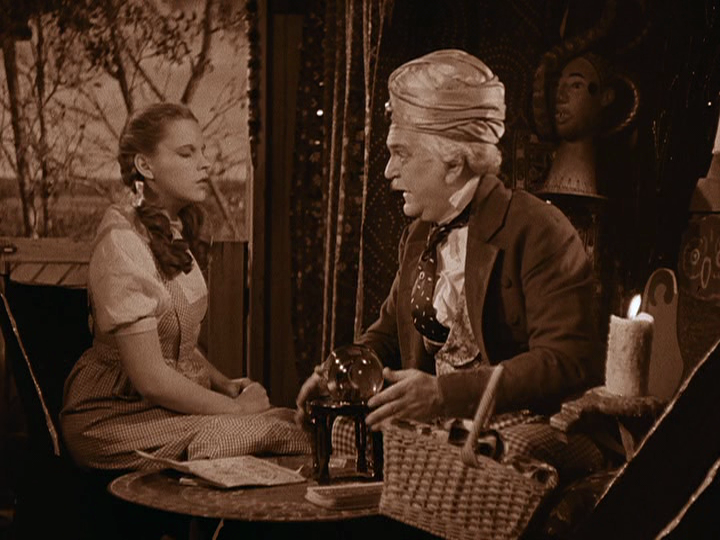
That's a Trickster at work.
- Once in Oz, Professor Marvel shows up as The Doorman in Oz:
DOROTHY AND OTHERS
We want to see the Wizard.DOORMAN
Ooooh! The Wizard? But nobody can see the
Great Oz! Nobody's ever seen the Great Oz!
Even I've never seen him!
Again a test, which Dorothy and the others pass.
- But of course, Professor Marvel is the biggest Trickster of them all when he 'plays' the Wizard of Oz:
OZ'S VOICE
The Wizard - The Wizard - The Great and
Powerful Wizard of Oz - Oz - Oz-Oz - Oz -
Oz - Oz - Oz.
Providing the biggest test of all -- and the biggest trick, too!
Note: Toto also functions as a Trickster character, sometimes creating problems for Dorothy (messing with Miss Gulch's yard), sometimes helping her (pulling back the curtain to reveal the real Wizard of Oz.
Summary (Part One)
The Wizard of Oz is a great example of a story that uses these five primary character archetypes. In Part Two, we'll look more closely at each of their respective narrative functions and as a result, how the characters drive both the Plotline and the Themeline.
Comment Archive