Are “TV” and “Movie” terms bound for obsolescence?

In a recent interview with Atlantic, “House of Cards” showrunner Beau Willimon articulated something in a clear, concise that I’ve been toying around with on the blog for the last 18 months or so: The idea that “TV” and “Movie” will in time become obsolete. Here are key excerpts from the interview [emphasis added]:
I don’t know how much longer the idea of a “season” will be something that we feel like we need to adhere to in television. Even the idea of an episode. I think with streaming, you might have shows in the future where you have three or four hours released. And then three months later you’ll get another couple hours. And then nine months later you might get six more hours. I mean, do all of those constitute a season, or do you sort of dispense with the notion of seasons altogether?
I’ve toyed with the idea for a show that doesn’t have episodes at all. That would simply be one eight-hour stream for a season, and the viewer decides when they want to pause, if at all. That definitely could affect the writing of a show. But we’re in an in-between period now,where we have traditional broadcast networks on one end of the spectrum and streaming on the other, meaning that shows kind of have to be able to live in both worlds.
— —
But it goes to the more fundamental question, which is: Does television exist anymore? And I would make the argument that it doesn’t, and neither does film. And what I mean by that is the differentiation between film and television is gone. If I were to ask you: “What is a film? How do you define a film? How do you define a television show?” What would you say?
By episodic what do you mean?
What is The Godfather? Parts 1, 2, and 3. You know? If you start thinking, well a TV show is a half-hour to an hour long and it’s in chunks, and a TV show is an hour to two hours and it has a beginning, middle, and end and then it’s done — those are pretty weak definitions, right? It really just comes down to formal, structural things. It’s like if I said to you there’s no fundamental difference between a sonnet and a haiku. Like, they have different meter structures. But they’re both poems. They’re both trying to express something. The words within them don’t know that they’re a haiku or a sonnet. If a television show has an episode that is 90 minutes long, could that episode in itself constitute a film? And what if you have a movie that’s 45 minutes long? We typically call that a short. But how different is that than a standalone episode of TV?
I mean, are we just talking about length? Because it doesn’t make it a movie [just] because you go to a movie theater to see it. You could show House of Cards in a movie theater, or Orange Is the New Black or The Sopranos. The quality and the sophistication of the filmmaking these days rivals what you see in the cinema and in some cases is even better. The level of talent, for the directors and the actors being drawn to television, is on par and in many cases better than what you’re seeing coming out of studios in Hollywood. For kids that are being born right now and will grow up with a smartphone or some sort of tablet in their hands, there’ll be no differentiation for them between watching these things on their phone or their tablet or their television.
We used to talk about television as a small screen. Well, a lot of people now have a 60-inch screen. The experience at home is now in some ways more cinematic than in a movie theater because that screen takes up a greater percentage of your field of vision than if you’re sitting halfway back in a movie theater. A lot of people watch a movie on their phone.
All of those experiences are valid. So if you were to say, “I want to make an eight-hour thing,” I can’t think about it as a television show. I can’t think about it as a movie. Right? And so I don’t know what to think about it as. I mean, the closest thing might be a novel. You have to think, “Well, what are the rhythms of that?” If you don’t have specific breaks in it, it’s got to be symphonic. It’s got to be something that has its natural fissures and places where it ebbs and flows. You’re really talking about making an eight-hour film, or a season of television without breaks. And those are sort of inferior ways of trying to describe the thing you’re trying to make. I’m not doing a good job answering your question because I don’t really have the words to describe something that doesn’t exist.

Beau Willimon with “House of Cards” writing staff
It doesn’t exist yet, but the terminology is out there, floating around. As Willimon suggests, the key difference between what we call TV and movies nowadays is time. This is especially true among young people. My college students? They confirm what Willimon asserts: Virtually none of them watch actual TV. They watch what Old Farts call “TV” on their computers, notebooks, smartphones, just like they do with movies.
Also as Willimon notes, what we call “TV” has, over time, become much more cinematic. This has trickled down from pay cable to basic cable to broadcast. In part, this is because so many movie writers have made forays into TV, but also TV execs know they are competing with movies on the same screens that young people are watching nowadays. It’s not one TV series versus another in terms of gaining eyeballs. It’s TV versus everything including $200M blockbuster CGI laden movies. So naturally the people who produce TV have had to up their game — and their budgets — to make TV series as visually engaging as movies. Perhaps no current TV series proves this point than “True Detective” which feels like a movie due to the brilliant direction of Cary Fukunaga and the show’s crew.
A fan of movie history, I was struck by Willimon’s comment: “I’ve toyed with the idea for a show that doesn’t have episodes at all. That would simply be one eight-hour stream for a season.” He picked this up later with his comment about an “eight hour thing”.
Did you know the original cut of the 1924 movie Greed, screen adaptation and scenario by June Mathis and Erich von Stroheim, the latter also the film’s director, clocked in at eight hours long?
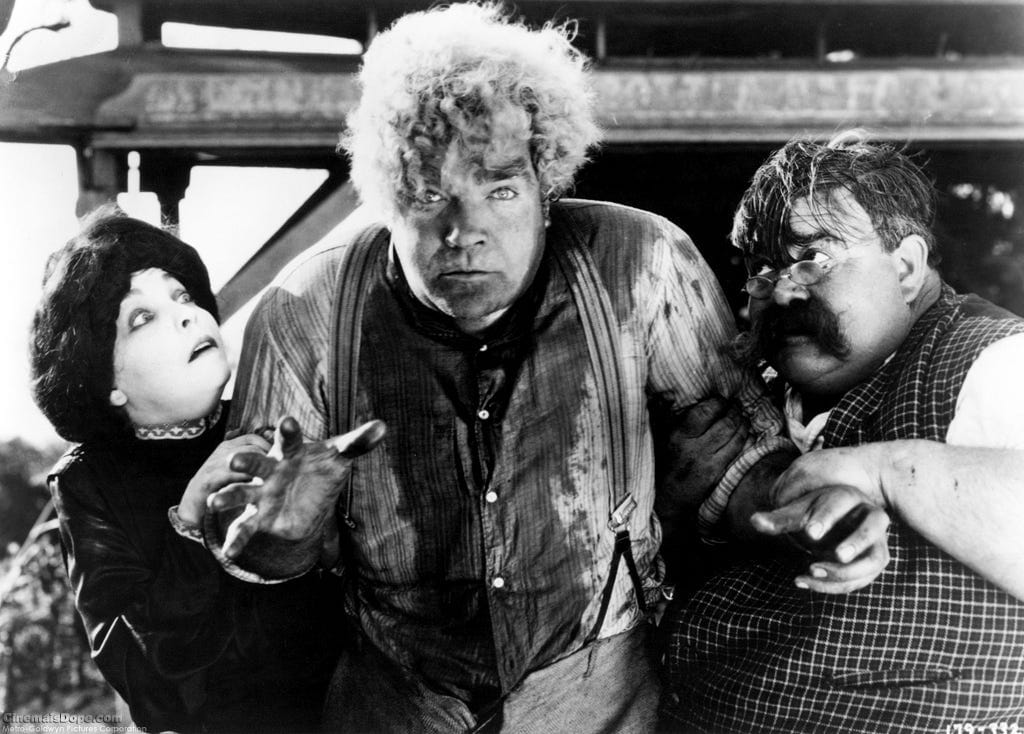
What if von Stroheim foresaw what Willimon is envisioning now? What if House of Cards is not TV, but rather an eight hour movie? What if in the future, every form of digitally produced visual narrative is categorized by their length? An eight hour thing. A two hour thing. A one hour thing. A half-hour thing. A four minute thing. A six second thing.
What if we’re headed for a future with no “TV” and no “Movies,” but instead a “Thing”? Because let’s face it… it’s all just storytelling.
What are your thoughts? And if you want to take a crack at what we might call this “Thing,” please stop by comments.
For all of the Willimon interview, go here.
UPDATE: In a nice bit of synchronicity, FilmSchoolRejects ran with this article earlier today: What Should We Be Calling Television Now?
Comment Archive