Beyond Words: Celebrating 2015’s WGA-Nominated Screenwriters
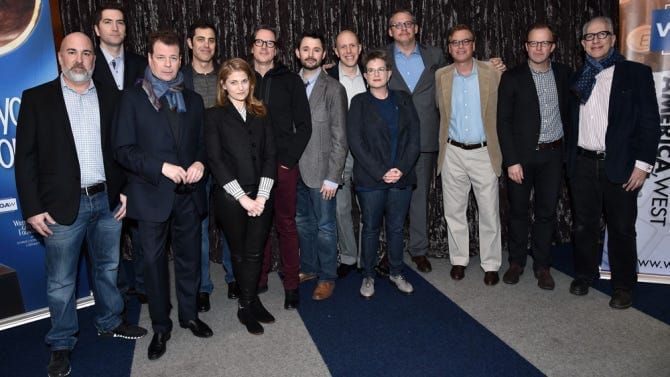
The Black List’s Kate Hagen (@thathagengrrl) attended the recent Beyond Words 2016 event sponsored by the Writers’ Guild of America, West, the Writers Guild Foundation, and Variety.
As awards season continues chugging along, the WGA-W, the Writer’s Guild Foundation, and Variety gathered together to celebrate 2015’s WGA-Award nominated screenwriters.
Andrea Berloff and Jonathan Herman (STRAIGHT OUTTA COMPTON), Aaron Sorkin (JOBS), John McNamara (TRUMBO), Charles Randolph and Adam McKay (THE BIG SHORT), Matt Charman (BRIDGE OF SPIES), Josh Singer and Tom McCarthy (SPOTLIGHT) and Drew Goddard (THE MARTIAN) took the stage at the WGA Theater to discuss their creative processes, what scenes they had to cut from their scripts, and how to approach script structure when dealing with real-life characters.
Photo credit: Variety
Even with original screenplay nominees Taylor Sheridan (SICARIO) and Amy Schumer (TRAINWRECK) unable to attend, the stage was packed as John August (this year’s recipient of the Valentine Davies Award) joined the 11 writers on stage to moderate. August told the audience we’d being seeing a lot of lightning round questions to keep the conversation moving.
August first asked the writers: How long was the production process of the film from initial conception to theatrical release?
THE MARTIAN: Three years
SPOTLIGHT: Four years
BRIDGE OF SPIES: Three years (11 months from pitch to production, an incredibly fast turnaround time)
CAROL: “Eighteen effing years,” as Nagy put it.
THE BIG SHORT: Five years
TRUMBO: Eight years
JOBS: Three years
STRAIGHT OUTTA COMPTON: Five years
Ah, the long, lonely life of a writer. Since all of the nominated scripts besides CAROL and THE MARTIAN were based on real people, August then asked the panel about how they approached integrating real life into their work. For Berloff and Herman, having access to Ice Cube and Dr. Dre from day one was hugely beneficial in shaping COMPTON, as they were able to draw on interviews and transcripts to make the film feel authentic. Sorkin told the crowd that meeting Jobs’s eldest daughter, Lisa, and John Sculley helped him find the emotional through line of the story, despite Jobs’s death three weeks prior to Sorkin’s start on the script. McNamara and Charman echoed Sorkin’s statements, saying that meeting Dalton Trumbo’s daughter and James Donovan’s son, respectively, allowed them to shape TRUMBO and BRIDGE OF SPIES.
For the writers of THE BIG SHORT, it was a split decision on meeting their real-life inspirations: Randolph “didn’t want [those people] in my head” while writing, but McKay had to meet the actual folks to help his work as director. McCarthy and Singer also relied heavily on research for SPOTLIGHT, spending six months interviewing anyone and everyone to help construct their story about the Catholic Church’s abuse of power in Boston. Both SPOTLIGHT writers praised the journalists who are the film’s core for their collaborative efforts, and their help in shaping scenes up until filming began.
Since their scripts were not based on real people, both Nagy and Goddard were thankful for the freedom that their fictional source material offered. For Nagy, who kept only the basic characters and ending from Patricia Highsmith’s novel THE PRICE OF SALT, having the freedom to craft Carol and Therese’s story totally on her own was invaluable. Likewise, Goddard, who has a long resume of TV credits, said that not having to rely on expository dialogue, as is often the case in TV, allowed him to craft his characters based only on their actions in the film.
For the rest of Kate’s take on the event, go here.