Black List word clouds
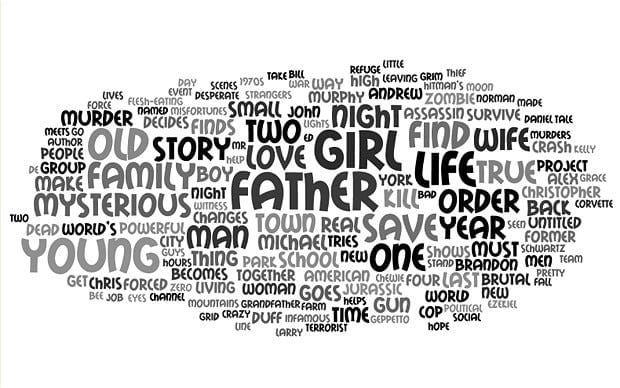
Awhile back Franklin sent me this article from The Telegraph which did a word cloud of the 2011 Black List synopses:
It is a predictable lesson in oedipal clichés and unchanging themes. Right at the centre, the most common word used in these film script plot lines is: “FATHER” which takes its place conveniently next to “KILL”. Then, of course, the obligatory “GIRL”, “MAN”, “SAVE”, “LOVE”, “FAMILY”, “MYSTERIOUS”, “STORY” surround it neatly — and don’t miss the old “YOUNG” / “OLD” duality, equally weighted here in exemplary PC fashion. And, voila, you have the abridged synopses of Hamlet, which is more or less where all stories begin and end. It is also believed to be the play most adapted to screen, as well as the inspiration behind the greatest children’s film ever made: The Lion King.
There may be nothing much of use that we can learn from this, besides the obvious: if you want to write a film script, kill your father first.
Here is the 2011 Black List word cloud:
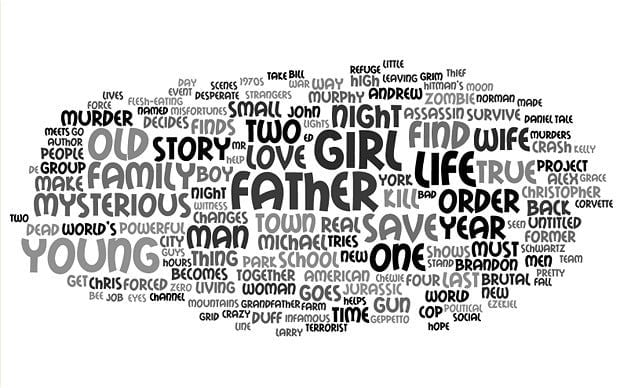
So @nate_winslow ran with the ball, going back through each Black List to 2007 and came up with these five top words each year:
2007
Life
American
Government
Must
Become
2008
Two
Town
Get
Wife
School
2009
Based
Town
Girl
Lives
Find
2010
Man
Get
Tries
Find
Woman
2011
Mysterious
Family
Find
Save
Love
And if that isn’t enough information, Nate also did two more word clouds:
Produced Black List Movies
Must
Girl
Woman
Living
Take
Order
Relationship
Falls
Job
Home
Takes
Unlikely
But this may be my favorite of all: The top words from synopses of Black List scripts from 2007–2010. Because if you string the words together, it almost sounds like a logline:
“Story Based Young Life Love Man One Find Woman Must Get Girl Friends Discovers”
I mean come on! Stick Jennifer Aniston and Michael Fassbender in that, directed by Michael Bay, you’ve got yourself a smash hit!
To see the Black List word clouds Nate created:
2007–2010 Black List word cloud
Black List movies that have been produced
So for all of you who have asked me, “How does somebody get a script on the Black List,” the answer lies in the above word cloud mystery. Let The One who has eyes to see… see!
Observations? Analysis? Insights? Anybody got Dan Brown’s phone number?
See you in comments!
UPDATE: Found an email exchange Nate and I had about the word clouds. Here is Nate:
Interestingly enough, “young” is the only word to be in every one of the lists.
The one other throughline through all of the lists is that all of these Top 5 words are primal. Universal. Love, men and women, relationships, time…all of those, in whatever context, deal with primal themes, recognizable and easily understood. Clearly, we’re taking individual words out of the context of their loglines, which in turn are taken out of the context of their story, so it’s not like we can point to a formula that presents a guaranteed entry on to the Black List, or even what makes a great story. But even so, it’s telling that these words are the way writers are choosing to pitch/represent their scripts in one sentence. Regardless of the execution of the idea or the tone (the Black List scripts represent just about as wide of a range of tones as you can get), the loglines are all using this language to get their stories across.
Never in the top, but I think the prevalence in the “second tier” of popular words of things like must or discovers or becomes is pretty telling too: those are active words. They reference needs, transformations and journeys. Not an accident, I would imagine.
“Based” showing up a lot tells you how many of these scripts are adaptations of some kind of source material, too. That was probably the most surprising thing to me. I knew there were adaptations of the BL, but I didn’t know there were THAT many. Just goes to reinforce the idea that source material screams built in audience to Hollywood, and as a screenwriter looking to break in, it’s probably a vital skill to have in your wheelhouse — at least having the basic skill-set to adapt something, recognize what to keep and what to leave out, and how to bring a story from one medium to another.
Here is my response:
Here’s what I could take from this off the top of my head:
* Relationships: Your point is quite valid. Man, girl, woman, family, father.
* Life [and death]: Young, old, life, time. This speaks to the contention that all stories are about death, even when the focus is about life.
* What happened to love: Interesting to see it fall off the list the last two years after three straight appearances. Makes me wonder if that ties into the anecdotal sense that stories are getting darker this year.
Still waiting for Dan Brown’s phone number so he can help us unscramble this riddle…
Comment Archive