Character Archetype Analysis: “Good Will Hunting”
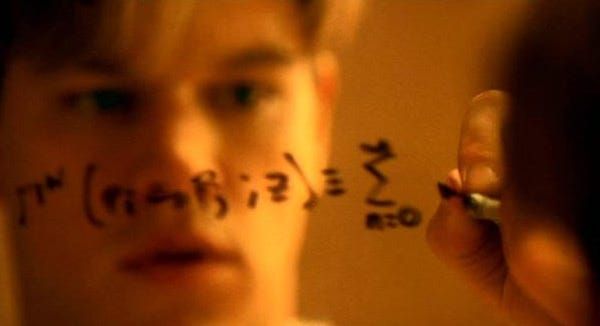
In my current Prep: From Concept to Outline online workshop, which by the way has a terrific group and is going great, we use five archetypes — Protagonist, Nemesis, Attractor, Mentor, Trickster — as tools for understanding each of the writer’s set of story characters.
The question came up: What about the character archetypes in Good Will Hunting? Since I had never applied them to that movie before, I gave it a shot in a forum post. Here are my thoughts:
As always, let me note up front that stories are organic while archetypes are a kind of artifice. Ultimately there is no right or wrong in this type of analysis, any individual may see the story differently than others. With that in mind, here’s my take on character archetypes in Good Will Hunting:
Protagonist: Will
Nemesis: Will’s Shadow (more below)
Attractor: Skylar
Mentor: Sean Maguire, Chuckie
Trickster: Lambeau
Lambeau would seem to be a Mentor, however he is steering Will toward a career in academics which ultimately is not an authentic choice for his character. Moreover there is a healthy dose of egoism on Lambeau’s part wishing to participate and share in whatever ‘glory’ Will might achieve via Lambeau’s overture on the young man’s behalf. So ally… enemy… enemy… ally… a shapeshifter who tests Will’s will.
Both Sean and Chuckie are actual Mentors. Sean completely obvious as he helps steer Will into and through his psychological miasma. Chuckie as the one member of Will’s clan who has enough depth of perception to spur Will on to a broader horizon, so when he shows up, knocks on Will’s door and Will isn’t there, Chuckie is happy, something Chuckie has set up in dialogue previously.
As to Nemesis, Will has a rage inside born of his many foster home experiences including the one guy who beat him (we actually catch a fleeting image of this tyrant climbing the stairs literally in shadows to wail on young Will). So until Will can confront and embrace his shadow — those dark memories and associations from his troubled past — he will always be ruled by them and his rage. Nor will he feel worthy of love, which is what drives Skylar away in the first place. It’s only after she goes and he has his breakthrough with Sean, compounded by the offer of a job on behalf of the U.S. government, it all congeals into the choice Will makes: To drive off to California to be with Skylar.
One thing is clear: At the beginning of the story, Will is in a deep state of Disunity, most notably evident by a guy who is a janitor at a university while being a genius. Hard to get a more discordant combination of circumstances than that.
A major benefit of working with these archetypes is it gives the writer a clear sense of what each character primary narrative function is. That enables the writer to use them as a touchstone in every scene and every interaction. Moreover it sets up a web of connectivity, how and what the character interrelationships are at their core, and again, the writer can use those as touchstones in crafting the story.
Beyond that, as I’ve said many times here before on the blog, I see these five archetypes at work in movie after movie after movie: The Wizard of Oz, Casablanca, The Apartment, The Graduate, Alien, Tootsie, Star Wars: A New Hope, Die Hard, Fatal Attraction, The Silence of the Lambs, True Grit, Inception, Bridesmaids, Gladiator, Up, Star Trek, Juno, and on and on.
Remember: They are tools, not rules. If they help your writing, great. If not, don’t use them.