Character introductions

We’ve been batting around the topic of character introductions in the advanced screenwriting course I’m currently teaching. In a lecture, I noted:
Whenever you first describe a character, it’s important to telescope who they are to the reader. Nowhere is this more critical than in the first 15 pages of your script, where the reader is scrambling to sort through your story’s roster of characters. There are a couple of ways to do this.
The single best thing you can do is ground the character introduction in action, something visual, memorable, and preferably reflecting the individual’s personality, station in life, etc. Use action to convey a thumbnail sketch of who they are.
You also can use a few key lines of scene description to get across some key elements of a character’s persona.
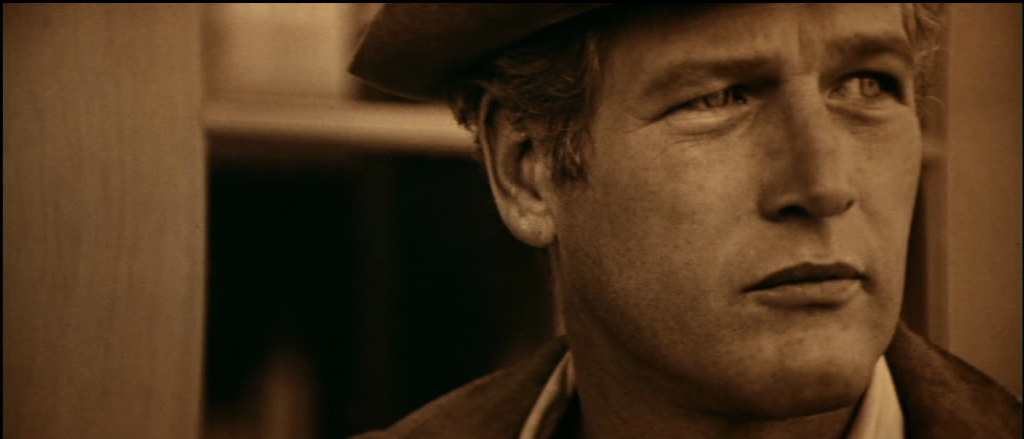
Here is how Butch Cassidy is introduced in William Goldman’s script Butch Cassidy and the Sundance Kid:
A MAN
idly walking around a corner of the building. He is
BUTCH CASSIDY and hard to pin down. Thirty-five and bright,
he has brown hair, but most people, if asked to describe him,
would remember him blond. He speaks well and quickly, and
has been all his life a leader of men; but if you asked him, he
would be damned if he could tell you why.
Goldman uses novelistic license in order to get at some of the core personality of this key character. “Hard to pin down… brown hair… most people… would remember him blond… a leader of men… he would be damned if he could tell you why.”
Hard to pin down: Iconoclast, his own man, makes up his own rules
Brown hair / remember him blond: Comes across younger than he is
Leader / damned if he could tell you why: Being a boss comes naturally to him
All that in five lines of when first describing the character to the reader. That’s one approach to crafting a memorable character introduction.
A student responded that while she liked the concept, “most coverage I’ve read trashes this type of description.” Here’s my response:
When you introduce a character, you have the opportunity to stretch the normal conventions of scene description. Where typically the expectation is we describe only what we can see and hear on screen, the actual events as they’re happening, when we first describe a character upon their introduction, we can take some artistic license to provide the reader with a description of a character’s core essence.
I base this on the simple fact that many professional screenwriters do just that. Here are some examples:
HARPER (William Goldman)
FADE IN ON
LEW HARPER’S FACE in CLOSE UP. He is tough, bright, and poor. A good man in a bad world.
A good man in a bad world. That is describing nothing in the scene. It is the story’s narrative voice providing the reader a key insight into the character’s core essence.
AS GOOD AS IT GETS (Mark Andrus & James L. Brooks)
POV — MELVIN UDALL
in the hallway… Well past 50… unliked, unloved,
unsettling. A huge pain in the ass to everyone he’s ever
met. Right now all his considerable talent and strength
is totally focused on seducing a tiny dog into the
elevator door he holds open.
unliked, unloved, unsettling. A huge pain in the ass to everyone he’s ever met.
Again not scene description per se, but a description of the character’s core persona.
BULL DURHAM (Ron Shelton)
ANNIE SAVOY, mid 30’s, touches up her face. Very pretty,
knowing, outwardly confident. Words flow from her Southern
lips with ease, but her view of the world crosses Southern,
National and International borders. She’s cosmic.
Words flow from her Southern lips with ease, but her view of the world crosses Southern, National and International borders. She’s cosmic.
This combines some physical description with a take of her persona, summed up by the wonderful thumbnail: “She’s cosmic.”
GHOSTBUSTERS (Dan Aykroyd & Harold Ramis)
INT. PARANORMAL STUDIES LAB — SAME TIME — DAY
DR. PETER VENKMAN is administering an ESP test to two student volunteers, a boy and a girl, who sit across the table from him separated from each other by a screen.
Venkman is an associate professor but his rumpled suit and the manic gleam in his eyes indicate an underlying instability in his nature. However, while a little short on academic credentials, Venkman is long on confidence, charm and salesmanship.
The entire second paragraph describes Venkman’s persona.
The reason, I think, readers will “trash” this type of description is when it’s done poorly. The keys are:
* Say something meaningful: If you’re going to take the time and effort to try to convey the core essence of a character, make sure you know what that core essence is.
* Make it specific: Hone down the description so that it conveys something specific about the character.
* Make it quick: No more than 2–4 lines.
* Make it memorable: The whole point is to provide the reader with a thematic hook they can use to ‘get’ each character.
A challenge: Go to www.simplyscripts.com and pick out 10 of your favorite movie scripts. See how the writers introduce a handful of their story’s key characters. If you find really good examples of this type of description, please post them here.
And so a shout out to all you script readers: What’s your take on this topic? Certainly don’t want to be leading people astray. But when working screenwriters, like those noted above, describe a character’s persona / core essence, doesn’t that mean that we have that latitude when approaching character introductions?
Comment Archive