Check Out a Very Early Outline for ‘The World’s End’
Via /film:
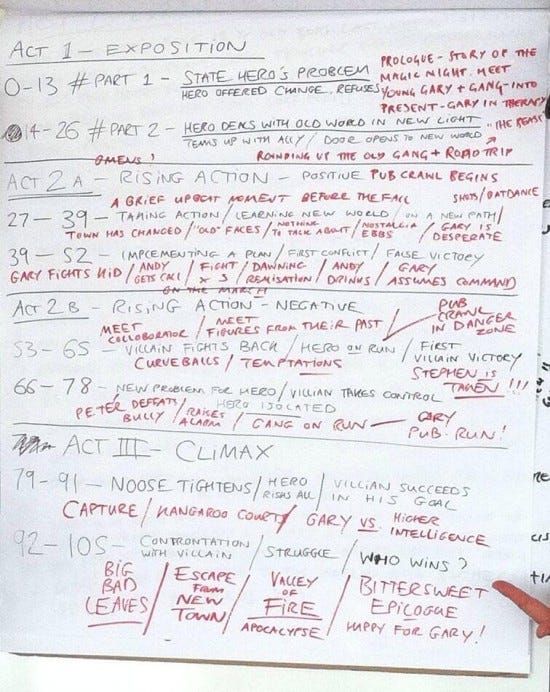
Edgar Wright‘s The World End opened in August 2013. Rewind two years before that to the time when the film was early in development, and he and co-writer Simon Pegg basically had the whole thing figured out. Pegg took to Twitter to post an awesome close-up of his and Wright’s rough, very early outline from August 2011.
Here’s a close-up of the outline:
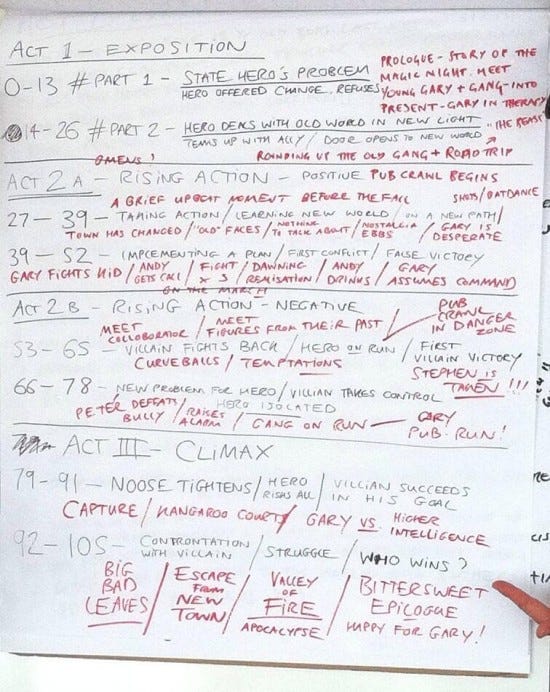
Couple of things. First, notice how they break down the story into four broad movements:
* Act 1 — Exposition
* Act 2A — Rising Action (Positive)
* Act 2B — Rising Action (Negative)
* Act 3 — Climax
I know lots of writers who look at Act Two as having two parts, if only to break up that long middle section and give each half a distinctive composition, tone and pace.
Next note how they construct the narrative in 8 parts:
0–13: State Hero’s problem
14–26: Hero deals with Old World in new light
27–39: Taking action / Learning new world / On a new path
39–52: Implementing a plan / First conflict / False victory
53–65: Villain fights back / Hero on run / Villain’s first victory
66–78: New problem for Hero / Villain takes control
79–91: Noose tightens / Hero risks all / Villain succeeds in his goal
92–105: Confrontation with Villain / Struggle / Who wins?
For those familiar with the sequence approach, this should seem quite familiar, even down to the number of sequences (8). I’m also reminded of this: The Whammo Theory. Movie producer Art Linson (Heat, Fight Club, Into the Wild) describes it in his book “A Pound of Flesh: Perilous Tales of How to Produce Movies in Hollywood”:
When you run out of theories and you can sense the writer’s eyes are getting glassy, you can always pull out the Whammo Chart. Supposedly Joel Silver got this from Larry Gordon, who got it from some Egyptian who worked at American International Pictures (AIP) many years ago. As the legend spreads, it is a scientifically tested theory which requires each action script to have a “Whammy” every ten pages. This would be a big-action set piece, something that would kick you in the groin and wake you up. If the script wavers a bit, spending a little too much time on nuance and character, it violates the theory. According to the natural laws of physics, without a bang the audience is buying popcorn by the twelfth page and looking for the exit sign if you stretch it to page twenty-five.
Joel Silver is one of the most successful producers of action movies in the last three decades (Lethal Weapon, Conspiracy Theory, The Matrix). Larry Gordon, former head of production at 20th Century Fox, has produced dozens of movies including 48 Hrs., Predator, Die Hard, and as it happens K-9. That’s where I first heard of The Whammo Theory — from Larry Gordon himself. Basically every 10 pages or so, something big has to happen. Most writers have come to call those big events Plot Points.
Here’s the thing: Stories are organic and there’s no set formula for screenplay structure, but if you write a script where the narrative breaks down along the lines of this outline for The World’s End, one thing is for sure: It will feel quite comfortable to anyone in Hollywood who is involved in movie development.
For the rest of the /film article, go here.
Comment Archive