Classic 30s Movie: “Captain Blood”
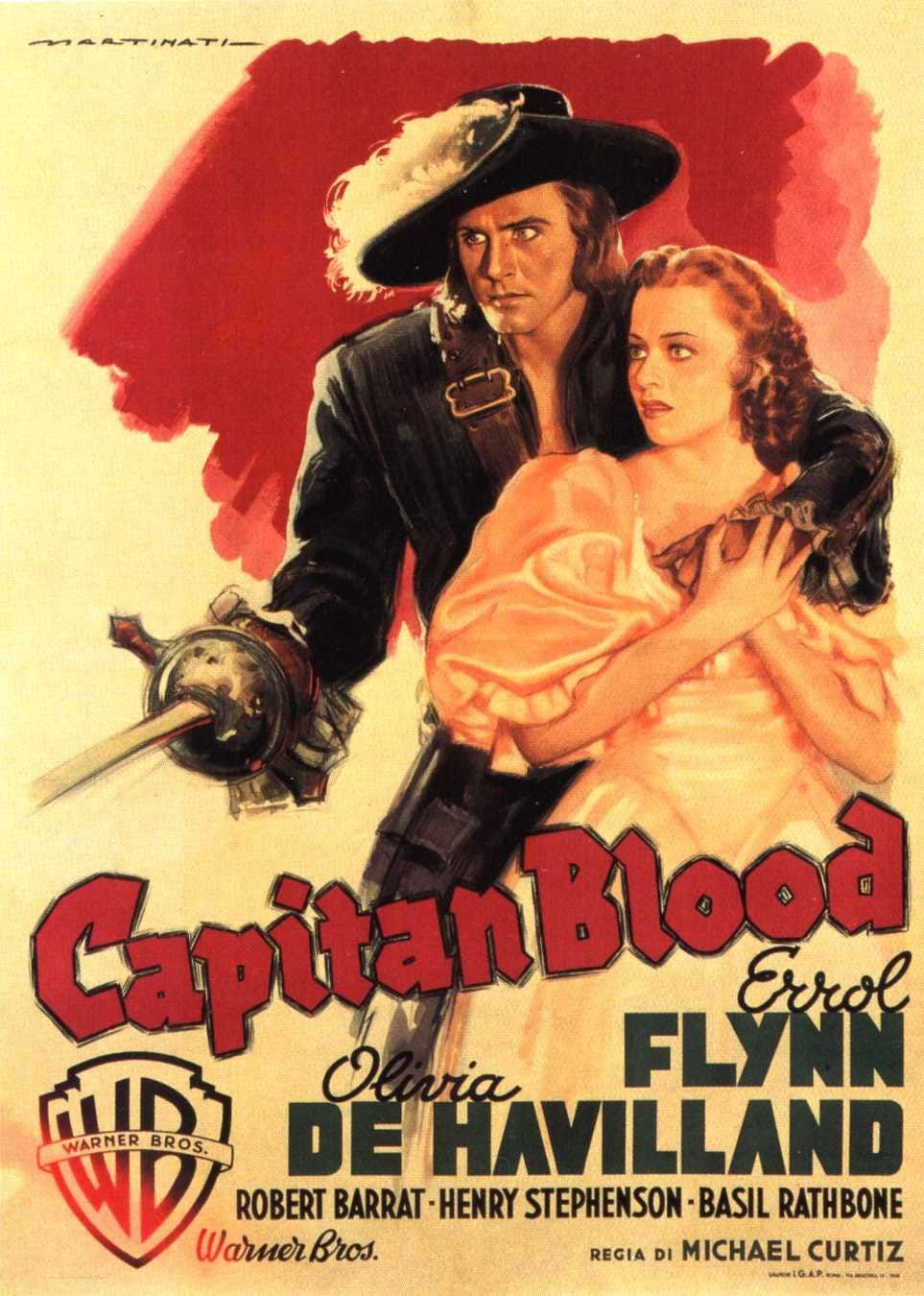
May is Classic 30s Movie Month. Today’s guest post comes from John Arends.
Movie Title: Captain Blood
Year: 1935
Writers: Written by Rafael Sabatini, Screenplay by Casey Robinson
Lead Actors: Errol Flynn, Olivia de Havilland, Basil Rathbone, Lionel Atwill, Ross Alexander
Director: Michael Curtiz
IMDb Summary: Arrested during the Monmouth Rebellion and falsely convicted of treason, Dr. Peter Blood is banished to the West Indies and sold into slavery. In Port Royal, Jamaica the Governor’s daughter Arabella Bishop buys him for £10 to spite her uncle, Col. Bishop who owns a major plantation. Life is hard for the men and for Blood as well. By chance he treats the Governor’s gout and is soon part of the medical service. He dreams of freedom and when the opportunity strikes, he and his friends rebel taking over a Spanish ship that has attacked the city. Soon, they are the most feared pirates on the seas, men without a country attacking all ships. When Arabella is prisoner, Blood decides to return her to Port Royal only to find that it is under the control of England’s new enemy, France. All of them must decide if they are to fight for their new King.
Why I Think This Is a Classic 30s Movie
Captain Blood is the quintessential swashbuckler from Michael Curtiz, the quintessential director of so many gems and classics from the 30s and 40s, including Casablanca and Mildred Pierce. Plus, it introduced an unknown Australian actor named Erroll Flynn to world, whose portrayal of physician-turned-pirate Dr. Peter Blood made him the instant heir apparent to 1920s swashbuckling star Douglas Fairbanks. The film also established another relatively unknown actor destined to superstardom, the 19-year-old Olivia de Havilland. This was only her fourth picture under contract to Warner Bros. She and Flynn would go on to make 8 more pictures together, including The Adventures of Robin Hood, two years later.
This film was released over the Christmas holidays of 1935. It was a hit, and a big part of that was its help in reviving the swashbuckler genre. Established during the silent era by Douglas Fairbanks, the genre was rekindled in 1934–35 by Treasure Island, The Count of Monte Cristo and Curtiz’ Captain Blood. All three consciously served up a hero who served as a “symbol of the unvanquished man” during the Great Depression, according to Nick Schager, writing in Slant Magazine (April 20, 2005). Captain Blood received several Academy Award nominations, including for Best Picture and Best Writing, Screenplay.
My Favorite Moments in the Movie
The swordplay, all of it. Especially what the picture is famous for: when Errol Flynn lifts his blade for the first time against Basil Rathbone, playing the villainous French captain Levasseur. So many creative and rousing innovations flow together in these sequences. Not just Curtiz’ direction and the rapid-fire edits. The cinematography by Ernest Haller (who would go on to shoot Gone With the Wind) is stellar and ground-breaking. The score by Erich Wolfgang Korngold and Leo F. Forbstein (also Oscar nominated) amplifies and unifies the action, especially the now-famous swordsmanship. It was choreographed by Hollywood fencing master and legend Fred Cavens, and executed brilliantly by the world-class skills of the actors, especially Basil Rathbone. The final duel between Flynn and Rathbone, filmed in the sand and on the slippery rocks of Laguna Beach, began raising the technical bar for swordplay for decades to come, right up through a relatively modern franchise called Star Wars.
My Favorite Dialogue in the Movie
The interplay of insults tossed back and forth between de Havilland and Flynn hold up even today. The rousing speeches so vital to the genre — and the period, sad to say — are both colorful and entertaining. Among all the Oscar-nominated bits in the film, let’s go with the rousing mid-point sequence where Dr. Blood leads the slaves in revolt and they hijack a Spanish ship and sail to freedom.
Key Things You Should Look For When Watching This Movie
Check out the pacing and economy of the storytelling. It’s pure, cherrywood smoked bacon — crisp, visually tasty, and fuels the narrative drive of the story brilliantly. Watch in Act 1 how quickly they set up our hero, Dr. Peter Blood. We learn lickety-split that he’s an apolitical but deeply principled physician, wrongly accused of treason, sentenced to hang, then spared the noose, only to be sent on a slave ship to the Caribbean. All that in what seems to take two pages.
Key Takeaways for Screenwriters Today
For starters, this black and white classic is filled with color. It’s in the character design, the slash of the language, the (often arch) characterizations played for both humor and villainy. Here in 2016, we live in a too-cool-for-school techno age that unintentionally gives conformity the power to shackle many of the choices and much of the language we’re “allowed” to use. Captain Blood is a blast from 1935 that tells us to be different, bold and direct. To make our choices bolder. To force our characters to take decisive action and be brave in the face of real consequences for each principled choice we force them to make. So “put some swagger on, you monkeys,” and scramble up the high rigging of our craft. And from the crow’s nest, keep leaning into the wind, out over the sails, driving your story forward, onward, home.
Thanks, John!
To show our gratitude for your guest post, here’s a dash of creative juju for you. Whoosh!
We already have a set of classic 40s movies, 5os movies, 60s Movies, 70s movies, 80s Movies and 90s Movies. This month, we’re working on 30s movies. And thanks to the GITS community, we’ve got at least 22 movies in the works and hopefully!
Those who I put in bold have already sent me their posts. If you haven’t sent yours to me, please do so as soon as you can!!!
All Quiet on the Western Front — Michael Waters
Bride of Frankenstein — Marija Nielsen
Bringing Up Baby — Melinda Mahaffey
Captain Blood — John Arends
City Girl — Adam Westbrook
Dracula — Sheila Seaclearr
Duck Soup — David Joyner
Gone With The Wind — Mark Twain
Gunga Din — Steve Huerta
It Happened One Night — Joni Brainerd
Make Way for Tomorrow — Susan W
Mr. Smith Goes to Washington — Amber Watt
Rebecca — Katha
Snow White and the Seven Dwarves — Will King
Sabotage — Jeff Xilon
Stagecoach — Thenewlight
The 39 Steps — Felicity Flesher
The Adventures of Robin Hood — Clay Mitchell
The Petrified Forest — supergloss
The Women — Liz Clarke
Topper — Wayne Kline
Trouble in Paradise — Vincenzo
I am still looking for volunteers. If there’s a 30s movie you’d like to write about, please post your suggestion in comments or contact me via email.
Thanks to everyone who steps up for this ongoing project!
For the original post explaining the series, go here.
For all of the 30s movies featured in the series, go here.
Click REPLY and see you in comments about today’s classic 30s movie!