Classic 40s Movie: “Notorious”
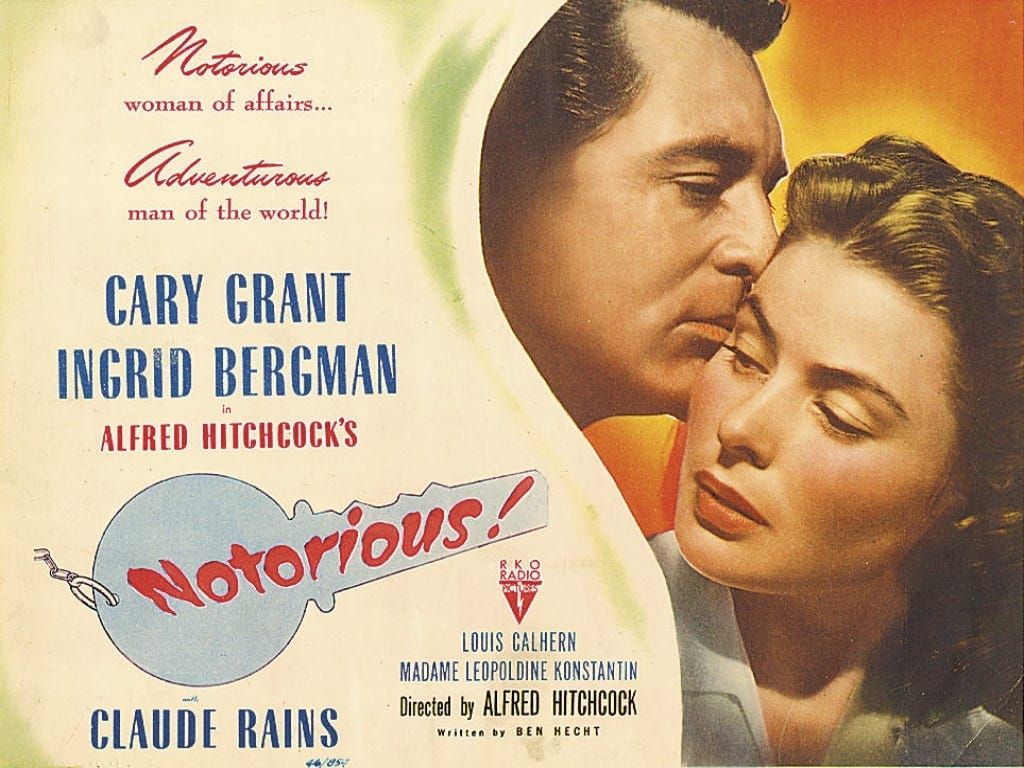
September is Classic 40s Movie month. Today’s guest post comes from Christine Hinton.
Movie Title: Notorious
Year: 1946
Writer: Ben Hecht
Lead Actors: Cary Grant, Ingrid Bergman, Claude Rains
Director: Alfred Hitchcock
Summary: In order to help bring Nazis to justice, U.S. government agent T.R. Devlin (Cary Grant) recruits Alicia Huberman (Ingrid Bergman), the American daughter of a convicted German war criminal, as a spy. As they begin to fall for one another, Alicia is instructed to win the affections of Alexander Sebastian (Claude Rains), a Nazi hiding out in Brazil. When Sebastian becomes serious about his relationship with Alicia, the stakes get higher, and Devlin must watch her slip further undercover.
Why I Think This Is A Classic 40s Movie?
Notorious represents the elegance and patriotism of the ’40s along with the paranoia and mistrust that the war against the Nazis instilled. At it’s heart, it’s about two men in love with one woman. The irony being that the man who trusts her (Sebastian) shouldn’t and the one who doesn’t (Devin) should.
Ingrid Bergman is at her best here as the capable yet vulnerable Alicia who takes on a dangerous spy mission and falls in love with a man who can’t see past her reputation.
That man is Cary Grant’s Agent Devlin. Knowing Alicia’s past, Devlin misunderstands her motivations for much of the film and pushes her further into a dangerous situation in which she almost pays the ultimate price.
The cast is rounded out by Claude Rains as Sebastian who deftly manages to make us feel sympathy for him, despite being the leader of a Nazi spy ring.
Alfred Hitchcock’s visuals are stylishly precise. Everything from a closeup on a glass of Alka-Seltzer to a seemingly unending staircase that leads our hero and heroine to safety has obviously been mapped out in great detail to reflect the underlying emotions of the characters involved.
And of course, Notorious has the infamous MacGuffin, Hitchcock’s term for a plot device of which everyone is concerned about or searching for, although it hardly matters what it is. In this case it turns out to be a radioactive substance hidden in a wine bottle.
Most appealing is that Notorious has a sensual edge to it even though there is never a moment when improper behavior is actually shown or explicitly stated. Ben Hecht’s clever dialogue full of subtle innuendo exudes sex appeal without ever being crass or obvious.
My Favorite Moment In The Movie
At the time, Notorious had what was claimed to be the longest kiss in the history of movies. In 1946, the production code forbade any kiss to last longer than three seconds. In order to get around this rule, Alicia and Devlin are wrapped in one another’s arms, alternating between dialogue and kissing. Their lips never touch for more than three seconds at a time but the sequence lasts for several minutes. In this case, creativity to get around the censors led to one of the most erotic kissing scenes in movie history.
My Favorite Dialogue In the Movie:
Captain Paul Prescott: [about Alicia] I don’t like this, I don’t like her coming here.
Walter Beardsley: She’s had me worried for some time. A woman of that sort.
Devlin: What sort is that, Mr. Beardsley?
Walter Beardsley: Oh, I don’t think any of us have any illusions about her character. Have we, Devlin?
Devlin: Not at all, not in the slightest. Miss Huberman is first, last, and always not a lady. She may be risking her life, but when it comes to being a lady, she doesn’t hold a candle to your wife, sitting in Washington, playing bridge with three other ladies of great honor and virtue.
I love this scene because Devlin has been quick to doubt Alicia’s character to her face in order to protect his heart but he won’t sit by and let someone else dismiss her and the risk she’s taking for her country. It shows that despite all of Devlin’s hurtful words to Alicia, he truly does care for her.
Key Things You Should Look For When Watching This Movie
The lighting and focus. Hitchcock is very specific about his shots and everything has an underlying meaning. Check out how Alicia starts the scene where Devlin asks her to become a spy in shadow and is eventually shown in full light as he plays a recording proving she is a true patriot. Or, later, how a cup of coffee we know to be poisoned appears huge in the foreground.
Finally we get to the ending. Devlin must carry Alicia out of the mansion and past a watching group of Nazi spies. The staircase that leads to their escape appears unending. As a matter of fact if you count the stairs earlier in the film and then count the steps taken at the end, you’ll find the staircase has increased dramatically for the effect of suspense. All poor Sebastian can do is watch. His fate is sealed with a simple, forbidding sentence:
Eric Mathis: Alex, will you come in, please? I wish to talk to you.
Thanks, Christine! To show our gratitude for your guest post, here’s a dash of creative juju for you. Whoosh!
We already have a set of classic 5os movies, 60s Movies, 70s movies, 80s Movies and 90s Movies. This month, we’re working on 40s movies. And thanks to the GITS community, we’ve got 30 movies in the works, one for each day of the month!
Those who I put in bold have already sent me their posts. If you haven’t sent yours to me, please do so as soon as you can!!!
Act of Violence — Eric Rodriguez
Arsenic and Old Lace — Katha
Bicycle Thieves — Megaen Kelly
Brief Encounter — Emily Bonkoski
Casablanca — Paul Graunke
Double Indemnity — Susan Winchell
Five Graves to Cairo — Jeff Gibson
Foreign Correspondent — Doc Kane
His Girl Friday — John Henderson
It’s a Wonderful Life — David Laudenslager
Key Largo — Will King
Laura — Melinda Mahaffey Icden
Les enfants du paradis — Brendan Howley
Mrs. Miniver — Traci Nell Peterson
Notorious — Christine Henton
Now Voyager — Melissa Privette
Out of the Past — Brantley Aufill
Rope — Lance Morgan
The Bank Dick — Bob Saenz
The Best Years of Their Lives — Shaun Parker
The Big Sleep — Ipsita Barik
The Ghost and Mrs. Muir — Annie Wood
The Long Voyage Home — Vincent Martini
The Lost Weekend — Liz Warner
The Maltese Falcon — Roy Gordon
The Ox-Bow Incident — Clay Mitchell
The Philadelphia Story — Kristen Demaline
The Sin of Harold Diddlebock — David Joyner
The Third Man — Harry Cooke
To Have and Have Not — Felicity Flesher
Thanks to everyone who steps up for this ongoing project!
For the original post explaining the series, go here.
For all of the 40s movies featured in the series, go here.
Click REPLY and see you in comments about today’s classic 40s movie!
Comment Archive