Classic 40s Movie: “Stray Dog”
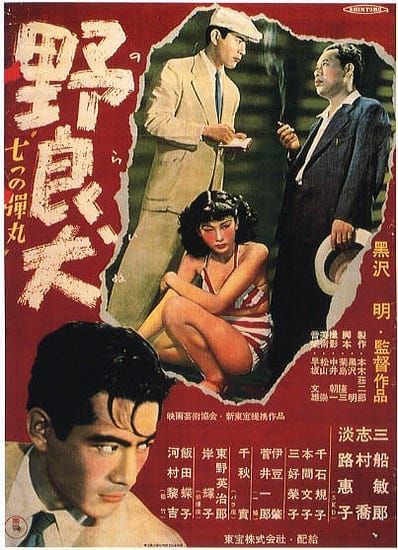
September is Classic 40s Movie month. Today’s guest post comes from Megaen Kelly.
Movie Title: Stray Dog (Nora Inu)
Year: 1949
Writers: Akira Kurosawa and Ryūzō Kikushima
Lead Actors: Toshiro Mifune and Takashi Shimura
Director: Akira Kurosawa
Plot Summary: In post-WWII Tokyo, war veteran but rookie cop Murakami (Mifune) has his Colt service revolver stolen on crowded transportation. Despite doggedly pounding the streets and alleys looking for it, he cannot recover it. Attempting to resign from humiliation, his superior instead pairs him with seasoned detective Satō (Shimura). The older man imparts many important lessons to the younger detective, including how to finesse uncooperative witnesses to looking at the bigger picture. Together, they track down the culprit but not before Murakami’s gun is used in several crimes, and the two detectives do not escape harm themselves.
Why I Think This Is A Classic 40s Movie
Let me just say upfront; I’m biased. The 16-film collaboration between visionary filmmaker Akira Kurosawa and legendary actor Toshiro Mifune over a 20 year period includes not only many iconic, influential films in general, but also some of my own personal favorite films. Kurosawa, a true artist as he entered film from a painting background, made visually interesting films that, combined with intriguing stories captured audiences’ imaginations around the world. And Mifune’s charisma made virtually all other actors on screen invisible. That is to say, except Shimura. He is also an important part of this long-standing partnership, in fact working with Kurosawa on 20 films. He was the perfect counterpoint to Mifune’s often visceral performances, as Shimura was typically more reserved and compact, as it were.
Stray Dog was just the third of these 16 films. And despite being less revered than say Seven Samurai or Rashomon, it is still a well-constructed, compelling film. Plus it showed the early promise of Kurosawa as a genius director just from the opening credits. Filmed in glorious black and white by cinematographer Asakazu Nakai (who would go on to win the Mainichi Film award for cinematography for his work on the film) the film opens on a close-up of an obviously hot, panting dog. This one image contained the idea behind many important elements found in the film: taking place in the sweltering Tokyo summer (before air conditioning), the heat itself was a motivating force in the story. Then there is a discussion between Murakami and Satō, in which a stray dog was often a mad dog and applying that metaphor to the criminal the two were pursuing.
Then there is the Tokyo of the late 40’s after the end of the war. The dusty streets and bedraggled populace do not give a hint of the electrical glamour that modern day Tokyo exudes. Rather, people have to struggle to survive and many turn to crime. This may be one of the reasons some film critics see Stray Dog as a kind of Film Noir film in a larger sense, but I don’t agree with this. It is more like the European films of the time than the shadowy dark American films of that genre.
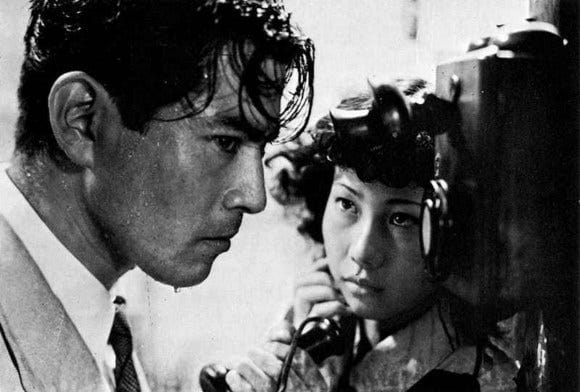
There are other opinions that Stray Dog is a precursor to the ‘buddy cop’ films, but that is maligning this masterful work. Buddy cop movies in today’s terms with their masculine juvenile humor, often at the expense of the women in the films, does not exist at all in Stray Dog. However, most women in the film are not shown in a positive light, with the exception of Satō’s wife.
To me, Stray Dog is a film both of its time and timeless, not losing its sense of purpose or quality, encapsulating a snapshot of Tokyo just a few years after the war and what people had to do to get by. But skilfully told in story, image and acting. What a movie!
My Favorite Moment in the Movie
I like the early sequence of Murakami going ‘undercover’ to try and find his gun. It relentlessly shows the character’s tenacity as well as just how hot Tokyo in the summer was!
My Favorite Dialogue in the Movie
A lot of the good quotes come from Satō, as can be expected. Apart from describing a stray dog as a mad dog he also responds to the lament of Murakami on his bad luck in losing his gun:
“Bad luck can make a man or destroy a man.”
Key Things You Should Look For When Watching This Movie
As mentioned more than once, the oppressive heat was an important element in the film. People are seen continually wiping themselves and fanning themselves with whatever is at hand. In one scene a group of show girls hurry upstairs in the theater they are performing at and collapse in a heap, too hot to move.
Also, Murakami reflects more than once on how his situation on his return home after the war was similar to that of the criminal, but the detective chose a different path, one that allows him to be free.
And one further note: although Mifune gave a solid performance (as can be expected), it was Shimura who won Best Actor at the Mainichi Film Awards. Justly deserved.
Thanks, Megaen! To show our gratitude for your guest post, here’s a dash of creative juju for you. Whoosh!
We already have a set of classic 50s movies, 60s Movies, 70s movies, 80s Movies and 90s Movies. This month, we’re working on 40s movies. And thanks to the GITS community, we’ve got 30 movies in the works, one for each day of the month!
Those who I put in bold have already sent me their posts. If you haven’t sent yours to me, please do so as soon as you can! I’m closing out the series this week!
Act of Violence — Eric Rodriguez
Arsenic and Old Lace — Gisela Wehrl
Bicycle Thieves — Megaen Kelly
Brief Encounter — Emily Bonkoski
Casablanca — Paul Graunke
Double Indemnity — Susan Winchell
Five Graves to Cairo — Jeff Gibson
Foreign Correspondent — Doc Kane
Here Comes Mr. Jordan — Wayne Kline
His Girl Friday — John Henderson
It’s a Wonderful Life — David Laudenslager
Kind Hearts and Coronets — James Calder
Key Largo — Will King
Laura — Melinda Mahaffey Icden
Les enfants du paradis — Brendan Howley
Mrs. Miniver — Traci Nell Peterson
Notorious — Christine Henton
Now Voyager — Melissa Privette
Out of the Past — Brantley Aufill
Rope — Lance Morgan
Stray Dog — Megaen Kelly
The Bank Dick — Bob Saenz
The Best Years of Their Lives — Shaun Parker
The Big Sleep — Ipsita Barik
The Ghost and Mrs. Muir — Annie Wood
The Long Voyage Home — Vincent Martini
The Lost Weekend — Liz Warner
The Maltese Falcon — Roy Gordon
The Ox-Bow Incident — Clay Mitchell
The Philadelphia Story — Kristen Demaline
The Sin of Harold Diddlebock — David Joyner
The Third Man — Harry Cooke
To Have and Have Not — Felicity Flesher
Thanks to everyone who steps up for this ongoing project!
For the original post explaining the series, go here.
For all of the 40s movies featured in the series, go here.
Click REPLY and see you in comments about today’s classic 40s movie!