Classic 60’s Movies: Rosemary’s Baby
January is Classic 60s Movie month. Today’s guest post comes from Ipsita Barik.
Movie Title: Rosemary’s Baby
Year: 1968
Writers: Roman Polanski (screenplay), Ira Levin (novel)
Lead Actors: Mia Farrow, John Cassavetes, Ruth Gordon, Sidney Blackmer, Maurice Evans
Director: Roman Polanski
IMDB Plot Summary: A young couple move into a new apartment, only to be surrounded by peculiar neighbors and occurrences. When the wife becomes mysteriously pregnant, paranoia over the safety of her unborn child begins controlling her life.
Why I Think This Is A Classic 60s Movie: It’s a cult classic cutting across the decades. Roman Polanski navigates through the story in an extremely cautious style, aware of the dangers of rushing through, even one moment. . It builds upon the suspense, slowly canvasses through the thrills, punctuated with streaks of dark comedy and based on a strong sense of embedded horror. The story based on Ira Levin’s novel Rosemary’s Baby, adapted for the screenplay by Polanski himself, is probably one of his best works. Is it horror, a dark comedy, a thriller, suspense? The genius of the movie is that it refuses a fixed label and blends different forms of storytelling.
Rosemary’s Baby opens on the very predictable ground of a family moving into a new house. New homes have secrets. Interestingly the couple is forewarned about these, right in the beginning, during a dinner and of course they deem them to be mere stories and Rosemary comments, “but Hutch, all house have a past.” The movie is replete with these small dark messages, undoubtedly placed for both Rosemary and the viewers. One of the best moments in the movie is when Rosemary while exploring the new apartment, approaches the previous occupant’s desk and casts upon a partially visible note — “am no longer able to associate myself.” She looks up, a bit taken aback, but pushes the disturbance into the background. She does the same with the hidden closet. Once revealed that the closet held nothing except a vacuum cleaner and towels, she wonders aloud, “why bother hiding a vacuum cleaner and towels?” The caretaker replied,” I guess we will never know.” Interestingly it is probably amongst the few things that appear crystal clear by the end, in a movie that never quite explains things clearly. After visiting the Cassavetes for the first time, she remarks in a conversation with her husband, Guy, “I wonder why have they removed the pictures. There are nails in the wall and blank spaces, and yet no pictures. And the one that’s there doesn’t quite fit.” In hindsight it seems to be a comment on the Cassavetes, ‘a couple appearing to be kind and generous and yet harboring a marked sinister streak.’
Rosemary is a complex character. While she appears to be quite docile and largely a content and happy homemaker, she is observant, opinionated, inquisitive and quite the fighter when the going gets tough. She questions Guy on the fact that he had sex with her when she had apparently been torpid and benumbed (drugged by the witch’s coven, the previous night). But she doesn’t push it. She never does. It is the same when Guy throws away the book, Hutch leaves for her, she questions Guy, saying it was wrong of him to rid of something that was hers and was a gift and yet never quite asserts herself. All her nagging questions and doubts, as we progress through the story, are never prodded or pursued. She never crushes or disowns them, and yet she pushes them into the dark, though she knows and realizes, the darkness is getting bolder and starker every day. We see the pattern related to her concerns and doubts regarding wearing Terry’s locket, consuming Minnie’s concocted drink, her pregnancy related pain and troubles, or her drastic weight loss. She seems to be constantly questioning and prodding and yet, never pursuing. When Terry allegedly commits suicide, Rosemary questions the incident, based on her understanding that Terry had been a visibly happy person. And then she falls into agreement with the general notion, that Terry who had been found on the streets quite doped and was sheltered by the Cassavetes, killed herself affected by the drugs and depression. Many contend that Rosemary is a pushover. But is she?? I don’t think so. To me she is normal, quite like all of us. Don’t we all venture into the dark lands, raising questions and doubts, and never quite exploring them, quite content with them remaining unanswered.
Another scene that unravels the viewers more than Rosemary is when she visits Dr Hill, around the end of the movie, trying to protect her baby from the clutches of the witches’ coven. As she narrates her part of the reality to a half bemused and half skeptical, Dr Hill, what wraps around the audience are the gestures. Rosemary twitches, appears ashen and white, stammers, repeats lines, giggles, intertwines her fingers, gapes and sweats, we all know it’s the gestures that are going to trap her, and not her narrative that much.
For me one of the most terrifying moments in the movie is when Dr Hill, coaxes her to the inner room, urging her to rest, while he apparently took care of the matter. Rosemary nods in agreement, reclining with a sense of assurance, while the audience immediately knows that she is going to be ripped apart, stunned that Rosemary doesn’t realize it!
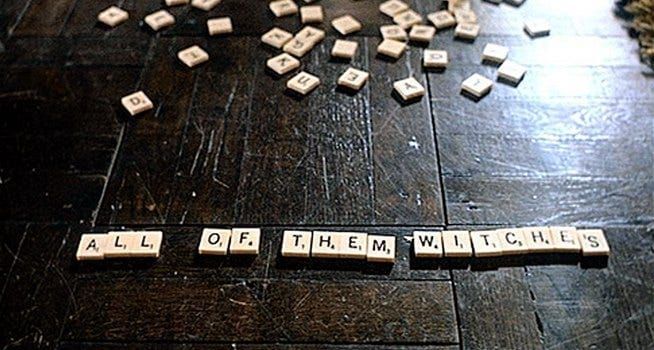
While the visibly horrifying scenes, include the moments when Rosemary catches her image on the surface of the toaster, eating a piece of raw liver quite ravenously, or the time when she is escorted out of Dr Hill’s office, and made to sit between Dr Sabastien and Guy, the very men she was attempting to flee! Or when Rosemary realizes that the terrifying dream sequence within which she is a part of the coven’s rituals and then the ultimate rape, is actually the reality, screaming aloud “this is no dream … this is for real!!” For that matter one of the highlights in the movie is when Rosemary attempts to solve the anagram!
The Anagram
It’s the subtle scenes though, which send the heart racing, such as when Rosemary and Guy, cuddling in their bed, are distracted by a low steady chanting hum from the neighboring apartment or the time when Rosemary fleeing from the elevator, struggles to open the door to her apartment, with the background music (Krzysztof Komeda) matching the exact sense of trepidation, or when Rosemary repeats the name of the blinded actor, quietly and in wonderment — “Bagumart ”.
Polanski knows what the mind fears and where the heart whispers a silent prayer! The scene when Rosemary locks herself inside the apartment, and calls up her friend Alice, for help, the camera shows two men tiptoeing across the living room, behind her. It leaves us gasping. The time when Minnie gifts Rosemary, Terry’s good luck charm, and the camera focuses on Rosemary’s hands, the pause followed by hesitant movement, and then the unsure, visibly stricken face, and her small protestation, before succumbing to Minnie, who is definitely the more overpowering of the characters.
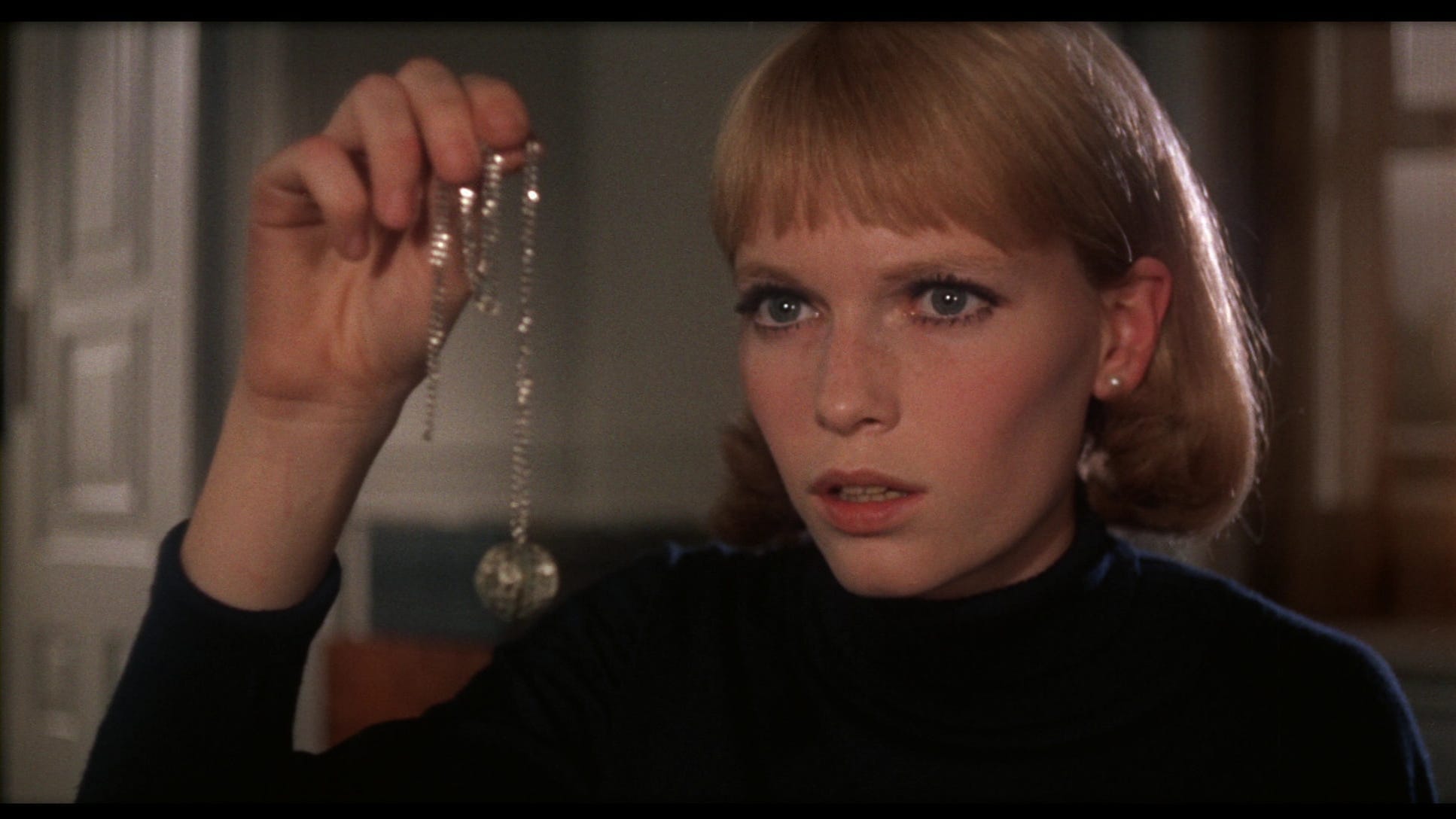
Terry’s locket
My Favorite Moment In The Film: All of them witches! Goes much beyond the book she receives from Hutch. In one of the most startling scenes in the movie, quite unnerving and definitely and astutely horrifying, Rosemary in the phone booth, calling Dr Hill, realizes all of a sudden that it wasn’t only the Cassavetes and Guy, that she was trying to escape — that indeed all of them, including her doctor, were involved in the plot. She repeats the book’s name, with a giggle, the horror surprisingly cascading to the highest levels. Though she looks visibly shaken by the revelation, a sense of calm subsides on her, as the picture clears of the fog. Her doubts asserting themselves, and she emerging stronger. And yet it was probably the most damning moment in the movie, we know she is trapped in the most intricate web that she has probably woven around herself.
My Favorite Dialogue In The Movie:
Rosemary — “It has an undertaste — a chalky undertaste.”
Key Things You Should Look For When Watching This Movie: Of course, the endless analysis of Rosemary’s fears being akin to those common to new mothers, or that of urban alienation, the anxieties of adulthood, questioning organized religion, marital rape, contraceptives, reproductive choices, the struggle between naturopathy and allopathy or for that matter the Pope!!
Some crucial phone conversations happen behind the walls, the person hidden from the camera, the viewer’s focus entirely on the conversation, some of them chilling to the core, including the conversation about Bagumart’s blinding.
The brilliant dream sequences.
The solving of the anagram and the phone booth scene.
The Music by Krzysztof Komeda and the Cinematography by William A Fraker.
Thanks, Ipsita! To show our gratitude for your guest post, here’s a dash of creative juju for you. Whoosh!
We already have a set of classic 70s movies, 80s Movies and 90s Movies. This month, we’re working on 60s Movies.
We have 31 volunteers. I have put in bold those who have already sent their guest post to me.
Ipsita Barik — Rosemary’s Baby
Ipsita Barik — Bonnie and Clyde
Mike Dobbins — The Sound of Music
Brandnewusedcar — Butch Cassidy and the Sundance Kid
Markham Cook — Jules et Jim
Steve Cook — The Blue Max
JasperLamarCrab — 2001: A Space Odyssey
N D — Lonely are the Brave
Drew Dorenfest — Easy Rider
Rick Dyke — Dr. Strangelove: Or How I Learned to Stop Worrying and Love the Bomb
Rick Dyke — Fail Safe
Felicity Flesher — The Music Man
PaulG — Lawrence of Arabia
D.L. Gill — Zulu
Jeff Guenther — Cool Hand Luke
Kate Hagen — Repulsion
John Henderson — Night of the Living Dead
John Henderson — The Odd Couple
John Hörnschemeyer — The Graduate
Zach Jansen — They Shoot Horses, Don’t They?
Will King — The Pink Panther
William Leitch — If…
Lisaisfunny — Blow Up
Jack McDonald — Who’s Afraid of Virginia Woolf?
Nick — Lonely are the Brave
Daryl Powell — The Apartment
jprichard — Persona
Ally Shina — The Jungle Book
Mark Twain — The Loved One
Liz Warner — The Manchurian Candidate
Michael Waters — Dr. No
For those who have signed up, but have yet to email me your post, please do so ASAP. This is the last week for the series.
Thanks in advance!
For the original post explaining the series, go here.