Classic 90s Movie: “L.A. Confidential”
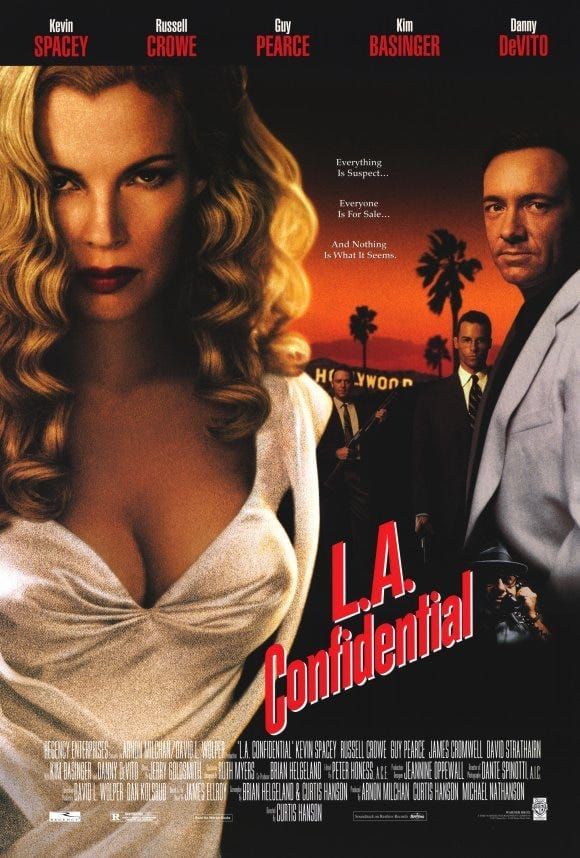
May is Classic 90s Movie month. Today’s guest post comes from Paul Graunke.
Movie Title: L.A. Confidential
Year: 1997.
Writers: Brian Helgeland, Curtis Hanson. They won the Oscar for best screenplay adaption from other material, the novel by James Ellroy
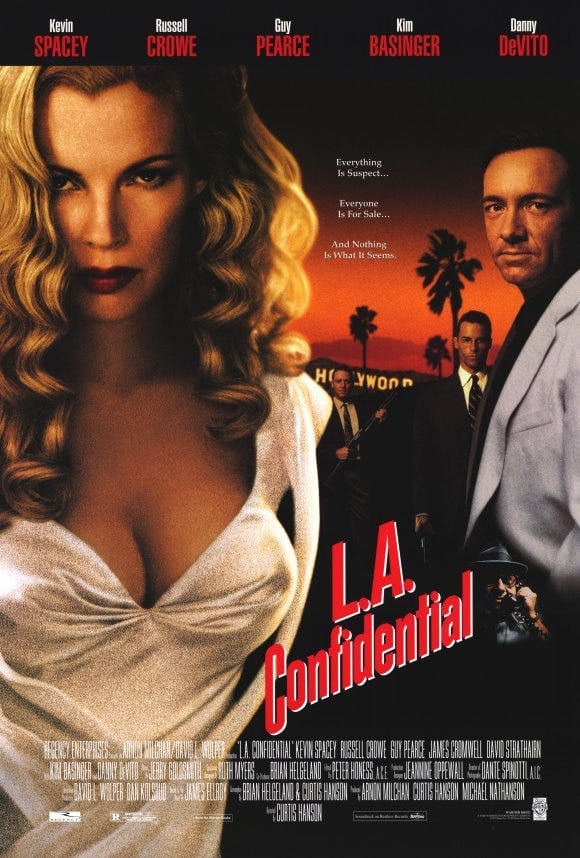
Lead Actors: Kevin Spacey, Russell Crowe, Guy Pearce, James Cromwell, Danny Devito, and Kim Basinger (who won the Oscar for best supporting Actress)
Director: Curtis Hanson.
Plot Summary: In the 1950’s, three Los Angeles police officers clash as they discover that a series of seemingly unrelated murderers are pieces of a larger crime puzzle.
Why I Think This Is a Classic 90’s Movie: The movie is an excellent instance of adapting from a novel with a complicated story line. Helgeland and Hanson did a superb job of pruning Ellroy’s sprawling story down to a lean and coherent plot.
The movie has all the essential ingredients of film noir: glitter, decadence and illusions in post-World War 2 Hollywood dream factories; endemic corruption in the police department; a cynical POV in the form of bemused V.O. commentary by a sleazy Hollywood tabloid editor, a gorgeous femme fatale prostitute, a morally ambivalent ending.
And the movie does it all in style: the movie recreates the period music, period clothes — and period prejudices. The corrupt police captain facilely throws the investigation of the major murder off the scent by fabricating “the usual suspects”: Blacks.
Last but not least, there is an abundance of strong acting talent given great roles and snappy dialogue. To the list of those actors already mentioned add David Strathairn, Ron Rifkin, Graham Beckel and Simon Baker.
My Favorite Moment In The Movie: The fight between officers Ed Exley (Guy Pearce) and Bud White (Russell Crowe). They’ve been the best of worst enemies for the entire film and the fight is the obligatory climax of their feud.
Out of the fight comes Aristotelian 1] catharsis, 2] discovery and 3] reversal. 1] After acting out their anger, 2] they realize who the prime suspect is and so 3] adversaries become allies as they combine their unique talents — Exley’s brain and White’s brawn — to solve the case.
My Favorite Dialogue In the Movie: Officer Bud White interrogating Lynn Bracken, the glamorous prostitute, about the murder of another prostitute. The text is official business; the sub-text is lust and love.
LYNN: I remember you from Christmas Eve. You have a thing for helping women, don’t you, Officer White?
BUD: Maybe I’m just fucking curious.
LYNN: You say ‘fuck’ a lot.
BUD: Your fuck for money.
LYNN: There’s blood on your shirt. Is that an integral part of your job?
BUD: Yeah.
LYNN: Do you enjoy it?
BUD: When they deserve it.
LYNN: Did they deserve it today?
BUD: I’m not sure.
LYNN: But you did it anyway.
BUD: Yeah, just like the half dozen guys you screwed today.
LYNN: Well, actually, it was two. You’re different, Officer White. You’re the first man in five years who didn’t tell me I looked like Veronica Lake inside of a minute.
BUD: You look better than Veronica Lake.
Key Things You Should Look For When Watching This Movie:
CHARACTER DEVELOPMENT:
The major characters are given memorable introductions in scenes with argument and conflict that clearly establish their roles and character flaws. Bud White is introduced brutally enforcing his personal brand of street justice. Edmund Exley is introduced as smart, overly ambitious [hubris], arguing with his superior. Jack Vincennes is introduced savoring the glitter and glamour of Hollywood, willing to play along with a sleazy tabloid editor for publicity — and a payoff.
PLOT CONSTRUCTION:
In distilling Ellroy’s sprawling novel into a script, it may seem at first glance that Helgeland and Hanson have violated a cardinal rule about the inciting incident. The rule is that the inciting incident of the plot should occur in the first Act, ideally on (or before) the 15 minute mark.
What happens in the 15th minute of the movie is a fight in the Hollywood jail that disgraces the department. The incident crystalizes the enmity Edmund Exley’s fellow officers have for him because he alone tried to stop it. And because he shrewdly leverages the scandal to his advance his career at the expense of other participants including Vincennes and White. Is this the inciting incident of the plot?
Or does the inciting incident of the plot occur later, at the start of Act 2, in the 30th minute of the movie, when Exley takes the call for the murders at the Night Owl restaurant? After all, this is the incident that triggers the principal problem that consumes the time and efforts of the principal characters for the rest of the movie, finding out who done it and why.
To answer the question, I went back to fundamentals laid out in the first book ever written about drama, Aristotle’s “Poetics”. Aristotle asserts that a plot should be built around one principal character, a protagonist, involved in one principal action. I nominate Edmund Exley as the protagonist. And I tag his struggle to advance his career within the department as the one action, the clothesline of the plot , on which is hung all the other colorful characters and events.
The markers for Exley’s action and the ethical issue (aka: theme) he will wrestle with are clearly laid down in his first Act 1 argument with Captain Dudley Smith:
DUDLEY: Edmund, you’re a political animal. You have the eye for human weakness, but not the stomach.
EDMUND: You’re wrong, sir.
DUDLEY: Would you be willing to plan corroborative evidence on a suspect you knew was guilt in order to ensure and indictment.
EDMUND: Dudley, we’ve been over this.
DUDLEY: Yes or no, Edmund.
EDMUND: No.
DUDLEY: Would you be willing to beat a confession out of a suspect you knew to be guilty?
EDMUND: No.
DUDLEY: Would you be willing to shoot a hardened criminal in the back to offset the chance that some lawyer —
EDMUND: No.
DUDLEY: Then for the love of God, don’t be a detective. Stick to assignments where you don’t have to make those choices.
EDUMUND: Dudley, I know you mean well, but I don’t need to do it the way you did. Or my father.
If this analysis is valid then the jail fight is, indeed, the inciting incident. It sets in motion the plot: can Edmund Exley (protagonist) advance his career (action) playing by the official rules instead of the unwritten rules of police work (moral issue/theme)?
By the mid-point of the movie, Exley seems to have solved the case, collecting a medal of valor in the process. The “usual suspects”, Blacks, have been brought to justice. The plot seems resolved, the case all sewn up. Exley has proved his point, achieved his dramatic goal. Everyone else can go back to business as usual.
Except Exley hasn’t sewn up the case.
Aristotle wrote that a plot is in part complication (“desis” literally “binding”) and in part denouement (“lusis” literally “unravelling”). “Many poets tie the knot well,” he observed, “but unravel it ill.”
The modern day poets, Helgeland and Hanson, skillfully unravel the plot of this movie. Thread by thread they unwind Exley’s “sewing”. And as the case that made his career and reputation falls apart, Exley discovers that the Night Owl Murders was merely a symptom of a greater problem, a deeper pathology, a conspiracy by corrupt cops to take over organized crime in L.A. (Which is clearly and cleverly foreshadowed in Danny Devito’s V.O. during the opening credits.)
And finally — this being a film noir — Exley’s moral stance also unravels: in order to solve the murders, he must do what he said he would never do. He beats a confession out of one suspect (or rather gladly allows Bud White to do what he does best). And he shoots Captain Smith, the chief conspirator, in the back to offset the chance that the Captain will evade indictment and conviction for his criminal conspiracy.
“L.A. Confidential” is an enjoyable film to watch. And an instructive one for screenwriters, a model, I submit, for how to adapt a complicated story line, how to build a plot from a book so rich in character and incident.
Thanks, Paul. To show our gratitude for your guest post, here’s a dash of creative juju for you. Whoosh!
We already have a set of 80s Movies. This month we cover 90s movies. So thanks to all of you for your participation in this project, creating a resource for writers, movies they should watch to help learn the craft of screenwriting!
Comment Archive