Classic International Movie: “Amélie”
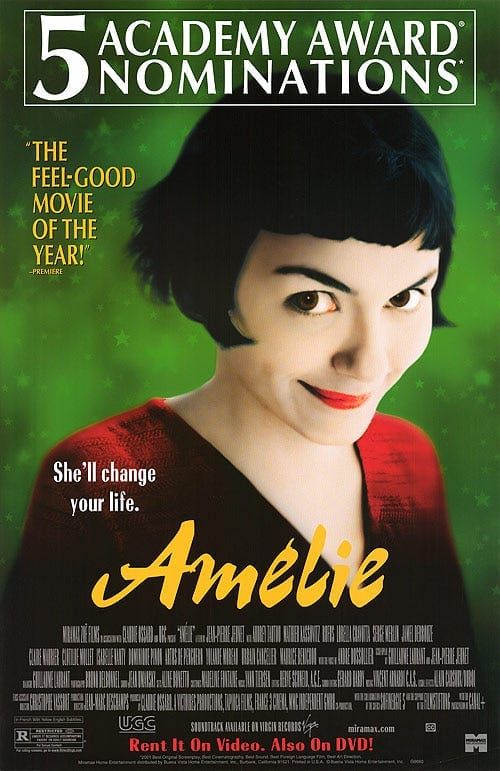
October is classic international movies month. Today’s guest post comes from Kevin Curran.
Movie Title: Amélie
Year: 2001
Writers: Guillaume Laurant and Jean-Pierre Jeunet
Lead Actors: Audrey Tatou, Mathieu Kassovitz, André Dussollier (narrator)
Director: Jean-Pierre Jeunet
IMDb Plot Summary: Amélie is an innocent and naive girl in Paris with her own sense of justice. She decides to help those around her and, along the way, discovers love.
Why I Think This Is A Classic International Movie
Amélie is storytelling in its purest form. We follow Amélie, a girl with an active and thirsty imagination, as she stops at nothing to help all those around find happiness. The screenplay is simply brilliant, which, in my opinion, qualifies it as a “classic movie” of any genre or category. However, the colorful beauty and subtle quirkiness that Jean-Pierre Jeaunet (writer/director) and Bruno Delbonnel (cinematographer) bring us is fun, honest, original, and imaginative beyond words.
My Favorite Moment In The Movie
After she returns the box to Dominique Bretodeau, Amélie takes the blind man around the block, swiftly describing to him, in vivid detail, their surroundings. She leaves the blind man in complete ecstasy. This quick sequence at the 36’ mark encapsulates Amélie’s character. What makes her tick is selflessly helping others and sticking around to catch a glimpse of their joyous reactions.
My Favorite Dialogue In the Movie
Raymond Dufayel aka Glass Man: So that’s the one, there, the guy who raises his hand?
Amélie: Yes.
Raymond Dufayel aka Glass Man: Is she in love with him?
Amélie: Yes.
Raymond Dufayel aka Glass Man: The time has come for her to take some real risks.
Amélie: Well yes, she’s thinking about it. She’s thinking of a stratagem.
Raymond Dufayel aka Glass Man: Yes, she likes stratagems, doesn’t she?
Amélie: Yes.
Raymond Dufayel aka Glass Man: She’s a bit of a coward. That’s why I have trouble with her eyes.
Key Things You Should Look For When Watching This Movie
All screenwriters should study this film and its screenplay. The writers do an amazing job of creating the world and its characters, while sticking to the basics of storytelling. From the very start they create sympathy for Amélie by showing us three things; her pensive reaction to her parents getting rid of her goldfish; the lack of affection her father shows her, which she so yearns for; and the ironic death of her mother at a young age.
In regards to developing the characters, the writers use the power of the narrator to describe their “Likes & Dislikes”. To some, this may feel like “cheating”, but it molds perfectly with the tone of the movie. You begin to feel a relatable human connection with each character because of it. You may not like what they like, or dislike what they dislike, but it makes you realize that everyone is so specifically different from one another, and that’s okay. It’s a great character development tool for screenwriters, regardless if it goes into your script.
The writers also do a wonderful job in showing us Amélie’s motivations and inner conflicts. We see in Act 1 that what drives her is to make others happy. She makes it her goal to find Dominique Bretodeau and return his box of childhood memories. Throughout Act 2, this motivation continues, as she becomes the “eyes” for the blind man, helping him see things he’s never seen before. She also conjures up a plan to set up the bothersome Joseph with the oblivious Georgette — she later learns that true love cannot be forced. In externally portraying her inner conflicts, the writers use the wise painter, Raymond Dufayel aka Glass Man. Their conversations about the girl in his painting is so obviously about Amélie, but the writers craft it in a way that makes it feel just right. The Glass Man serves as her inner voice, guiding her to the realization that she must take a risk in order to find true love, or else she will regret it for the rest of her life. Happy endings ensue…and what’s so bad about that?
Thanks, Kevin!
To show our gratitude for your guest post, here’s a dash of creative juju for you. Whoosh!
We already have a set of classic 30s movies, 40s movies, 5os movies, 60s Movies, 70s movies, 80s Movies and 90s Movies. This month, we’re working on classic international movies. And thanks to the GITS community, we’ve got at least 22 movies in the works and hopefully more!
Those who I put in bold have already sent me their posts. If you haven’t sent yours to me, please do so as soon as you can!!!
A Prophet — Paul Graunke
Akira — Clay Mitchell
Amelie — Kevin Curran
Belle Epoque — Melinda Mahaffey
Cinema Paradiso — Traci Nell Peterson
Diabolique — Sherin Nicole
Jules et Jim — Susan Winchell
Kolya — Melinda Mahaffey
Lady Vengeance — David Joyner
Millennium Actress — Chris Neumann
OSS 117: Cairo, Nest of Spies — John Henderson
Reprise — Wally Marzano-Lesnevich
Seven Samurai — Will King
The Lives of Others — Paul Graunke
The Tenant — Marija Nielsen
This Man Must Die — Marija Nielsen
Looking for more volunteers, your chance to memorialize your favorite international movie and yourself as a contributor to our ongoing blog series on classic movies.
Comment Archive