Classic International Movie: “Belle Epoque”
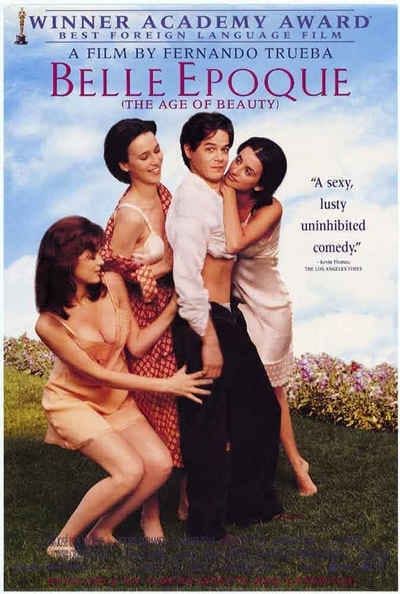
October is classic international movies month. Today’s guest post comes from Melinda Mahaffey.
Movie Title: Belle Epoque
Year: 1992
Writers: Screenplay by Rafael Azcona, story by Rafael Azcona, Jose Luis Garcia Sanchez and Fernando Trueba
Lead Actors: Penelope Cruz, Fernando Fernan Gomez, Jorge Sanz
Director: Fernando Trueba
IMDb Plot Summary: Set in 1931, a young Spanish soldier deserts the army and soon befriends a lonely older man in a village. Problems arise when the man’s four beautiful daughters come to visit their father, and the soldier quickly falls in love with each of them.
Why I Think This Is A Classic International Movie
I’ve always really loved the spirit of this movie — its joy, its playfulness, its absurdity. Considering that it opens and closes with death (and the behavior of many of the characters is questionable if looked at too closely), Belle Epoque manages to be a lighthearted and lovely film. It’s set during political upheaval in Spain, and the characters experience a belle epoque in the sense that they spend a spring together in the countryside, away from everything, enjoying picnics by the river, carnivals, etc. It’s a happy interlude for them, and that’s how I like to think of the movie.
My Favorite Moment In The Movie
Manolo happily welcomes Fernando, the young soldier, into his home, but then Fernando is unceremoniously sent off when Manolo gets word that his daughters are coming to stay. Their train arrives first, and my favorite part is when the four women step out of the carriage one by one. As he gets a look at each of them in turn, Fernando clearly won’t be going anywhere.
My Favorite Dialogue In the Movie
When Amalia, the mother, comes home toward the end of the movie, she brings her lover, Danglard, with her. Danglard isn’t happy when Amalia and Manolo soon go off to the bedroom together. He calls to her through the door:
DANGLARD: Amalia!
AMALIA: Christ, what a nuisance! What is it?
DANGLARD: I think it would be better if you and I rested together now.
AMALIA: No. And if you make a scene, I’ll go back to Manolo.
DANGLARD: No, not that!
AMALIA: Just give us a few minutes. Why do you torture yourself? You know we have forever.
DANGLARD: Really?
AMALIA: I swear it. Now, go away.
Key Things You Should Look For When Watching This Movie
There’s not much in the way of symbolism, but the movie is set in a very sunny countryside, and the four sisters appropriately have names evocative of beauty and the outdoors: Rocio (dew), Clara (clear), Violeta (violet), and Luz (light).
When accepting the Oscar, Francisco Trueba said, “I would like to believe in God in order to thank him, but I just believe in Billy Wilder, so thank you, Mr. Wilder.” Wilder’s influence is front and center in one particular scene, when Violeta and Luz force Fernando to attend the carnival in drag. It’s quite remarkable how much he looks like Tony Curtis in Some Like It Hot.
Trueba has also said that he and screenwriter Rafael Azcona were heavily influenced by Jean Renoir’s A Day in the Country. He also told a journalist in 1994 that when you watch Belle Epoque, he hopes the four sisters bring to mind the strong women that populated Howard Hawks’ films. “I think Hawks was the first (filmmaker) to make female characters powerful and great. Hawks was in advance of his time. That’s why when you see his movies today, they still work.” (Source: http://articles.mcall.com/1994-05-08/entertainment/2978552_1_fernando-trueba-fernando-fernan-gomez-epoque)
Another Trueba quote: “Belle Epoque is the story of Paradise: too good to last. It’s about the discovery of life, but the real one, I mean: freedom, art, love, sex, friendship…all the things that make life interesting. It’s an oasis… Maybe it’s too idealistic, but I always thought one of the reasons for cinema was to give pleasure and happiness to the audience. I don’t want to make people think about how miserable life is. I prefer to leave that for tomorrow. I like to hear the audience laughing in a dark theater. That’s the best music for me.” (Source: http://www.imdb.com/reviews/24/2484.html)
Trivia:
- Belle Epoque won the Oscar for best foreign language film in 1994.
- It also won nine Goya Awards (Spain’s Oscars) in 1993
- Fernando Fernan Gomez, the actor who played Manolo, has 212 acting credits to his name on IMDb.
Thanks, Melinda!
To show our gratitude for your guest post, here’s a dash of creative juju for you. Whoosh!
We already have a set of classic 30s movies, 40s movies, 5os movies, 60s Movies, 70s movies, 80s Movies and 90s Movies. This month, we’re working on classic international movies. And thanks to the GITS community, we’ve got at least 22 movies in the works and hopefully more!
Those who I put in bold have already sent me their posts. If you haven’t sent yours to me, please do so as soon as you can!!!
3 Idiots — Abhinav Tiwari
A Prophet — Paul Graunke
Akira — Clay Mitchell
Amelie — Kevin Curran
Belle Epoque — Melinda Mahaffey
Cinema Paradiso — Traci Nell Peterson
Diabolique — Sherin Nicole
Jules et Jim — Susan Winchell
Kolya — Melinda Mahaffey
Lady Vengeance — David Joyner
Millennium Actress — Chris Neumann
OSS 117: Cairo, Nest of Spies — John Henderson
Reprise — Wally Marzano-Lesnevich
Seven Samurai — Will King
The Lives of Others — Paul Graunke
The Tenant — Marija Nielsen
This Man Must Die — Marija Nielsen
NOTE: Looking for more volunteers, your chance to memorialize your favorite international movie and yourself as a contributor to our ongoing blog series on classic movies. Need 4 more volunteers!
Also if you have volunteered and haven’t yet sent me your analysis, please do ASAP. Thanks!