Classic International Movie: “Millennium Actress”
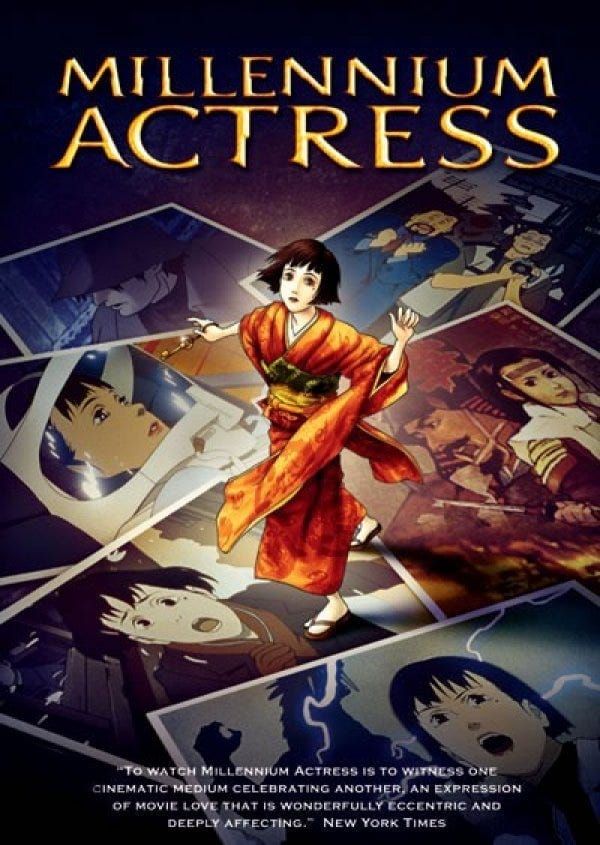
October is classic international movies month. Today’s guest post comes from Christopher Neumann.
Movie Title: Millennium Actress (千年女優 Sennen Joyū)
Year: 2001
Writers: Satoshi Kon, Sadayuki Murai
Lead Actors: Miyoko Shōji, Mami Koyama, Fumiko Orikasa, Shōzō Iizuka
Director: Satoshi Kon
IMDb Plot Summary: In a rare interview, a reclusive actress recounts her life in cinema in post-war Japan.
Why I Think This Is A Classic
This has been one of my favorites ever since I discovered it on DVD in the early 2000s, it’s a wonderful film by a master artist who’s no longer with us, I think that makes it a classic.
Millennium Actress follows a documentary producer and his cameraman interviewing a mysterious, reclusive actress named Chiyoko Fujiwara. The interview is prompted by the demolition of her old studio, and driven by the question of why she disappeared from films suddenly in the 70s. As she begins to tell her story, the two interviewers find themselves caught up in the story and eventually becoming part of it, as her true history merges with the movie roles she played.
The premise of being an actress allows Chiyoko to take roles and personas from a thousand years of Japanese history (samurai films, geisha films, etc) while her real life counterpart experiences the recent history of Japan (World War II, and specifically the Japanese invasion of Manchuria) and a thousand years of Japanese history at the same time. You would think that this would make the movie impossible to follow, with three timelines and unreliable narration, but nothing could be further from the truth.
The movie actually reminds me of Forrest Gump: history being explored through the lens of pop culture and nostalgia, being told by an untrustworthy narrator. I can also sense some Citizen Kane, with the story being an investigation into a mysterious individual guarding a great secret, and with a singular, unmet goal. And yet, the movie doesn’t feel derivative of either of those films. Perhaps it’s the culture that it takes place in, perhaps it’s the freedom that animation gave the director to cut from one reality to another to another within a single frame… it’s hard to say.
I suppose you could also connect this film with Adaptation, with the real and story worlds becoming interwoven, although I think those may have come out at the same time… or at least too close together to draw inspiration from each other.
This is a tricky movie to talk about, because it’s not well known and the DVD’s out of print. On the one hand, it’s a mystery and I want to preserve as much of that as I can, but I also don’t want to spoil it. And despite jumping between time periods and real and fantasy worlds, the story is relatively straightforward. It’s told more or less in order, with the visual just being the best way to express the emotion of a scene, the more heightened emotions become movies because they’re the perfect vehicle for heightened emotions and stakes.
The movie hasn’t been sampled in the same way that Kon’s other works, Perfect Blue or Paprika, were. But it doesn’t really allow for that in the same way. This film, alongside Tokyo Godfathers, is more grounded and down to earth. I don’t hear much about those movies, the same way I do Kon’s other work. There’s fantastical stuff in here, sure, but it feels more or less like the real world. But it still looks amazing. Anime’s always been good at making the mundane look beautiful on screen, and this film is no exception. Keep an eye out for the wood, it’s everyone in the movie, and the grain and texture of it just leaps off the screen, you feel like you can touch it.
My Favorite Moment In The Movie
Whenever I think of this movie, the first scene that pops into my head is Genya catching Chiyoko’s hat. Until this moment, the two interviewers had been passive participants in Chiyoko’s flashback, but after that moment, anything can happen. The two go from being passive observers to active participants. This is the moment where Chiyoko’s past, her movie career, and the present begin to interact, and from that moment you know that you can’t trust everything that you’re seeing.
My Favorite Dialogue In the Movie
Kyouji the cameraman has quite a few good zingers throughout the film, “wasn’t this supposed to be a documentary?” etc but the closest I can come to a good stand-alone quote is:
Otaki: Remember one thing: in this business we flatter both the audience and the actresses. I’ll show you how one of these days.
I don’t want to say that the dialogue is mechanical, but there’s no wasted flourishes, there’s a lot to do so everything has a utility to it. There’s no lines there to be quotes.
Really, my favorite dialogue in the movie comes at the end, but if you think I’m going to spoil it, you’re nuts.
Honestly, what gets me more than the dialogue is the music. This is one of the rare anime soundtracks I own and the music is perfect. It’s nice that there’s not a lot of talking over it.
Key Things You Should Look For When Watching This Movie
Every Frame A Painting went into detail on Satoshi Kon’s specific editing style in his video.
While film fans may recognize some of the pop culture references in the movies-within-the-movie (the Akira Korusawa influences in the samurai feature being key among them), there are tons of Japanese references that are probably lost on western audiences. The details of the history of Japan might not be as clear, or the significance of the names be as distinct (Chiyoko’s last name, Fujiwara, which means “child of a thousand generations,” is also an aristocratic name, and the Fujiwara clan was in prominent political power at the turn of the 1st millennium AD). I suppose it would be equivalent to a British film having characters named Tudor or Cromwell. Just watching this movie made me realize how little Eastern history I know, and it’s not lost on me that my knowledge of their history is coming from movies, specifically a movie where they make historical movies.
Final thoughts? Pretty movie… it spans a thousand years and heads into outer space, and yet it still feels small and intimate in the best possible way. If you find it, do yourself a favor and pick it up.
Thanks, Chris!
To show our gratitude for your guest post, here’s a dash of creative juju for you. Whoosh!
We already have a set of classic 30s movies, 40s movies, 5os movies, 60s Movies, 70s movies, 80s Movies and 90s Movies. This month, we’re working on classic international movies. And thanks to the GITS community, we’ve got at least 22 movies in the works and hopefully more!
Those who I put in bold have already sent me their posts. If you haven’t sent yours to me, please do so as soon as you can!!!
3 Idiots — Abhinav Tiwari
A Prophet — Paul Graunke
Akira — Clay Mitchell
Amelie — Kevin Curran
Belle Epoque — Melinda Mahaffey
Cinema Paradiso — Traci Nell Peterson
Diabolique — Sherin Nicole
Jules et Jim — Susan Winchell
Kolya — Melinda Mahaffey
Lady Vengeance — David Joyner
Millennium Actress — Chris Neumann
OSS 117: Cairo, Nest of Spies — John Henderson
Reprise — Wally Marzano-Lesnevich
Seven Samurai — Will King
The Lives of Others — Paul Graunke
The Tenant — Marija Nielsen
This Man Must Die — Marija Nielsen
NOTE: Looking for more volunteers, your chance to memorialize your favorite international movie and yourself as a contributor to our ongoing blog series on classic movies. Need4 more volunteers!
Also if you have volunteered and haven’t yet sent me your analysis, please do ASAP. Thanks!