Classic International Movie: “The Lives of Others”
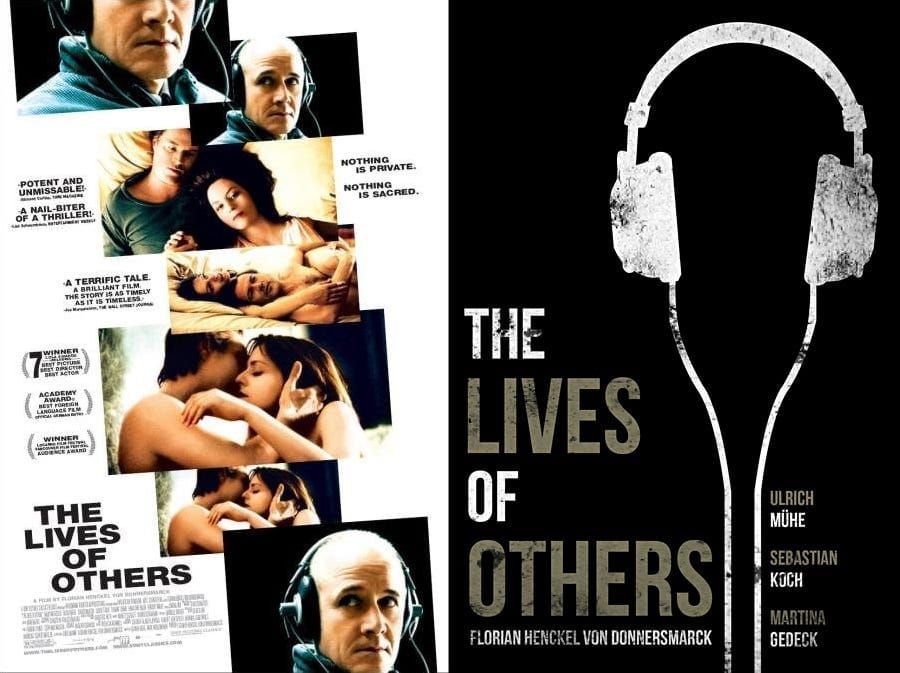
October is classic international movies month. Today’s guest post comes from Paul Graunke.
Movie Title: The Lives of Others (Das Leben der Anderen)
Year: 2006
Writers: Florian Henkel von Donnersmarck
Lead Actors: Ulrich Mühe, Martina Gedeck, Sebastian Koch
Awards: Altogether 76 wins and 32 nominations in various categories including: German Film Awards, Outstanding Feature Film, Best Screenplay (2006); Oscar, Best Foreign Language Film (2007); BAFTA, Best Film not in the English language (2008); César Awards (France), Best Foreign Film (2008), European Film Awards, Best European Film (2006).
Director: Florian Henkel von Donnersmarck
Plot Summary: In 1984, when an East German Stasi agent is ordered to spy on a writer, the more he discovers about the writer’s disloyalty, the more his own faith in the Communist system is shaken.
Why I Think This Is a Classic International Movie
The Communist party of the defunct German Democratic Republic, aka: GDR, maintained its grip on the population through a reign of paranoia conducted by the Stasi, a secret police force of some 100, 000 agents. This movie is a powerful indictment of that system.
The indictment is made not through grandiloquent speeches, or sweeping visuals of masses being herded into submission. Rather it is made by focusing on one agent, Gerd Wiesler, coming to terms with what he discovers as he spies on one couple, a popular dramatist, Georg Dreyman, and his lover, a glamorous actress, Christina-Marie Sieland.
The protagonist is an anti-hero the story persuaded me to root for. I came to admire how he develops the cunning to outwit his foes.
My Favorite Moment in the Movie
The setup: The Stasis agent, Wiesler, a true believer in the ideology and the system, has discovered the real reason he’s been ordered to spy on the writer. Not because the Culture Minister suspects the writer Dreyman is disloyal, but because he covets the writer’s lover, the actress Sieland, and has used his rank to force her into sexual liaisons. Wiesler has tipped this relationship to the Dreyman.
The moment: Later, Dreyman begs Sieland not to go to another liaison with the Culture Minister. But she goes anyway, arguing they are both in bed with the system; she’s doing what she has to do to protect both of them.
In the attic above, Wiesler overhears in silent agony and growing empathy.
The moment ends on a beat of comic relief. A running gag has been that the young agent working the next shift is always late. And sure enough, at the climactic moment of the emotional scene unfolding below him, the young agent arrives on time.
My Favorite Dialogue in the Movie
My favorite dialogue is what happens after my favorite moment. Instead of going straight home to his lonely and sterile flat as is habit, Wiesler, emotionally distraught, goes to a bar across the street for a drink. An equally distraught Sieland enters for a drink. Wiesler, despite his lack of social skills, despite his career and ideological convictions, musters the courage, the humanity, to approach her:
Wiesler: Madam?
Sieland: Go away. I want to be alone.
Wiesler: Ms. Sieland.
Sieland: Do we know each other?
Wiesler: You don’t know me, but I know you. Many people love you for who you are.
Sieland: Actors are never ‘who they are’.
Wiesler: You are. I’ve seen you on stage. You were more who you are than you are now.
Sieland: So you know what I’m like.
Wiesler: I’m your audience.
Sieland: I have to go.
Wiesler: Where to?
Sieland: I’m meeting an old classmate. I…
Wiesler: See? Just now you weren’t being yourself.
Sieland: No?
Wiesler: No.
Sieland: So you know her well, this Christa-Maria Sieland. What do you think? Would she hurt someone who loves her above all else? Would she sell herself for art?
Wiesler: For art? You already have art. That’d be a bad deal. You are a great artist. Don’t you know that?
Sieland: And you are a good man.
Key Things You Should Look For When Watching This Movie
CHARACTER ROLES AND CHARACTER ARC
Protagonist: The Stasi agent, Wiesler, the character who makes the choices that determine the fate of writer and the actress. And he’s a character with a flaw: he’s an emotionally desolate true believer, a dutiful soldier enforcing submission to an oppressive system.
Antagonist/Proxy: The Culture Minister, Hempf, who exploits his rank to take advantage of Sieland. He also stands in as the representative, the proxy, for the corrupt regime.
Attractor/Transformer: The actress, Sieland. The writer Dreyman is attracted to her as a talented woman, a soul mate. The boorish (and boar-ish looking) Culture Minister is attracted to her out of lust. But neither of them are both attracted to her and transformed in the process.
The Stasis agent Wiesler is.
He is drawn into her dilemma, becomes emotionally involved in her suffering. As a result, he is transformed into a man who acts on the feelings of his heart instead of the ideology stuffed into his head. (For those who dig the depth psychology of Jung, this is a primary role of the Anima archetype in the male psyche, the contrasexual agent of transformation and individuation.)
Wiesler’s arc of transformation through her influence from Disunity to Deconstruction to Reconstruction to Unity is well worked out and credible.
And moving. In spite of (for some), because of (for me) the fact that the emotional current in his character is all subterranean, all sub-text. Wiesler is not given a reflector character, a friend or lover, who he can use to externalize what he’s thinking and feeling. The actor playing Wiesler, Ulrich Mühe, has to convey what his character is feeling and thinking almost exclusively by facial expressions, by say little or nothing while expressing everything.
PLOT
Again, well worked out with a powerful denouement after the fall of the Berlin Wall and the re-unification of Germany. We get a glimpse of how Germany as a country, by opening up the Stasi archives, has worked out its own process of transformation from Disunity and Unity.
Thanks, Paul!
To show our gratitude for your guest post, here’s a dash of creative juju for you. Whoosh!
We already have a set of classic 30s movies, 40s movies, 5os movies, 60s Movies, 70s movies, 80s Movies and 90s Movies. This month, we’re working on classic international movies. And thanks to the GITS community, we’ve got at least 22 movies in the works and hopefully more!
Those who I put in bold have already sent me their posts. If you haven’t sent yours to me, please do so as soon as you can!!!
A Prophet — Paul Graunke
Akira — Clay Mitchell
Amelie — Kevin Curran
Belle Epoque — Melinda Mahaffey
Cinema Paradiso — Traci Nell Peterson
Diabolique — Sherin Nicole
Jules et Jim — Susan Winchell
Kolya — Melinda Mahaffey
Lady Vengeance — David Joyner
Millennium Actress — Chris Neumann
OSS 117: Cairo, Nest of Spies — John Henderson
Reprise — Wally Marzano-Lesnevich
Seven Samurai — Will King
The Lives of Others — Paul Graunke
The Tenant — Marija Nielsen
This Man Must Die — Marija Nielsen
NOTE: Looking for more volunteers, your chance to memorialize your favorite international movie and yourself as a contributor to our ongoing blog series on classic movies. Need 6 more volunteers!
Also if you have volunteered and haven’t yet sent me your analysis, please do ASAP. Thanks!