Classic International Movie: “Un Prophète” (A Prophet)
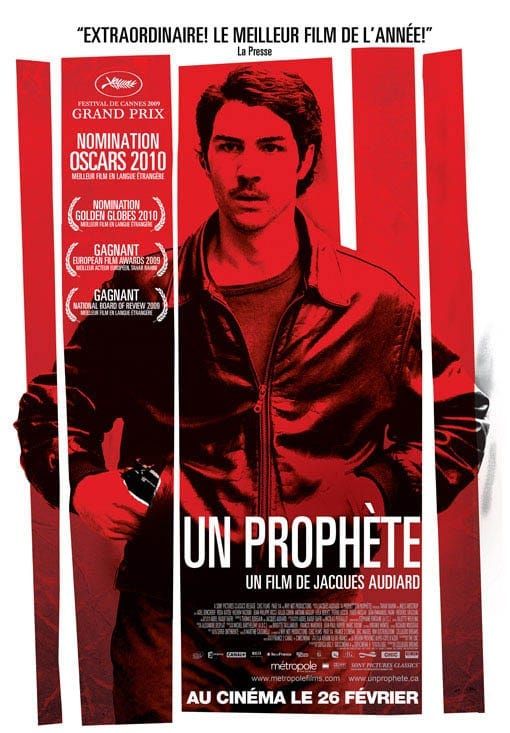
October is classic international movies month. Today’s guest post comes from Paul Graunke.
Movie Title: Un Prophète (A Prophet)
Year: 2009
Writers: Thomas Bidegain, Jacques Audiard, Abdel Raouf Dafri, Nicolas Peufaillit
Lead Actors: Tahar Rahim, Niels Arestrup, Adel Bencherif, Reda Kateb
Director: Jacques Audiard
Awards: Grand Prize of the Jury: Cannes Film Festival (2009); César Awards, France: Best Film and Best Original Screenplay (2010); British Independent Films: Best Foreign Film (2010); BAFTA: Best non-English Language Film,
Plot Summary: After a vulnerable young Arab, serving a 6-year prison term, is compelled by a Corsican mafia leader to kill an informer, he covertly plots to overthrow the Corsican and become a mafia leader himself.
Why I Think This Is a Classic International Movie
This movie gets my vote as the best “rise to power of an anti-hero” movie since The Godfather I & II. The arc of character transformation of the protagonist is compelling and credible.
The movie is well cast with a colorful gallery of criminal characters. It’s fascinating to watch the two leads, Tahar Rahim as the Arab Malik El Djebena and Niels Arestrup as the Corsican mafia leader César Luciani, play off against each other.
My Favorite Moment in the Movie
My favorite moment occurs a little past the half way mark when the protagonist, Malik El Djebena, uses a “Yojimbo” ploy; that is, he plays the rival Corsican and Arab prison gangs against each other to advance his own interests. This is a critical turning point in the story. It’s the moment when Malik begins to transition from a hapless victim of circumstances to the wily master of his own future.
My Favorite Dialogue in the Movie
Nothing in particular stands out in my mind. Malik keeps his own counsel. There are no long speeches, no Big Speech where Malik drops his guard, reveals emotional vulnerability. That’s not his temperament and he can’t afford to expose himself like that if he is to survive and prevail in such a hostile environment.
Key Things You Should Look For When Watching This Movie
CHARACTERS:
Protagonist: Malik is caught in a conflict between his identity as an Arab and his role as a lackey of the Corsican mafia leader. He must check his anger, endure in silence Corsican slurs of Arabs. At the same time, he must defend himself against insults and physical assaults by Arabs for betraying his own people. And he is haunted by the ghost of the informant, a fellow Arab, whom he was forced to kill.
Antagonist/Nemesis and Mentor: César, the Corsican mafia leader, plays dual roles. He’s Malik’s oppressor who forces him to do his bidding, run his errands. But unwittingly, he is also Malik’s mentor. By observing him Malik learns how a master mobster operates, how he uses other people and works the system. And Malik is a keen student, a dutiful protégé.
And…
Two other characters, a fellow Arab and a Gypsy, perform the role of Allies, who help him to build his drug dealing enterprise outside the prison while he’s still doing time inside.
The Arab criminal Lattrache is a shape shifter character. First, he intends to kill Malik, but after a traffic accident of which Malik seems prescient (hence, the film title), he becomes an ally. (This is a less than totally credible moment in the film, but it comes after so many other credible and riveting moments, it gets a pass.)
There is no Attractor/Love Interest; no woman on the outside is keeping a candle burning for him in the window. Although an Attractor/Love Interest seems to emerge at the end of the film, the widow of his Arab ally. But she is less a trophy for victory, more an ethical obligation; he’s obliged to fulfill his role as the godfather to his dead ally’s son.
PLOT:
The plot can be decomposed into the 4-part Disunity-Deconstruction-Reconstruction-New Unity paradigm, albeit with a denouement befitting an anti-hero.
Disunity: Malik enters the prison anxious and vulnerable. He has no family on the outside for emotional support, no friends or allies on the inside to protect him, no particular survival skills.
He becomes all the more conflicted when the César taps him to be a lackey, an Arab errand boy serving a Corsican, betraying his own kind. And he remains haunted through most of the film by the fellow Arab whom César forced him to kill.
This subjective disunity is not resolved until the end of the film when Malik frees himself from César, become leader of his own gang.
Deconstruction: Meanwhile, after performing the murder, Malik comes under the protection and service of the Corsican mafia leader. This provides him the opportunity to shed his rather passive, risk-aversive behavior as he observes and learns how César, a genuine mafia gang leader, rules.
Reconstruction: Malik begins to assert himself, take risks, quietly builds a network of allies in and outside the prison. He learns how not merely to survive but to thrive in the hostile world of the prison.
New Unity: Having acquired the skill set and a network of allies, Malik topples César. He confidently emerges from his 6-year prison term as the respected head of his own gang. He’s ready to take on the underworld.
Malik’s character arc is about the transformation of a hapless, insecure, callow juvenile delinquent into a confident, respected, savvy gang leader. If it’s an anti-hero journey, it’s one where the audience can empathize with Malik’s choices because they are forced upon him by his circumstances. We can root for him because he’s not intrinsically a sociopath; he’s an ordinary young man forced to do what he has to do to survive. We come to admire how he does it, how he develops the courage and shrewdness to eventually prevail.
Thanks, Paul!
To show our gratitude for your guest post, here’s a dash of creative juju for you. Whoosh!
We already have a set of classic 30s movies, 40s movies, 5os movies, 60s Movies, 70s movies, 80s Movies and 90s Movies. This month, we’re working on classic international movies. And thanks to the GITS community, we’ve got at least 22 movies in the works and hopefully more!
Those who I put in bold have already sent me their posts. If you haven’t sent yours to me, please do so as soon as you can!!!
A Prophet — Paul Graunke
Akira — RealThndrMonkey
Amelie — Kevin Curran
Belle Epoque — Melinda Mahaffey
Cinema Paradiso — Traci Nell Peterson
Diabolique — Sherin Nicole
Jules et Jim — Susan Winchell
Kolya — Melinda Mahaffey
Millennium Actress — Chris Neumann
OSS 117: Cairo, Nest of Spies — John Henderson
Reprise — Wally Marzano-Lesnevich
Seven Samurai — Will King
The Lives of Others — PaulG
The Tenant — Marija Nielsen
This Man Must Die — Marija Nielsen
Looking for more volunteers, your chance to memorialize your favorite international movie and yourself as a contributor to our ongoing blog series on classic movies.
Comment Archive