Classic International Movie: “Y Tu Mama Tambien”
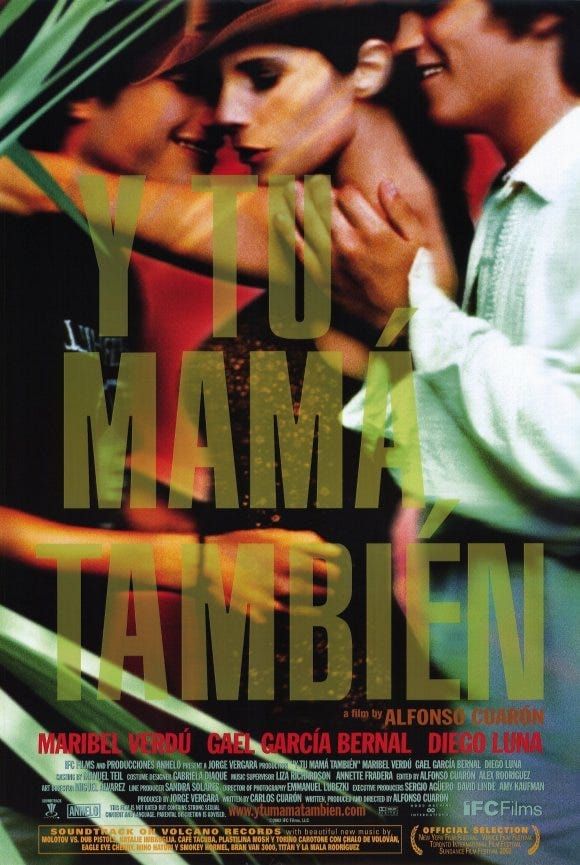
October is classic international movies month. Today’s guest post comes from Georgina Hutchinson.
Title: Y Tu Mama Tambien
Year: 2001
Writers: Alfonso Cuaron and Carlos Cuaron (nominated for Best original Screenplay Academy Awards 2003)
Actors: Gael Garcia Bernal, Diego Luna, Maribel Verdu
Director: Alfonso Cuaron
Plot Summary: In Mexico, two teenage boys and an attractive older woman embark on a road trip and learn a thing or two about life, friendship, sex, and each other.
Why I Think This is a Classic International Movie
Describing Y tu Mama Tambien as a quintessential road movie about two teenage boys and an older woman is accurate it’s just that it barely does the reality of it justice. There are layers and intricacies and a much deeper message here. However, Cuaron doesn’t slap you around the face with theme. It’s just there, in everything, as I believe it should be in a great movie.
It’s about the fragility of life, the inevitability of death, the need to experience the now. It’s also about men and women and relationships and what they can teach each other. It’s about the geographical, political and cultural landscapes of Mexico, juxtaposed with the Mexico we see from the eyes of our protagonists. A kind of parallel Mexico that plays out in the background, commented on by an objective and omniscient narrator.
Ultimately I think this is a classic movie because it distinguishes itself in an authentic way. It’s shot in a documentary -realist style. The performances are honest, vulnerable and real. There is a sincerity in the voice behind this story that permeates every shot and I was not surprised to discover that with this movie, Alfonso Cuaron wanted to make the kind of low-budget film he had dreamed of making in Mexico before he went to film school. A road movie, in Spanish with young actors improvising a lot of the dialogue.
My Favorite Moment
All the moments where the soundtrack is silenced and the narrator comments on seemingly unrelated things that have happened or will happen in the outside world. It’s a constant, albeit detached commentary on the current (for the time) social and political climate of Mexico and the way this sometimes overlaps into the characters lives.
At one point the narrator tells us they are passing through the village of Tenoch’s nanny, who left when she was 13 to work for Tenoch’s family in Mexico City, and that until he was 4, Tenoch called her mom. Tenoch had never been to her village. Tenoch chooses not to mention this to the others in the car, and in doing so this small moment speaks volumes of Mexican class divisions and culturally created attitudes. There is something very potent about the way this character insight is conveyed by the narrator in such a seamless, unassuming and un-judgemental way. Leaving us to form our own opinions.
My Favorite Dialogue
Narrator talking over a long shot of the car driving a stretch of road, shot through the front windscreen.
“If they had passed this spot ten years earlier, they would have seen a couple of cages in the middle of the road… and then driven through a cloud of white feathers. Shortly after more crushed cages, filled with bleeding chickens flapping their wings. Later on, an overturned truck surrounded with smoke. Then they’d have seen two bodies on the road, one smaller than the other, barely covered by a jacket…and next to them a woman crying inconsolably. “
The last words over a shot of a small road-side shrine to the dead, barely noticeable.
Key Things You Should Look For
The way the camera often wanders away from the main action to focus on something happening in the background, moments where Cuaron is clearly visually providing the socio-political context to this story. Like when the three main characters are eating in a little roadside restaurant and the camera leaves them to follow the women in the kitchen making the food and dancing. Or the armed police in the background aggressively making an arrest as our protagonists drive casually past.
The camera, though hand held, is not shakily annoying. It’s just extremely present and real. The result is a beautifully authentic feel to the way this story is told. And the style of it manages to capture the balance between juxtaposing the every day friendship of two teenage boys with much wider, heavier issues.
Link to a fight scene between the two friends.
A scene from the movie:
The movie’s trailer:
Thanks, Georgina!
To show our gratitude for your guest post, here’s a dash of creative juju for you. Whoosh!
We already have a set of classic 30s movies, 40s movies, 5os movies, 60s Movies, 70s movies, 80s Movies and 90s Movies. This month, we’re working on classic international movies. And thanks to the GITS community, we’ve got at least 22 movies in the works and hopefully more!
Those who I put in bold have already sent me their posts. If you haven’t sent yours to me, please do so as soon as you can!!!
3 Idiots — Abhinav Tiwari
A Prophet — Paul Graunke
Akira — Clay Mitchell
Amarcord — Norma Parena
Amelie — Kevin Curran
Belle Epoque — Melinda Mahaffey
Cinema Paradiso — Traci Nell Peterson
Diabolique — Sherin Nicole
Jules et Jim — Susan Winchell
Kolya — Melinda Mahaffey
Lady Vengeance — David Joyner
Millennium Actress — Chris Neumann
OSS 117: Cairo, Nest of Spies — John Henderson
Reprise — Wally Marzano-Lesnevich
Seven Samurai — Will King
The Lives of Others — Paul Graunke
The Tenant — Marija Nielsen
This Man Must Die — Marija Nielsen
Y Tu Mama Tambien — Georgina Hutchinson
NOTE: Need 1 more volunteer to round out the monthly series!!!