Daily Dialogue — January 27, 2017
“Here’s looking at you, kid.”
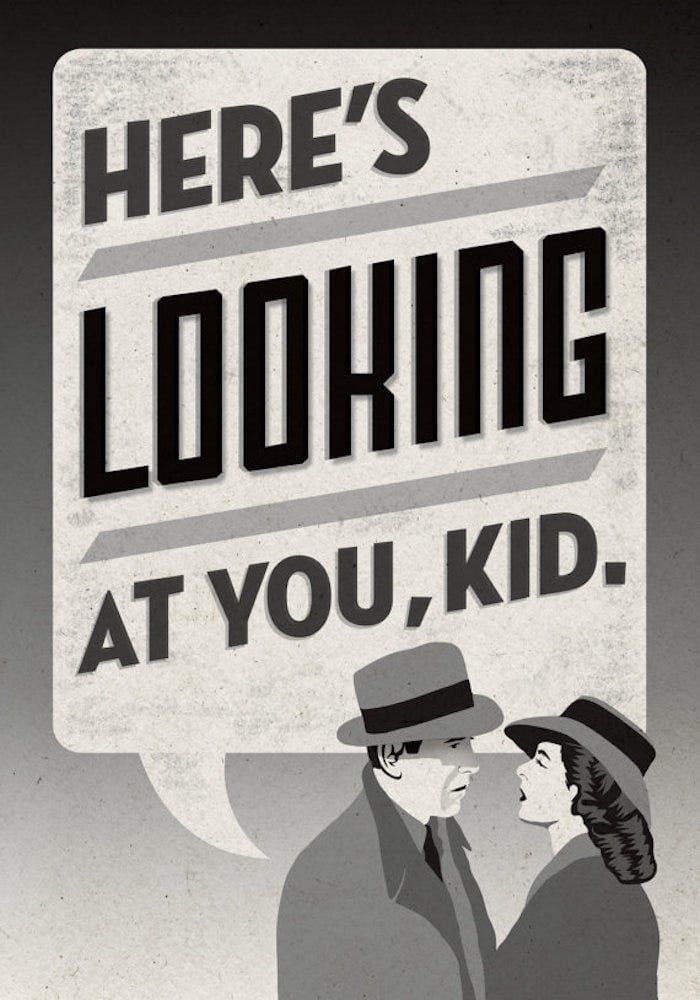
“Here’s looking at you, kid.”
— Casablanca (1942), screenplay by Julius J. Epstein and Philip G. Epstein and Howard Koch, play by Murray Burnett and Joan Alison
The Daily Dialogue theme this week: Callback.
Trivia: “Here’s looking at you, kid” was improvised by Humphrey Bogart in the Parisian scenes and worked so well that it was used later on again in the film. He originally used the same line in Midnight (1934). It is also rumored that during breaks, Ingrid Bergman would play poker with other cast members. Since she was still learning English, Bogart would occasionally watch the game, and he added “Here’s looking at you” to her poker repertoire.
Dialogue On Dialogue: One thing callbacks can do is mark a character’s metamorphosis. They can utter a line when they are in one psychological state, then again much later, the meaning of the callback changed to reflect the change in the character. A good example of that is in the movie Casablanca. The first use of the line “Here’s looking at you, kid” comes during the extended flashback of Rick and Ilsa falling in love in Paris:
INT. RICK’S PARIS APARTMENT — DAY
Ilsa fixes flowers at the window while Rick opens champagne.
She walks over and joins him.
RICK
Who are you really? And what were
you before? What did you do and what
did you think? Huh?
ILSA
We said “no questions.”
RICK
Here’s looking at you, kid.
It’s kind of a throwaway line by Rick, offered spontaneously and casually. The same as this callback later in the flashback:
Sam looks at his glass.
SAM
This sort of takes the sting out of
being occupied, doesn’t it, Mr.
Richard?
RICK
You said it!
(to Ilsa)
Here’s looking at you, kid.
However the line is used twice more, first in this scene in Casablanca where Ilsa has confessed to Rick that she still loves him:
Ilsa puts her head on Rick’s shoulder.
ILSA
I can’t fight it anymore. I ran away
from you once. I can’t do it again.
Oh, I don’t know what’s right any
longer. You’ll have to think for
both of us, for all of us.
RICK
All right, I will. Here’s looking at
you, kid.
Here one layer of subtext is, “I’ll take care of things, don’t you worry.” The line is called back at the very end of the movie, capping Rick’s explanation why Ilsa must take the letters of transit and leave with Laszlo:
ILSA
You’re saying this only to make me
go.
RICK
I’m saying it because it’s true.
Inside of us we both know you belong
with Victor. You’re part of his work,
the thing that keeps him going. If
that plane leaves the ground and
you’re not with him, you’ll regret
it.
ILSA
No.
RICK
Maybe not today, maybe not tomorrow,
but soon, and for the rest of your
life.
ILSA
But what about us?
RICK
We’ll always have Paris. We didn’t
have, we’d lost it, until you came
to Casablanca. We got it back last
night.
ILSA
And I said I would never leave you.
RICK
And you never will. But I’ve got a
job to do, too. Where I’m going you
can’t follow. What I’ve got to do
you can’t be any part of. Ilsa, I’m
no good at being noble, but it doesn’t
take much to see that the problems
of three little people don’t amount
to a hill of beans in this crazy
world. Someday you’ll understand
that. Now, now…
Ilsa’s eyes well up with tears. Rick puts his hand to her
chin and raises her face to meet his own.
RICK
Here’s looking at you, kid.
Here the line takes on added poignancy as it recalls both their personal history (Paris) and Rick’s implication in the previous use of the line that he will take care of things. He has done that, basically telling Ilsa this is the only thing we can do, it’s the right thing to do. And in this moment, he tops off his his transformation arc from cynic to reclaiming his idealism.