Daily Dialogue — January 29, 2017
Flik: Here, pretend — pretend that that’s a seed. Dot: It’s a rock. Flik: Oh, I know it’s a rock, I know. But let’s just pretend for a…
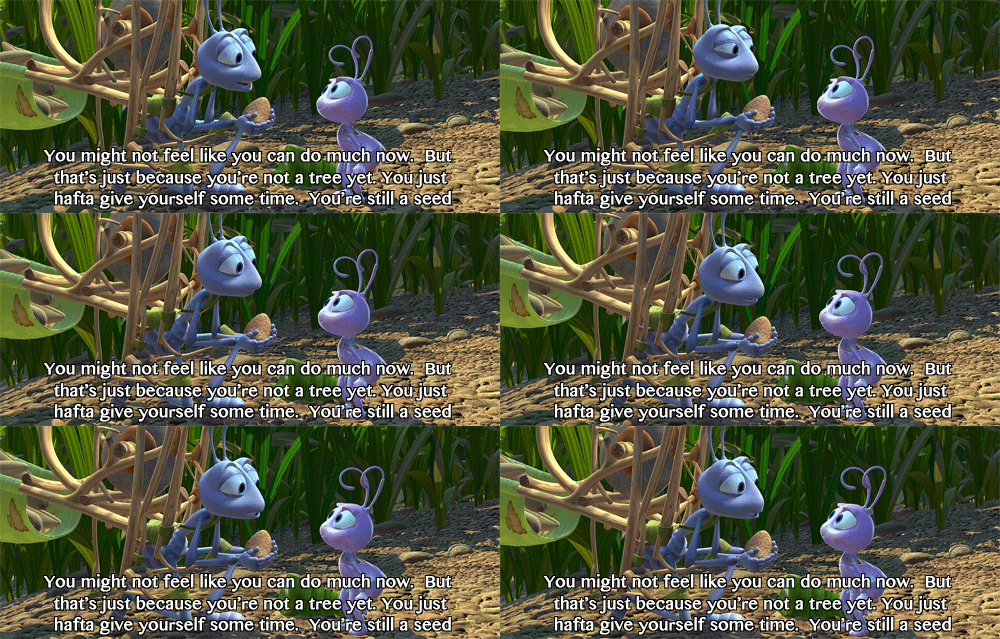
Flik: Here, pretend — pretend that that’s a seed.
Dot: It’s a rock.
Flik: Oh, I know it’s a rock, I know. But let’s just pretend for a minute that it’s a seed, alright? We’ll just use our imaginations. Now, now do you see our tree? Everything that made that giant tree is already contained inside this tiny little seed. All it needs is some time, a little bit of sunshine and rain, and voilá!
Dot: This rock will be a tree?
Flik: Seed to tree. You’ve gotta work with me, here. Alright? Okay. Now, y-you might not feel like you can do much now, but that’s just because, well, you’re not a tree yet. You just have to give yourself some time. You’re still a seed.
Dot: But it’s a rock.
Flik: [shouting] I know it’s a rock! Don’t you think I know a rock when I see a rock? I’ve spent a lot of time around rocks!
Dot: You’re weird, but I like you.
— A Bug’s Life (1998), screenplay by Andrew Stanton and Don McEnery & Bob Shaw, story by John Lasseter & Andrew Stanton & Joe Ranft
The Daily Dialogue theme this week: Callback.
Trivia: During the summer of 1994, Pixar’s story department began turning their thoughts to their next film, while Toy Story (1995) was in post-production. The storyline of A Bug’s Life (1998) originated in a lunchtime conversation between John Lasseter, Andrew Stanton, Pete Docter, and Joe Ranft, the studio’s head story team. Toy Story 2 (1999), Monsters, Inc. (2001), Finding Nemo (2003), and WALL·E (2008) were also conceived at this lunch. Lasseter and his story team had already been drawn to the idea of insects as characters. Insects, like toys, were within the reach of computer animation at the time due to their relatively simple surfaces. Stanton and Ranft wondered whether they could find a starting point in Aesop’s fable The Ant and the Grasshopper. Walt Disney had produced his own version with a cheerier ending decades earlier in the 1934 short film The Grasshopper and the Ants (1934). In addition, Walt Disney Animation Studios had considered producing a film in the late 1980s entitled “Army Ants”, that centered around a pacifist ant living in a militaristic colony, but it never fully materialized.
Dialogue On Dialogue: One of the most effective uses of a callback is to invert the dynamic from the first to second use. That’s exactly what happens in A Bug’s Life. In the scene cited here, Flik uses a rock to symbolize a seed to help Dot feel better about herself.
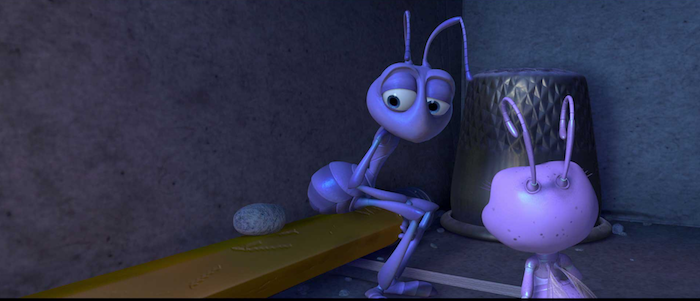
Later when Flik is in the midst of his All Is Lost moment, Dot turns the table, presenting a rock to Flik and saying to him, “Pretend it’s a seed.” She uses the association of Flik’s own words from before to pull him out of his funk.
We’ve had a week’s worth of callbacks. Hopefully this is something you can — and will — use in your own writing.