David Milch: “The Writer’s Voice” (Part 5)
Videos and transcripts from Milch’s legendary 2001 and 2007 WGA series.
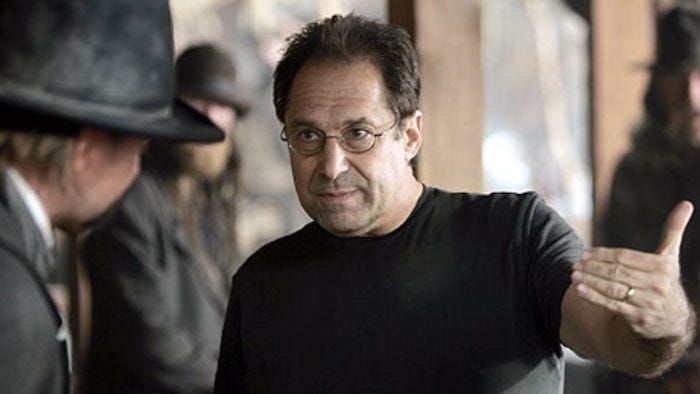
Videos and transcripts from Milch’s legendary 2001 and 2007 WGA series.
In September 2010, I ran a week-long series featuring key excerpts from a memorable series of presentations in December 2001 by David Milch at the WGA Theater in Beverly Hills. Then I stumbled upon this: An entire series available on YouTube called The Idea of the Writer by Milch from a second WGA presentation, this one from December 2007. Since Milch is both an amazing writer and thinker about writing, each day this week I will reprise my posts featuring transcript excerpts from Milch’s 2001 presentation and embed videos from his 2007 series.
Television credits (as creator)
- Beverly Hills Buntz (1987–1988) — co-creator, writer, producer of this Hill Street Blues spin-off
- Capital News (1990) — co-creator, writer, producer
- NYPD Blue (1993–2005) — co-creator, writer, executive producer
- Brooklyn South (1997–1998) — co-creator, executive producer
- Total Security (1997) — co-creator, writer
- Big Apple (2001) — creator, writer, executive producer
- Deadwood (2004–2006) — creator, writer, executive producer
- John from Cincinnati (2007) — co-creator, writer, executive producer
- Last of the Ninth (2009) — creator, writer, executive producer
- Luck (2010) — creator, writer, executive producer
- The Money (2014) — writer, executive producer
Awards and recognition
- 1993 Emmy Award, Outstanding Writing in a Drama Series (Hill Street Blues)
- 1994 Edgar Award, Best Episode in a Television Series Teleplay (NYPD Blue, “4B or Not 4B”)
- 1995 Emmy Award, Best Drama Series (NYPD Blue)
- 1995 Edgar Award, Best Episode in a Television Series Teleplay (NYPD Blue, “Simone Says”) (shared with Steven Bochco and Walon Green)
- 2006 Austin Film Festival, Outstanding Television Writer Award recipient
Not to mention the 259 episodes of “N.Y.P.D. Blue” he’s credited with writing.
I did this post back in July that featured some great video of Milch sharing his thoughts about writing. At the time, I noted this:
What leaped to mind when I read the news about the new HBO series was a series of presentations Milch gave at the WGA Theater several years ago. They were covered and excerpted in the fine WGA journal “Written By” over the course of several months. I remember reading them, both fascinated and inspired by Milch’s ideas.
I contacted “Written By” and they have kindly offered to create electronic versions of the original hard copies, so I can excerpt them on GITS. Look forward to that sometime soon.
Here are some of Milch’s comments from those presentations at the WGA Theater from back in 2001, excerpted from the “Written By” journal. Part 5:
Let me hasten to say I’m not comparing myself to St. Paul. But I know what it is to do what you never dreamed of doing, what you never thought you’d be capable of doing. The utter mystification that you experience. “How did I get here? How did this happen?” Let me read from Paul’s Epistles. He doesn’t seem like a murderer: “We know that the law is spiritual, but I am carnal. Sold under sin. I do not understand my own actions, for I do not do what I want. But I do the very thing I hate. Now if I do what I do not want, I agree that the law is good. So then it is no longer I that do it but sin which dwells within me. For I know that nothing good dwells within me, that is, in my flesh. I can will what is right but I cannot do it. For I do not do the good I want but the evil I don’t want is what I do.”
Let’s think a little bit just for a second about writing, when for any reason you don’t do it, and if you do do it, you don’t do the writing you want to do, and if you do the writing you thought you wanted to do it turns out that you didn’t do it the way you wanted to do it, or you gave it to the wrong person, or the person you gave it to didn’t handle it the way you wanted . . . It’s a mystery. It’s all a mystery to us.
— —
But consider what that was like for him to have his works rejected like that. And when he went out, he said, “All right, so you want me in Rome. You want me working in Rome?” And they said, “Yeah, work in Rome.” And he did. That’s where he died. So all of us can tell our war stories of isolation and humiliation and vacillation in commitment to the faith, which for us is, in this very secular context, the enterprise of fellowship. What I would have you understand is that if you keep coming — you know, Franz Kafka was every bit as crazy as Paul, but he kept coming — and if you sink your roots deep and if you keep coming, you can find an accommodation for anything.
You think you’ve got problems with self-esteem? One day Gregor Samsa woke and discovered he was a bug. So you got problems with self-esteem, now let’s see if you can write. And, ah, that story, The Metamorphosis, is the most beautiful domestic comedy. It’s not about being a bug; it’s about how a family lives with a bug. To paraphrase Yeats, the ladder starts in the foul rag and bone shop of the heart. And that ladder, if you keep climbing, will take you out. Here’s the last that Paul wrote:
“If I speak in the tongues of men and of angels, but have not love, I am a noisy gong or a clanging cymbal. And if I have prophetic powers and understand all mysteries and all knowledge and if I have all faiths so as to move mountains, but have not love, I’m nothing. If I give away all I have but have not love, I gain nothing. Love is patient and kind. Love is not jealous or boastful. It is not arrogant or rude. Love does not insist on its own way. It is not irritable or resentful. It does not rejoice of wrong, but rejoices in the right. Love bears all things, believes all things, hopes all things, endures all things. Love never ends. As per prophecy, it will pass away. As per tongues, they will cease. As per knowledge, it will pass away, for our knowledge is imperfect, and our prophecy is imperfect. But when the perfect comes, the imperfect will pass away. When I was a child, I spoke like a child, I thought like a child, I reasoned like a child. When I became a man, I gave up childish ways. For now we see as in a mirror dimly, but then face to face. Now I know in part, then I shall understand fully, even as I had been fully understood. So faith, hope, and love abide. But the greatest of these is love.”
Now that came to Paul because he kept showing up. After he wrote that, he made a lot of mistakes. And he failed to be fully human a lot of times. But the words abide. And that the words abide perfectly is the little bit of God that we touch, in the same way that when we see our children, you will live outside yourself. As you experience the voices — whether they’re punitive, whether they’re meek, whether they’re shrill, whether they’re placid — understand that love accepts them all. Love redeems them all.
It’s interesting to note how much Milch ties in spirituality to writing. That’s certainly one of the reasons why I remember these articles in “Written By” because I completely agree that there is something about our writing and the words we write that is connected to God / the Universe / the Creative, whatever you choose to call it.
Let’s consider another biblical reference, this from the Gospel of John: “In the beginning was the Word, and the Word was with God, and the Word was God.” In the Christian community, the “Word” in this context refers to Christ. But as writers, we can draw another meaning from the metaphor: the “Word” representing our stories. That in some mysterious, even mystical way they already exist. And it is our challenge to go into our stories to find them. And then the next step, also from John: “And the Word was made flesh.” When we write our stories, we are in effect engaged in a process of incarnation. And it’s all that, I believe, that is connected to God / the Universe / the Creative / Whatever.
Writing and perhaps especially writing for TV and film can be soul-sucking experience. So much effort, so much time, so many other voices mixed into the so-called ‘collaborative effort,’ often diminishing our original vision.
My hope for each one of you is that you never lose touch with the power and beauty of writing-as-incarnation experience. For bringing something into this world from the world of ideas is an awesome thing.
Day 5: David Milch on The Idea of the Writer.
For Part 1, go here.
Part 2, here.
Part 3, here.
Part 4, here.