“Despite new ‘Henry Poole,’ religious topics are seen as less than divine”
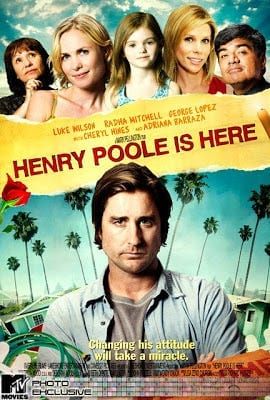
Our friend and entertainment journalist Lewis Beale is back — for previous posts, go here and here — with this article in the New York Daily News re the new movie Henry Poole Is Here:
In “Henry Poole Is Here,” opening Friday, a neighbor of the title character claims she has seen the apparition of Jesus’ face on the stucco wall of his Southern California ranch home.
It’s one of the more unique plot points in film history, and as Henry (Luke Wilson) grapples with the possibility that the mysterious vision is causing miracles, director Mark Pellington’s feature deals with an issue that Hollywood has almost completely abandoned: religious faith.
As Lewis points out in his article, movies in which religious faith play a central narrative role have seemingly fallen out of favor:
It wasn’t always this way, of course. Back in the day, studios churned out very specific, religious-themed films by the truckload. Whether it was pumped-up Cecil B. DeMille Bible epics like “The Ten Commandments,” humanistic entertainments set in religious communities (the Oscar-winning “Going My Way,” “The Nun’s Story”) or costume dramas about historical figures grappling with spiritual questions (“Becket,” “A Man for All Seasons”), the industry was not afraid to deal with the sacred.
But costume dramas eventually fell out of favor, and except for anomalies like Mel Gibson’s “The Passion of the Christ,” biblical films also became passé.
But what if we open up the language a bit and let it breathe? Secularized versions of themes like ‘redemption’ and ‘belief’ have been and still are present in Hwood movies. For instance, in The Silence of the Lambs (1991), the movie’s protagonist Clarice Starling (Jodie Foster) achieves a measure of ‘redemption’ for the childhood guilt that haunts her re her father’s murder by killing Buffalo Bill and saving his kidnap victim Catherine Martin. In Field of Dreams (1989), Ray Kinsella (Kevin Costner) chooses ‘belief’ over skepticism re the ethereal whispers he hears — “If you build it, he will come” — and transforms his farm’s cornfield into a baseball field, resulting in a reunion with the living ghost of his deceased father.
Henry Poole treads in more traditional religious waters. Here is the current IMDB plot summary. WARNING: PLOT SPOILERS AHEAD:
HENRY POOLE is HERE is a comedic drama about a disillusioned man who goes hiding in placid suburbia only to discover he cannot escape the forces of hope. Returning to the middleclass neighborhood where he grew up, Henry chooses to live in indulgent isolation. Real life, however, refuses to cooperate with his plans. Nosy neighbors interrupt him with curious visits and prying questions. Then the situation escalates as a stain on Henry’s stucco wall is seen to have miraculous powers. His last-ditch hideout becomes a shrine; his backyard turns into an arena for passionate debate about faith and destiny. Seeking anonymous oblivion, cynical Henry Poole instead finds himself right at the center of the human comedy. A modern-day fable, director Mark Pellington’s new film investigates the unexpected wonders of the everyday. A faithless man finds hope. A hopeless man finds love. Whether backyard miracles are real or triggered by hope and belief, their personal effects are permanent.
Given my background, I guess it’s no surprise that I’m excited to see Henry Poole. As I mentioned in an email to Lewis, some of my favorite stories involve the ‘saintly sinner’ dynamic, “The Power and the Glory” by Graham Greene atop the list. And the movie’s protagonist, played by Luke Wilson, looks to fill that role quite well. But one of the main points Lewis makes in his article, how religious movies tend to divide audiences, would seem to be in play with Henry. For instance, early voting on the movie at Box Office Mojo, even before it’s come out, is split evenly: 50% A, 50% F. And at Rotten Tomatoes, the movie currently rates a less-than-angelic 40%.
Well, you decide for yourself. Here is the trailer for Henry Poole Is Here.
And for further background, here is a New York Times article which focuses on the movie’s director Mark Pellington, how he used this movie to help cope with the sudden death of his wife four years ago.