Dispatch from The Quest: Rob Pilkington
Last week as we did here on GITS, the Quest writers focused on the subject of Scene. Today’s dispatch: Rob Pilkington on long scenes:
Whenever I start thinking about tackling a scene, I tend to think of it like a crime: get in and get out as soon as possible. This is particularly useful to me, as I know I tend to embellish, over-emphasize, and clutter scenes with details as I write. If I don’t dive in with an Inception-Snow-Level sense of urgency, I’m going to end up with a document that could crack pavement.
So I was pretty surprised to realize that when Scott had us reading about scenes last week, that many of my memorable favorites are actually pretty long. What’s the deal? Here are a few of them and why I discovered, despite their high page counts, these scenes work so well for me.
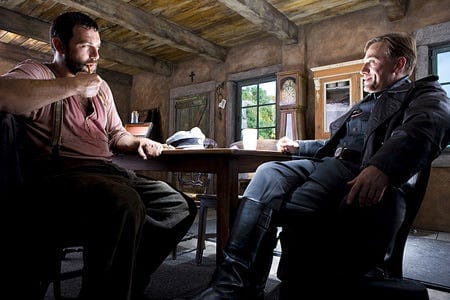
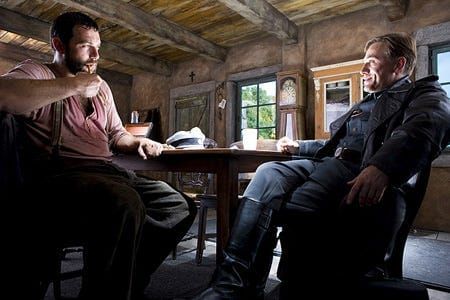
Opening scene from Inglorious Basterds
Written by: Quentin Tarantino
Oh man, can you think of a better opening scene that rocks as hard as this one? What blows me away about this is that it’s just sitting and talking — a pretty plain Jane scene premise us mere mortals try to avoid while writing. Unless of course you’re Tarantino, in which case, the sitting-and-talking thing is probably going to be freakin’ amazing. The characterization and slow, sadistic pacing are really tense here, with an assist from an oversized pipe and the scariest glass of milk in the history of cinema.
But the real key for me is how Tarantino rations information. It isn’t until we’re minutes and minutes deep until we know that the farmer IS actually hiding people in the basement (when we so hoped he wasn’t). Suddenly our worst fears are realized and we see actual dynamite at the end of this slow-burning fuse. Inglorious Basterds does it again and again, but never is it so terrifying, or drawn out, than in this first tortuous scene.
Harry’s Call from In Bruges
Written by: Martin McDonagh
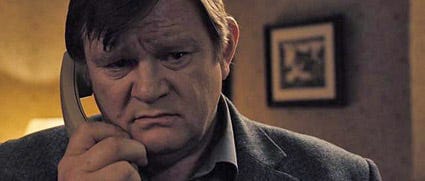
Along with sitting-and-talking, another general no-no is lean on a phone conversation, which is what McDonagh does here in this early scene in In Bruges where Ken finally gets a call from his boss and long-time friend Harry Waters. Harry is the nemesis of In Bruges, but only actually appears late in the film. This is the first time we hear his voice. And he swears a lot, so it’s awesome.
Much like the Basterds opening, this scene is careful not to show its hand too quickly. Harry pushes two major talking points early in the scene: Make sure Ray (Farrell) isn’t around and how could Ray not love Bruges? Why? Because Bruges is the last place Ray is ever going to see. What first appears as a rambling, irreverent scene instantly gets tied all together in one line of dialogue — Harry’s only had one thing on his mind this whole time. Add the claustrophobia and rising tension it all adds as one long take, and we got a winning scene we never even notice taking the scenic route.
Britt vs. Kato in The Green Hornet
Written by: Seth Rogan & Evan Goldberg
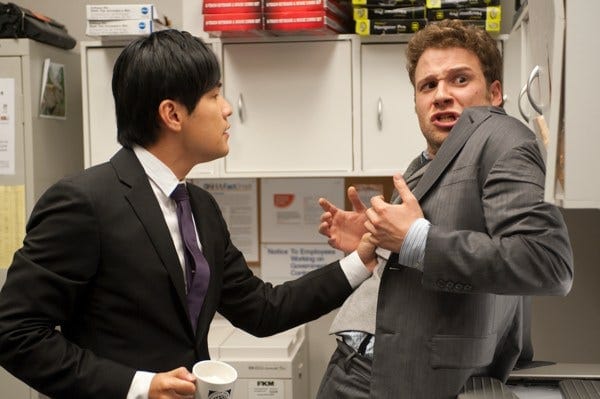
Since I’m apparently the only person in the world who thought The Green Hornet was great, I’m going to continue to bang drums and blow horns about it (I will die on this hill!). Its long scene is actually a fight scene — first arguing and then fisticuffs. After the duo’s first major defeat, they arrive home, tails between their legs, and are quick to blame each other. Soon, girls and manhood come into question and dukes get raised.
Most of this scene plays as a slapstick bulldozer ride through Britt’s (Rogan’s) mansion bachelor pad, but as I watch it more and more, I see that the visuals actually remind us that even though we start to sympathize with Britt as takes a beating from Kato’s Kung Fu, he’s still an insufferable douche that needs to grow up. There’s something really satisfying about seeing a 30-something get smashed over the head with his own Guitar Hero set. CATHARSIS.
So there it is: three really long scenes that break the rules and still stand on their own feet. The important realization for me is that they do it via the same principles I try for in every scene, no matter what the length or position in the story: strong characterization, pacing out the reveals and payoffs, and really pumping the visual end of things. In some cases, it might take up a little more page real estate than you want, but as long as it’s fertile ground, the pages should keep turning.
*Come to think of it there are several scary [glasses of milk] in film.
[Weird].
One of the first things I told the Questers when we started our journey together: There is no right way to write a script. However if you feel inclined to write a long scene, you had better damn well have a legitimate rationale for it, structurally, thematically and aesthetically. The simple fact is most scenes are between 1–3 pages in length. Professional script readers are attuned to this rhythm. But if you really feel the need to drop in a 5 page scene, a 7 page scene, or more, and you believe in your heart of hearts that it works, you can go for it. Just make sure you’ve gotten in touch with your inner Tarantino when you write it.
Next week: More Dispatches from The Quest.
About Rob: Boston writer headed for LA. Lover of Kubrick, Nolan, McDonagh, and the Coens. Okay, good talk. Back to writing. Twitter: @HeroesAreBoring.
Note for the record: Rob has now officially moved to L.A.
Comment Archive