Explore your characters’ world view and philosophy
Once again, the conversation in one of my Screenwriting Master Class sessions has spawned some terrific insights into the craft of writing. The current course is the Coen Brothers and the Craft of Storytelling and it’s an excellent group from Iceland, Belgium, France, England, and all across North America. Plus many of them who work in the entertainment industry in a variety of positions, a nice mix of pros and non-pros.
Anyhow in addition to my seven written lectures, I also provide six story-crafting tips I’ve derived from watching the Coen brothers movies time and time again. Yesterday’s tip: Life Philosophy. Here is my post:
One of the recurring motifs in Coen brothers movies is a character pontificating about life. Here are a few examples:
“The world is full o’ complainers. An’ the fact is, nothin’ comes with a guarantee. Now I don’t care if you’re the pope of Rome, President of the United States or Man of the Year; somethin’ can all go wrong. Now go on ahead, y’know, complain, tell your problems to your neighbor, ask for help, ‘n watch him fly. Now, in Russia, they got it mapped out so that everyone pulls for everyone else… that’s the theory, anyway. But what I know about is Texas, an’ down here…you’re on your own.”
— Private Detective Visser (Blood Simple)
“It’s gettin’ so a businessman can’t expect no return from a fixed fight. Now, if you can’t trust a fix, what can you trust? For a good return, you gotta go bettin’ on chance — and then you’re back with anarchy, right back in the jungle.”
— Johnny Caspar (Miller’s Crossing)
“What you got ain’t nothin’ new. This country is hard on people. Hard and crazy. Got the devil in it yet folks never seem to hold it to account. You’re discouraged. You can’t stop what’s comin. Ain’t all waitin’ on you. That’s vanity.”
— Ellis (No Country for Old Men)
“But maybe can I share something with you? Because I too have had the feeling of losing track of Hashem, which is the problem here. I too have forgotten how to see Him in the world. And when that happens you think, well, if I can’t see Him, He isn’t there any more, He’s gone. But that’s not the case. You just need to remember how to see Him. Am I right? I mean, the parking lot here. Not much to see. But if you imagine yourself a visitor, somebody who isn’t familiar with these. . . autos and such. . . somebody still with a capacity for wonder. . . Someone with a fresh. . . perspective. That’s what it is, Larry. Because with the right perspective you can see Hashem, you know, reaching into the world.”
— Rabbi Scott (A Serious Man)
Perhaps it shouldn’t be surprising, these thoughtful musings of characters in Coen brothers movies seeing as Ethan was a philosophy major at Princeton.
The Coens being who they are can get away with this sort of thing. But what about us? Can we afford to insert sides of dialogue featuring life-philosophy? Wouldn’t we run the risk of slowing down the story’s momentum and lessening the entertainment of our story?
That’s too broad of a question to answer yes or no. The larger consideration is this: Make sure your characters have a world view. Expressed or not, they should have their own take on reality, why we’re here, what life is all about.
If nothing else as a development exercise, why not sit down with one or more of your characters, and ask them to summarize their take on life. Allow them to do a monologue akin to one of the dialogue sides featured above.
The exercise may very well help you zero in on the core of your characters. Moreover you may surface some interesting lines and thoughts you can use with dialogue in the script.
You may find yourself having a character donning a mentor mask and verbalizing their perception of the meaning of life. Or you may simply use life philosophy as a means to understand your characters better.
In either case, make sure you spend time delving into how your characters view the world.
One of the class participants Marija wrote this:
I like asking my characters specific questions when getting to know them in the development stage, questions that center on the themes/situations of my story. It helps with dialogue and also how they would act (or not) in this or that scene. I did include a life philosophy monologue in the first draft of a script I finished two days ago. It’s still too “on the nose” so I highlighted it in red because I thought that I might have to get rid of it altogether but I realize now that it only needs to be reworked.
It’s so much about not being afraid to tap into the heart of both story and characters, isn’t it? I find that, strangely, we sometimes hold back when we should just let go, at least in a first draft. Or maybe that’s just me… :)
My response:
First off, Marija, I think it’s great for you to engage your characters at the level of their philosophy. Much of the character work we do mimics some of the questions and areas of focus actors have. What question do we always associate with actors: What’s my motivation? Well, as part of that response, we have to consider the character’s world view, as well as a host of other factors. But their philosophy is an important component in understanding a characters as that represents in many ways the aggregation of a lot of other defining factors.
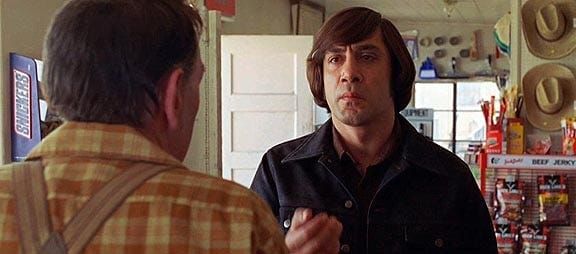
As to whether to include a monologue which conveys a characters philosophy or not, there are no rules about this type of thing. I just screened the movie Network last night with my college students. Howard Beale’s monologues on TV? Each one of them is a reflection of his philosophy, at least as it is shaped by motivating factors (e.g., his depression, then a vision from ‘god’, then a sales pitch by Arthur Jensen). In No Country for Old Men, Chigurh articulates his life philosophy specific to his take on fate and fairness over and over again as with the gas station proprietor:
Anton Chigurh: You need to call it. I can’t call it for you. It wouldn’t be fair.
Gas Station Proprietor: I didn’t put nothin’ up.
Anton Chigurh: Yes, you did. You’ve been putting it up your whole life you just didn’t know it. You know what date is on this coin?
Gas Station Proprietor: No.
Anton Chigurh: 1958. It’s been traveling twenty-two years to get here. And now it’s here. And it’s either heads or tails. And you have to say. Call it.
In other stories, maybe a monologue or dialogue-driven articulation of a character’s philosophy would not work.
Certainly in your prep-work you want to explore this area with every single one of your characters. And feel free to do so in dialogue in a first draft, which I look at as a journey of discovery.
But one thing is certain: Every character has had enough life-experience to develop a world view. If a writer doesn’t know it, they haven’t dug deep enough… and need to do more character work.
Then another class member Alan weighed in:
I like this idea for an exercise.
If nothing else as a development exercise, why not sit down with one or more of your characters, and ask them to summarize their take on life.
I did something similar in class for my current script (a journal entry), though I never went back to it once I got caught up in the writing. This exercise even goes a little further and makes me realize that my protagonist does in fact have a life philosophy that I haven’t really incorporated too much — either directly or indirectly. Will definitely have to work on that.
Thanks for the helpful idea!
My response:
Alan, a journal entry is a great idea for a character development tool. In the Prep workshop I teach, I encourage writers to do any of a host of character-interaction exercises:
* Interviews: Third person or better yet, first person. Imagine a scenario such as a news reporter interviewing a subject; an employer interviewing an applicant; a therapist in a session with a client; a cop interrogating a suspect.
* Monologue: Get into the mind-space of a character, then type or write down whatever dialogue, thoughts, impressions emerge.
* Sit-Down: Get into the mind-space of a character, close your eyes, then type everything that flits through your mind, always trying to zero in on what the character is feeling, thinking, etc.
A journal entry is a terrific example of a interaction exercise, especially because it’s in the first person voice. There’s a host of stuff that can surface from these exercises and the character’s world view / philosophy is one of them. See my comments to Marija in this thread for more on the subject.
Every character has a world view. Every character has a life philosophy, no matter how well or ill-formed. This is part of the work we must do in order to understand our characters — their personalities, motivations, and goals.
Takeaway: Do some interactive writing exercises with your story’s key characters where you zero in on what they believe, why they believe it, and how they see the world. Whether it’s an interview, monologue, sit-down, or journal entry, engage your characters in a dialogue. Learn what makes them tick… and why.
If you want to upgrade your skills at developing characters, I’ve got just the class for you: Character Development Keys. Starts Monday, March 30. Check it out here.
Comment Archive