Flight 1549
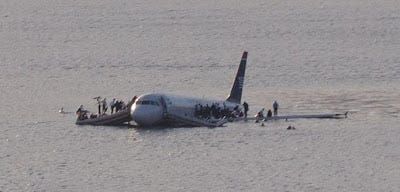
I had lunch today with David Sontag, who heads up the Writing for Screen and Stage program at UNC-Chapel Hill. As it turns out, David was a passenger on Flight 1549. Yes, that flight, the one that landed in the Hudson River. He, along with other passengers and crew members, have made the media rounds including “Good Morning America,” “The Today Show,” and “60 Minutes,” but David was kind enough to go through the whole incredible saga again with me.
Here’s a couple of points that I didn’t know. First, when the plane hits the geese and lost both engines, they had climbed to only 2,200 feet. That gave the pilot hardly any breathing room for error. Second, they have done some subsequent calculations re the plane’s air speed at the time it lost power to both engines, its weight, and the distance from the proposed alternative landing site Teterboro Airport in New Jersey, and determined that the plane would have crashed well short of that destination. So the pilot’s decision (Captain Chesley Sullenberger) turns out to be the only one that could have succeeded.
David also told me something interesting: The plane was equipped not only with an auxiliary power unit, it also had what is called a “ram air turbine” which can be deployed into the airstream to provide backup hydraulic pressure and electrical power in the event the plane loses primary power. Both the APU and RAT were in use as Sullenberger guided Flight 1549 for eight miles to its ditch landing in the Hudson River.
The UK outfit Channel 4 has created a 1-hour documentary about Flight 1549 and it debuts in the U.S. tonight on Discovery tonight at 10PM EST. But for a more personal look at the event, check out David Sontag’s appearance here on the NPR radio show “The Story.” As it turns out, David was on the US Air flight returning from his brother’s funeral. Some words David shared as part of his brother’s eulogy came to have prophetic meaning in light of the events of Flight 1549.
Comment Archive