“Follow your bliss” & the Protagonist’s transformation
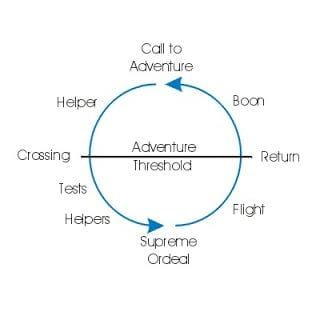
I just posted this on the online site of the course I’m currently teaching “Character Archetypes.” We’ve engaged in a fair amount of discussion about Joseph Campbell and a student posted something with his famous quote, “Follow your bliss.” Here’s my response which I tied into screenwriting:
“Follow your bliss.” That’s what Campbell claimed was the ‘theme’ or ‘message’ of The Hero’s Journey — to find that thing within in us that enlivens us, inspires us. Because that’s what we should be doing. How simple, right? And yet, how easy it is to get off track and create a life far removed from the things we truly love.
And right there, you have the plight of the Protagonist in Act I, their Disunity state. They are separated from their bliss. In a way, the entire point of the journey that follows in Act II and Act III is to punch through all the defense mechanisms, coping skills, and all the rest the P has developed to live their flawed life in order to drive the P deeper into their ‘self,’ where lo and behold, there’s this bliss state that’s been sitting fallow all these years. In Act II, P starts to tap into that bliss ‘stuff,’ then begins the Reconstruction process building on this new foundation, even if the ‘stuff’ is quite old, been a part of the P’s being for years. They reconnect with that part of their self that is alive and vital, and with that results newfound resources of power.
All that combined with what the P learns in the actions and events in the Plotline and the insights and understanding in the Themeline leads to the inevitable Final Struggle: if they win, they achieve Unity state.
The fundamentals of the Protagonist’s transformation arc is really quite simple if you frame the discussion with “follow your bliss.”