Go Into The Story Interview (Part 2): Katla Sólnes
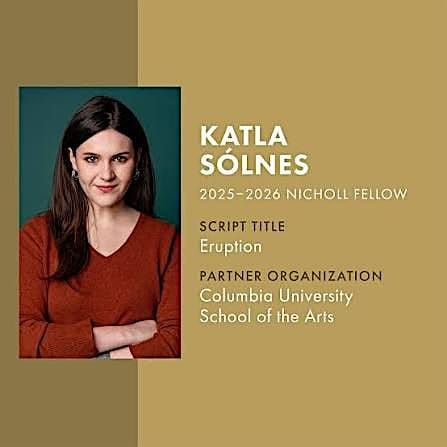
Katla Sólnes wrote the original screenplay Eruption which won a 2025-2026 Nicholl Fellowship in Screenwriting. I had an hour-long conversation with Katla exploring her creative background, analyzing her Nicholl-winning screenplay, and a discussion of key aspects of the screenwriting craft.
Today in Part 2, Katla talks about the origin for her screenplay Eruption and two of the script's lead characters.
Scott: Your script Eruption won the Nicholl Fellowship in 2026, but you worked on it as a Sundance Screenwriter Lab Fellow in '25, Hampton Screenwriter Lab Fellow '26. Has it evolved through the various writer labs?
Katla: Yeah. The story for Eruption I'd had for years and years before I went to grad school. I love 19th and 20th century literature and often these sorts of stories are of just a few people out in some kind of adventure. I just find those very riveting.
So, I had the story tinkering around for a long while, and then I got a grant (The Alfred P. Sloan fellowship) my second year at Columbia. You send in a short treatment, and you have to write a script, then rewrite it. And, of course, like many overworked grad students. I didn't write it in time for the rewrite class and ended up writing the entire Eruption script over one weekend at the library. It was 168 pages long. It was feverish, it was regurgitating text without any kind of pause to think about what I was writing. That draft was a beast to read and thankfully not too many people had to delve into those very dark waters.
The first really huge step Eruption took was thanks to my mentor, a Professor at Columbia, Katherine Dieckman. Really got that script into shape. Then when I went to the Sundance lab, structurally I'd say it wasn't too different from the script that you've read, and the sort of big tent poles. There was a synergy there, but the character work was lacking, mostly due to the whirlwind of Grad School (and I usually had two or three jobs) and thus it was hard to find time to sit with the characters. At Sundance, where the mentors were just outrageously good, I was really challenged to delve deep into these characters. I, like all Nordic people, struggle with getting too emotional or personal, and of course when you're writing your characters, you have to be vulnerable. And the best way to access that vulnerability is to explore your own struggles through the characters.
Scott: This script is a character piece. It's fundamentally about three people.
Katla: Exactly.
Scott: Here's a logline as summarized by the Nicholl folks.
“In the highlands of 1970s Iceland, a geologist's wife finds her marriage tested when a wily American student arrives stirring tensions as volatile as the surrounding volcanic landscape.”
How did this assembly of characters emerge in your story-crafting process?
Katla: I remember struggling because I wanted the story to be period, and I had an idea what it was looking like, the physical environment, I had these vignettes in my mind. And I was thinking to myself, "I'd love for it to be a female protagonist." And at first, it was the student as the protagonist.
Scott: The American student.
Katla: Originally, it was just a straight love story between the professor and the student. And it was more something akin to Jane Eyre, and I just wasn't moved by either, or driven by it. I got a small grant from Iceland to go from idea to treatment. Which is a great grant that I don't think they do anymore. But it's very helpful for young screenwriters to get a tiny bit of money to spend time writing a treatment.
I remember I was thinking I'd love for it to be two women, but It would have been so historically inaccurate. It would have then almost verged on fantasy, this sort of great female professor of geology in Iceland, even though I love the image of that. And then it just came to me in a vision: “Obviously, we just have the professor married …" and thus it's the wife who’s the protagonist, the wife who is changed by the student, not the professor, and that's the central relationship.
That led to feverish treatment writing. It almost wrote itself. It suddenly made so much sense to me. I've always been super interested in these stories of women behind the scenes who do the work, part of the work, or the emotional work, or whatever that may be, who are then completely lost to time.
I all of a sudden felt like I knew them very well. I didn't want Kári, the professor, to just be this stone of a man. I wanted him to be human and have his own pathos and his own anxieties and of course with the wife's anxieties, Elín's, they were clear because you think, obviously, she's insecure towards a younger woman and the fact that the younger woman is more educated and possibly more intelligent than her. But then, once you delve deeper you find more and more about the characters. But I'd say that was that lightning flash and from that, the story really became what it is.
Scott: Let’s talk about the protagonist, Elín. She's mid-40s. Married to this famous professor. When we meet her at the beginning, how would you describe her?
Katla: She's very much a woman who is content and she doesn't dare dream for more. And this is a very intelligent, thoughtful, multi-talented woman who I think through her relationship with her husband actually feels that she's gotten to experience a lot of interesting things.
We find her ... and is she happy? No. But is she wanting more? I think she dares not yet when we meet her. She's reminiscent of many women of her era, but also especially in Iceland. Had she been born twenty years later (as Jane was) she’d have a completely different, freer, more exciting set of choices. Time has robbed her of something. What's very fascinating about Iceland is that currently, we rank number one in the gender index between men and women. So, she's emblematic of this sudden and miraculous change that happened just at around the point where the film is set.
Scott: In Hollywood, screenwriters are always asked, “Why are you doing this movie as a period piece?" In your story, it’s like second wave feminism… And I thought that was interesting because you've got this metaphor of volcanoes and tectonic plates. And when you say Elín's not happy, like she has tectonic plates grinding away psychologically, a volcano waiting to erupt.
Katla: Yeah, I'd say that’s a very apt characterization of her. And as you say, as we come to know her, it's clear that there's something bubbling underneath the surface. I don't think she's allowing, both metaphorically and, and then of course in the film, she's not allowing herself to consider change. She's very much living a life of quiet desperation.
Scott: Carl Jung talks about how the unconscious yearns to come into the light of consciousness. Elín has these tectonic plates, this lava she’s trying to bury…
Katla: Exactly. They're all, as we all do, burying things. And of course, we Nordics are world class at burying things. .
Scott: Elín’s married. She was like 19, I think, when she first started having this relationship with Kári. I thought this was interesting how you introduced this guy. From the script about the house the couple lives in:
“Each inch of the hallway wall is covered in a plethora of framed diplomas, images, newspaper articles, all emphasizing the successes and triumphs of a great man, renowned geologist Dr. Kári Carlson.”
So, this is a guy who’s in his 60s and lives on the laurels, yes?
Katla: So, where we meet Kári is he similarly has many things bubbling under and one of his primary anxieties is that he's realizing A, he's aging; B, he's recently injured himself, so the fact that they're even going into the field is not a wise choice for him to make. And this is a man who's always been this mountaineer scientist, so there's the physical ailment which impacts his sense of masculinity, his sense of mortality. But also, as we come to learn over the script, it's been a while since he released the book that people cared about. It's been a while since he's become a legend and not a man. Which is, I think, frightening.
That adds to his fear of death, fear of age, fear of irrelevancy, fear of emasculation. And they've been married for 20 years when we meet them, so the heat has left the relationship. Both of them in their own way are very much in need of a change.
Tomorrow in Part 3, Katla dives deeper into her Nicholl-winning screenplay Eruption as she talks about the third principal character in the story and dynamic tension between them all.
For Part 1 of the interview series, go here.
I have interviewed every Nicholl winner since 2012. You may read those interviews here: LINK.