Go Into The Story Interview (Part 2): Omar Al Dakheel and Elie El Choufany
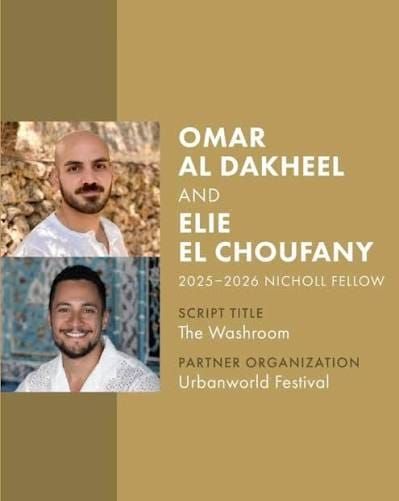
Omar Al Dakheel and Elie El Choufany wrote the original screenplay The Washroom which won a 2025-2026 Nicholl Fellowship in Screenwriting. I had an hour-long conversation with the pair exploring their creative backgrounds, analyzing their Nicholl-winning screenplay, and a discussion of key aspects of the screenwriting craft.
Today in Part 2, we discuss how the pair met and originated the idea for their screenplay The Washroom.
Scott: How did you two meet?
Elie: We actually had short films competing in the festival circuit, and we kept bumping into each other in different festivals. And it would be either my movie would win or his movie would win or my movie would win.
And we just kept bumping into each other over and over again. So, we ended up connecting and we realized that we actually live two blocks away from each other in LA. We started developing a relationship and decided to work together.
Omar: I just loved Elie's writing and the story that he wrote Towards the Sun and I remember seeing it at Austin Film Festival, and I it was very powerful. What I liked about it is it doesn't have a lot of dialogue, but it says so much visually, and that's the kind of storytelling I love.
And then after I did the shorts that I did at USC, Ablution, which is a little short about a Muslim father and his son, and it did really well in the festival, and I wanted to expand it. And then there was this thing, big thing in my community, the Muslim community, about burials, and, that my community was struggling to find plots, and I'm like, "Why?"
Then I dug into it, no pun intended, and I started researching it and learned about the difficulties some Muslim communities in America have faced trying to establish burial grounds that accommodate Islamic practices.
And Islamically, you have to bury right away. Basically like a green burial, no casket, no embalming. You bury right away and, you wash and you wrap the body. And Islamically it has to be facing Mecca. And the case that fascinated me was in Texas.
Now in the actual film, we do not talk about that specific town or anything because it is not just that town. When you do the research, it is in Virginia, it's in Ohio it's in many places. In Pennsylvania. It's in so many places where it's the Muslim community is working against the clock to bury, and they don't have place to bury because many American burial systems and practices weren't designed with Islamic burial traditions in mind.
Even though in the Constitution there's freedom of religion and supposedly should be everybody, practice their rituals according to their own faith. I was fascinated. Then I was like, "Okay what if I combine these two?" But I didn't know. It was just an, a vague idea.
And then I was like, "Elie, wanna grab coffee?" And then it was like a brainstorming session. I was like, "There's these things that are happening," and Elie, was thrilled, and then we started writing.
We put pen to paper, and we're not going to show you the first draft because it was a big mess. But the characters and what we were trying to say was always the same.
Elie: We have, I think, dozens of drafts. At this point, we've been writing the story for, I think five years now. But I think what has always been clear to us is that this is a story about identity and about belonging and about what the meaning of home is. And what we really have been trying to do is tell a human story that transcends religion, that transcends culture even though it is set in a specific space with a specific culture and a specific religion, but it really speaks to human nature.
The idea has always been to put our lived experience. I grew up queer in Lebanon and, besides the war and everything, that was like an internal war happening in my life. Oh, and trying to translate that onto the page where hopefully we can, relate what it means to be yourself.
Like Omar was saying, like it is the hardest thing to do because it takes a lot of courage. And the process of finding yourself is a painful process. That's what has always been clear to us for The Washroom is how do we get Waleed to go through the process of finding himself in a community that asks him not to.
Scott: Let's jump into it. The Washroom, the script you wrote that you won the Nicholl on. Here's a logline.
"In a small Texas town, a young imam fights for his community's right to bury their dead while hiding a forbidden love that threatens to cost him everything."
I think, Omar, you were the one who discovered this storyline that was in Texas, is that right?
Omar: The burial story that first fascinated me was in Texas, and because I come from a documentary background, I started researching the issue more broadly. But we're not, again, we're not talking about that specific case. No. What fascinated me about Texas was that people were fighting over this small piece of land in a state with so much space.
I thought that was ironic, and I thought the same thing about places of worship that speak of mercy and compassion, where there can still be little room for queer love. To me, the story is about space physically and also spiritually, metaphorically.
Scott: When did the queer aspect of the story emerge? Was that right there from the beginning?
Omar: Yeah, the queer aspect was there from the beginning.
Elie and I sat down and, And again, I did a short called Ablution, which was a very a very a very early seed about this disabled Muslim father and his son is closeted, and he takes care of his father, but then the father finds out, and then he has to choose between his son or God.
But what if your son is the only way that you can worship God because of your disability? And so that was an early seed. Elie already knew about that short, and then I told him about the setting in Texas. And then we started brainstorming.
I was like, "Okay what if, the person actually fighting for this cemetery or, this piece of land is actually closeted Muslim man." So he's, he's fighting a battle from outside and inside. It's about belonging externally. Internally, it's about belonging in life and in death.
And also, like Elie said, it's also about home because the thing about cemeteries and burials, once you put a headstone, that's home. That's where the place you're connected. That's home. That's where your ancestors are. And when Muslim communities encounter resistance around something as fundamental as burial, it raises a much bigger question: are we being given the space to truly belong? Because once you bury your family somewhere, once you place a headstone there, you're saying: this is home.
So it becomes bigger than a dispute about things like drainage or land use. For us, it becomes a question of belonging.
Elie: I would also say on a writing level, we were both, wanting to write a story that scares us a little bit because there's the best stories are the stories that scare you because there's a level of vulnerability-.
In it that doesn't, that pushes you to face some of your own fears, some of your own experiences some of the stuff that has been holding you back. And we've had discussions about what it really means to write a story like this.
Like once, once it's out there, it's going to have an impact on both of our lives for sure.
So there, there is something to be said about again, it's, and now we are brave enough to be ourselves, and we need that extra bravery to write a story like this and set it to the world.
For Part 1, go here.
Tomorrow in Part 3, Omar, Elie, and I delve into the main character's in their Nicholl-winning script The Washroom.
I have interviewed every Nicholl winner since 2012. You may read those interviews here: LINK.