Go On Your Own Quest — Week 1: Plot
The 2013 iteration of The Quest begins this week! Later this afternoon, I will introduce the second of 6 writers who will be working with me in this unique program. Don’t let this opportunity pass you by because you can Go On Your Own Quest by following the structure of The Quest to dig into screenwriting theory [Core — 8 weeks], figure out your story [Prep — 6 weeks], and write a first draft [Pages — 10 weeks]. It’s a 24-week immersion in the screenwriting process and you can do it here — for free!
Plus you can join The Black Board, the Official Online Writing Community of the Black List and Go Into The Story, another free resource to help keep you inspired and on target at you Go On Your Own Quest from FADE IN to FADE OUT on the first draft of your original screenplay.
This week, we are reflecting on the subject of Plot, mirroring the content the Questers are engaged with in Core I: Plot, working through six lectures I have written building off the 1st Essential Screenwriting Principle: Plot = Structure.
We had an interesting start to our discussion Monday — you can see those comments from GITS readers and myself here. We began with two questions: (1) How would you define plot? (2) How is plot different in a screenplay compared to a novel? Tuesday the discussion was about screenplay paradigms. You can read that conversation here. Yesterday we considered the question, “How do you go about working on your screenplay’s plot?” You can read that discussion here.
Today another question:
- Index cards: Do you use them when plotting your story or not?
And before you answer, check this out.
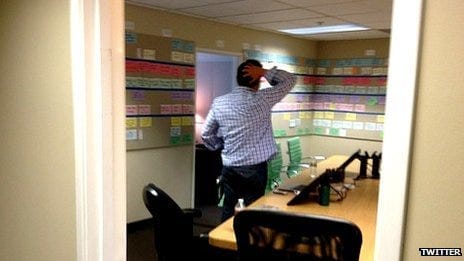
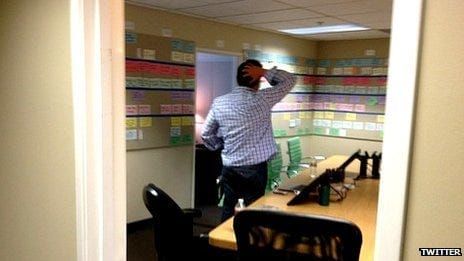
That’s the writer’s room for “Arrested Development”. And check this out:
You can listen to Vince Gilligan talk about “Breaking Bad,” but don’t gloss over the first set of images you see in this video. It’s index cards. Yes, in this day and age of super hi-tech everything, 3x5 inch index cards are still a staple of most professional writers.
I use them. After I brainstorm every scene I can think of for the plotline and subplots, I write each of them down onto individual index cards. If I know I need a bridge scene, but don’t know what it is, I write “Put bridge scene here” on a card. Then I create four stacks: Act I, Act II [first half], Act II [second half], Act III. Next it’s time shuffle and reshuffle the cards, testing out various arrangements of scenes. I spread them on the floor. I tack them up on the wall. I even use color-coded cards to represent different subplots, so I can see if I’m light here or back-to-back scenes there.
Do you use index cards?
I’ll see you in comments for your thoughts on this question and [hopefully] a discussion that will enlighten everyone about the subject of Plot.
If you’d like to access the same Core content as the writers participating in The Quest, I will be teaching Core I: Plot starting Monday, August 26.
Why wait? You can have immediate access to the content of all eight Core classes by signing up for The Core Package. This enables you to go through all of the Core lectures (48 total, each written by me), tips, techniques and optional writing exercises on a self-paced basis as well as take any of the 1-week classes as I offer them. Plus The Core Package offers a nearly 50% savings compared to if you took each Core class separately. For more information on this unique offer, go to Screenwriting Master Class.
Meanwhile I encourage you to head to comments to discuss today’s questions about Plot. And for a related discussion on The Black Board, check out these topics:
- Dr. Goodwrite or: how I learned to stop worrying and love the [index] card
- Dan Gordon’s pre-writing advice
Onward!
Comment Archive