Great Character: Dr. King Schultz (“Django Unchained”)
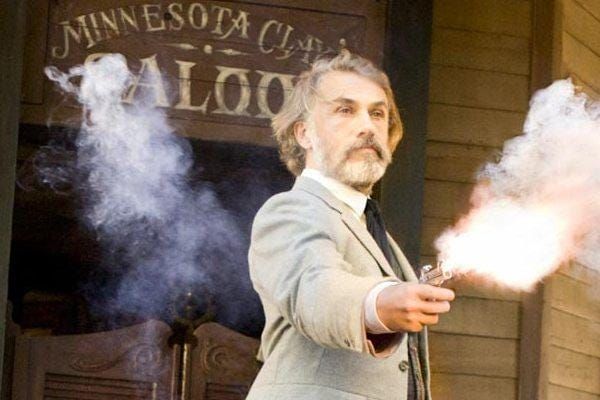
This month, the focus is on great characters from Quentin Tarantino movies. Today’s guest post by Jason Cuthbert features Dr. King Schultz from this year’s movie Django Unchained.
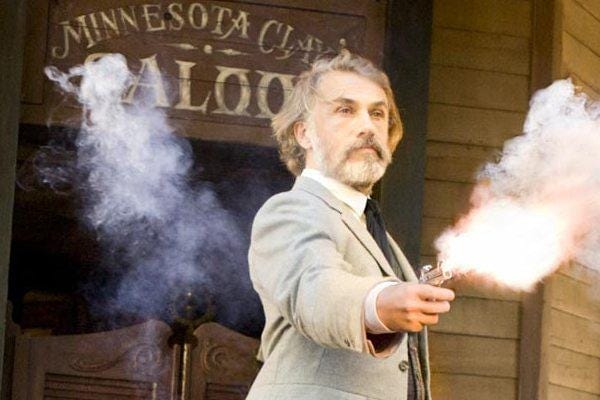
With Django Unchained, Quentin Tarantino has continued several of his tried and true traditions: sizzling dialogue that defines the story environment, genre homages (spaghetti western, blaxploitation), all-star casting (Jamie Foxx, Leonardo DiCaprio, Kerry Washington), career rebuilder casting (Don Johnson), comedian cameo casting (Jonah Hill), and Academy Award nomination casting — Christoph Waltz, returning from Tarantino’s Inglourious Basterds Oscar winning role as Col. Hans Landa. Waltz has now gone from Landa the Jew-killer to an Oscar-nominated spin as Dr. King Schultz, the slave-freer.
Dentistry may not be the usual career path that provides the background to becoming a pistol-packing bounty hunter. But in Tarantino Land, this style of unique back-story for German headhunter Dr. King Schultz is not only welcomed, but also refreshingly ironic — a guy going from a career of easing pain to causing pain. Quentin Tarantino has once again emerged as a visceral screenwriter and dynamic director of the ultimate revenge tales with Django Unchained, his most financially successful film ever — $366 million and counting. Tarantino and Waltz have already collected Golden Globes and BAFTA prizes for Django Unchained, thanks to the screenplay and the Dr. King Schultz role respectively — adding fuel to a strong fire that this duo can heat up the ballots in those categories again at the 85th Academy Awards ceremony on Sunday February 24th 2013.
Django Unchained plot summary from IMDB:
With the help of a German bounty hunter, a freed slave sets out to rescue his wife from a brutal Mississippi plantation owner.
From the moment Dr. King (as in Civil Rights Dr. Martin Luther King Jr.?) first rolls into the action in his “Dental Wagon”, complete with gigantic fake tooth, we realize we are in for a wild ride. This dapper chap out-dresses the slimy slavery overseers he confronts, has a vast vocabulary that they can’t translate, and a slick German accent that intimidates their casual cowboy pride. Furthermore, he is so comfortable in making them uncomfortable that their apprehension never dawns on him.
DR. KING SCHULTZ: My good man, did you simply get carried away with your dramatic gesture, or are you pointing your weapon at me with lethal intention?
Aside from the fact that the movie is not called “Schultz Unchained”, we are well aware that the good doctor is not the central protagonist. This sympathetic mentor buys Django’s freedom for admitted selfish reasons — to identify and help hunt down crooked characters that Dr. King has never laid eyes on. The appealing duality of this deadly man of dentistry is that his money-driven desires for freeing Django are never lost upon him. He is aware and openly admits it. But he also admits to being sickened by the concept of slavery and finds solace in the fact that his “flesh for cash business” differs from slavery in that he is not victimizing innocent people, but those that victimized others. He would just as soon see Django and every other slave set free.
DR. KING SCHULTZ: [to slaves] And in the odd chance there are any Astronomy aficionados amongst you the North Star is… that one.
Schultz is sly enough to lure his adversaries by embracing and showcasing the presumed spectacle of Django’s freedom in communities that are still rotting away with racism. This dangerous approach not only teaches Django the business but also establishes Schultz’s commitment to getting him acquainted with the world outside of the rigid repressive plantation structure.
Schultz’s bounty hunter training gradually outgrows his own exploitation of Django’s newfound freedom and evolves into genuine concern for Django’s post-bounty-hunting future. Once he realizes that Django has a wife still held captive in an ethically repugnant plantation, and she can speak his native German tongue no less, his true heart emerges. Sure, he could just continue to capitalize on Django’s unparalleled gun slinging marksmanship, making Django comparatively wealthy in the progress. But his character arc swings over from selfish to selfless — risking his life to assist the incredibly courageous Django who is willing to risk his new reality to rescue his beautiful bride Broomhilda.
After baring witness to inhumane profiteer Calvin Candie putting enslaved people in fights to the death, forced prostitution and to the hungry jaws of angry dogs — Schultz is more than ready to check out of Candyland. The true test of Schultz’s nature is that at any point he could have walked away from everything, no harm no foul. But the knowledge of knowing that this insufferable cycle of sickness would have continued on obviously would have ballooned into a regret so big his future would become unbearable.
DR. KING SCHULTZ: Normally, Monsieur Candie, I would say “Auf wiedersehen.” But since what “auf wiedersehen” actually means is “‘till I see you again”, and since I never wish to see you again, to you sir, I say, goodbye.
Although Candy and Schultz have the last face off, it is ultimately Django by himself who finally seals the deal on Broomhilda’s rescue mission, all alone, graduating from being Schultz’s prized student to an independently noble professor of self-sacrifice, with the greater good as his inspiration. Tarantino wisely gives Schultz the beginning half of the film to perform his “Yoda Jedi Training” and Django the latter half to emerge fully free, fully focused and fully unstoppable — exercising his civil rights in the face of uncivil circumstances.
For his unflappable nerve in the face of danger, capability to conjure up cunning capers and his desire to break the barbaric chains of oppression — Dr. King Schultz is an immensely GREAT CHARACTER.
See you in comments for your thoughts on Dr. King Schultz.
Thanks to Jason for the post. Next week we start a new month-long theme: Femme fatale.
Comment Archive