Great Character: Guido (“Life is Beautiful”)
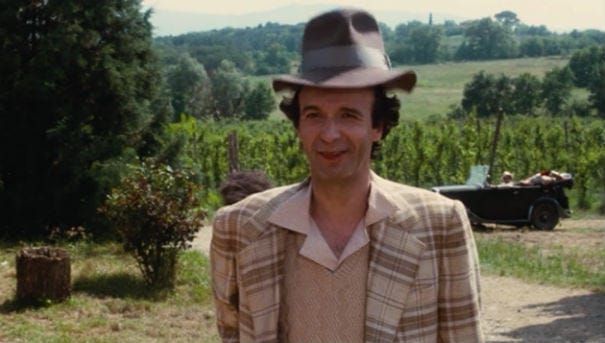
This month’s theme: Father figures. Today’s guest post by Jason Cuthbert features Guido from the 1997 movie Life Is Beautiful, written by Vincenzo Cerami and Roberto Benigni.
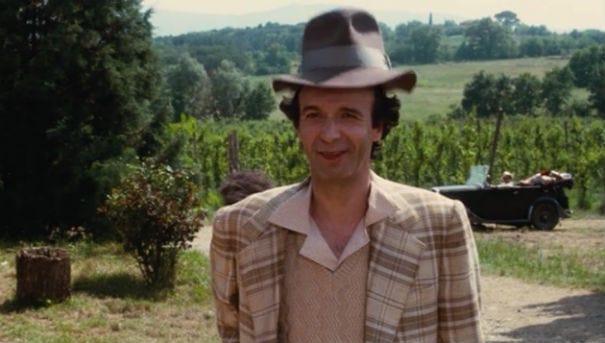
“Life is Beautiful,” or “La vita è bella” in its original Italian language, is a dynamic 1998 romantic comedy drama that follows the heart-warming and heart-breaking extents that a loving father goes to shield his young innocent son from the genocidal horrors of the German Nazi occupation and the demonic onslaught known as the Holocaust. Roberto Benigni, the highly engaging Italian actor, scriptwriter, and filmmaker stars as Guido, the perpetually smiling spark of life who’s ability to always look on the bright side illuminates the lives of every person he ever comes across — especially his son Joshua.
Roberto Benigni not only played center stage in the lead actor position, but he sat comfortably in the director’s chair and shared the screenwriter’s desk with Vincenzo Cerami. Life was definitely beautiful for “Life is Beautiful” at the box office with $229,163,264, and in the award category: three Academy Awards, Grand Prize of the Jury at the Cannes Film Festival, People’s Choice Award at the Toronto Film Festival, BAFTA Film Award, CFCA Award, Lumiere Award and two National Board of Review Awards as just the tip of this movie’s successful iceberg.
Life is Beautiful plot summary from IMDB:
A Jewish man has a wonderful romance with the help of his humor, but must use that same quality to protect his son in a Nazi death camp.
Guido is an Italian/Jewish father figure that treats his family like a treasured audience for him to entertain, inspire and to celebrate the world around them with. He loves stories, which we learn as he becomes a bookstore owner and through his spontaneously constructed exaggerations that repaint real life in more shiny and happy hues. Guido’s arrival into a new town may seem mundane on the outside looking in, but on the inside looking out — Guido feels like a prince relocating to his palace.
GUIDO: What kind of place is this? It’s beautiful: Pigeons fly, women fall from the sky! I’m moving here!
With enthusiasm as his paintbrush and unconditional love as his spectacular spectrum of paint, Guido can mutate anti-Semitic slurs used to weaken him into silly, goofy pranks that his young son Joshua doesn’t have to be afraid of. Although his “kill them with kindness” response to pure hatred may seem way too passive for adults who have suffered through such evil aggression, to Guido’s naive son, the sting of this unprovoked ignorance is being diluted and the safety of childhood is being preserved.
Guido continues to shelter Joshua from the evil that men do when he and his son are abducted and sent off to a concentration camp. His vast imagination continues to flourish and be challenged with harsher realities that he must struggle through to keep a level head and an unpolluted spirit about for the sake of his son’s sanity.
GUIDO: You can lose all your points for any one of three things. One: If you cry. Two: If you ask to see your mother. Three: If you’re hungry and ask for a snack! Forget it!
What makes Guido such an enduring and beautiful human being is that he refuses to let his inner frustrations and anger bubble up to the surface and sabotage his son’s piece of mind in such a horrid predicament. Never once does he complain or beg for mercy in the presence of Joshua. It is as if he has already accepted his fate, and is now dedicated to maintaining the best possible experience for Joshua, for however much time they may have left, by transforming their dark future into a game of hope.
If Joshua really knew that innocent people around him were being systematically murdered, and him, his mother and father were probably next, the devastating trauma of that massive nightmare would haunt his every waking hour. The unrelenting certainty of sudden death would make it impossible to eat, sleep, think or appreciate life. Inner peace is the priceless gift that Guido gave Joshua by bending the rotten truth until it became its polar opposite. Ignorance definitely becomes bliss.
GUIDO: [carrying his son through the camp] You are such a good boy. You sleep now. Dream sweet dreams. Maybe we are both dreaming. Maybe this is all a dream, and in the morning, Mommy will wake us up with milk and cookies. Then, after we eat, I will make love to her two or three times. If I can.
Guido succeeds in two of the unwritten laws of being the ideal parent: give your child opportunities to flourish and keep them safe. Through this imaginary game, Guido is teaching his son to not quit (a fool-proof way to not fail) and to be self-reliant. Sure, he is misleading Joshua, but Guido understands the fragile nature of a child’s limited worldview.
For his noble self-sacrifice, his storytelling savvy, and his immaculate beauty radar, Guido is one easy-to-love GREAT CHARACTER.
At one level, we can look at Guido’s story as being about steadfastness, clinging to the game as a means to protect his son from the awful truth surrounding them and keeping him hidden. And so the fact he stays the course with such purposefulness throughout is one of the main thematic points: In the face of eventual annihilation, Guido persists. And so one could say his lack of an arc by maintaining his hopefulness is central to his character’s story.
But then I wonder if there is a subtle arc for his character as well. He begins a carefree fellow who fully enjoys his life, then thrust into in the concentration camp, Guido symbolically gives his fate over to his son by concocting the lie of the ‘game.’ Once begun, he has a choice every step of the way: To continue with the lie in order to protect his son or tell the truth and risk his son’s life. Guido persists with the lie, each time a selfless act. Then he takes the final step: With his death, he moves beyond symbolism to literally giving up his life for his son. If that is accurate, then not only does it suggest a character arc, it also speaks to a measure of growth on Guido’s part.
Thanks to Jason for yet another Great Character post. Join us in comments for a discussion of Guido in the movie Life is Beautiful.
Comment Archive