Great Character: Hanna (“Hanna”)
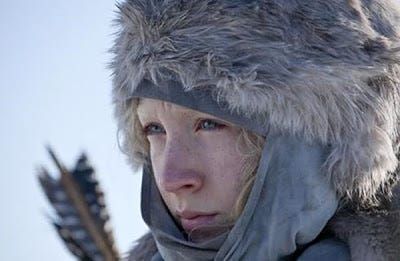
This month’s theme: Heroines. Today’s guest post by Jason Cuthbert features Hanna from the 2011 movie Hanna, screenplay by Seth Lochhead and David Farr, story by Seth Lochhead.
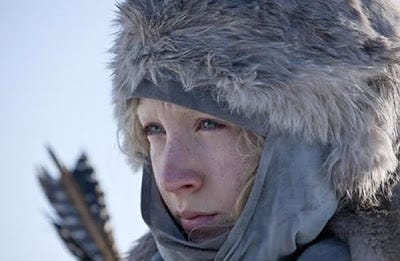
Canadian screenwriter Seth Lochhead, student of the esteemed Vancouver Film School’s Writing for Film & Television program, devised the original story of Hanna and crafted the script, which landed on story angel Franklin Leonard’s annual Hall of Fame for unproduced screenplays — the Black List — in 2006. During the following year, the Hanna project was nurtured further with a sale to Focus Features and eventually with Joe Wright (Pride & Prejudice, Atonement) directing and British theatre director/playwright David Farr providing rewrite duties. With a bold self-referential title named after its protagonist, Hanna emerged in 2011 as the story of a 16-year old girl who wasn’t a typical mall rat teenybopper or the hot unattainable high school “it” girl a la Molly Ringwald. Hanna was a trained killer.
Hanna plot summary from IMDB:
A sixteen-year-old girl who was raised by her father to be the perfect assassin is dispatched on a mission across Europe, tracked by a ruthless intelligence agent and her operatives.
Irish actress Saoirse Ronan (The Lovely Bones, Byzantium) who embodied the teen war machine Hanna successfully entered into a complex pre-adult that had no mother to teach her womanhood. Hanna’s only growth was spurred on by an ex-C.I.A. agent father named Erik (Eric Bana), a lonely forest and a strict regimen of survival skills. While young ladies her age were probably shopping for over-priced shoes and going on awkward double dates at boy band concerts, Hanna was killing her meals, learning multiple languages, memorizing books and being deprived of every means of entertainment and technological advancement post-bow and arrow.
http://www.youtube.com/watch?v=LtGMFRPRh8o
If we were permitted access to craw into the numb chamber of Hanna’s manipulated memories, we would be cautiously creeping past thoughts that most of us take for granted like: “What is a boyfriend?” “How do families behave?” “Where do you go to make friends?” “Why do people want us dead?” Remember, Hanna has been raised around no women, no young gals or guys for that matter, no communal signs of civilization, only one man teaching her how to kill like he can.
HANNA: Adapt or die.
ERIK: Think on your feet.
HANNA: Even when I’m sleeping.
Even something as emotionally enticing and passionately fulfilling as a kiss between lovers is totally lost upon Hanna with her frozen development and severely engineered upbringing to blame. The only way that Hanna could even begin to quantify the total reaction of “lip-locking” is via the academic definition her father has forced her to commit to memory, with none of the goose bumps or rigorous heart-beat residual effects.
HANNA: Kissing requires a total of 34 facial muscles, and 112 postural muscles. The most important muscle involved is the orbicularis oris muscle, because it is used to pucker the lips.
The impending doom that awaits Hanna from beyond the boundaries of her serene and secluded surroundings is the equivalent of more fortunate modern children being groomed for college and a career. Her pubescent evolution is all leading towards the day that her father sets her off on a crash course to eviscerate the individuals hired to eliminate them. So much for a Sweet 16 birthday party or getting that first driver’s license. Hanna’s destiny has been written in advance in someone else’s handwriting and she will have to embark on its evil pre-plotted voyage before she can alter her future.
http://www.youtube.com/watch?v=Km71QCX39rQ
Hanna is not just another bloody bruiser of an action thriller. There is an eerie mutation of a fairy tale motif casting a surreal spell over this grim reality. Director Joe Wright has previously cited David Lynch, the filmmaking father of the sickness that lies beneath, as an influence over this mythic heroine’s premature “birth as an adult” into a world as foreign to her as the afterlife would be to the rest of us. She is like a naïve child with a dry sponge heart ready to get soaked, but with the physical reactions of a warrior twice her age. She can’t even begin to understand the magnitude of what has actually happened to her because she is just beginning to have other outside examples to compare her atypical life to.
SEBASTIAN: So Hanna, is your mum and Dad still together?
HANNA: My mother is dead.
SOPHIE: [to Sebastian] Nice one, Dad.
SEBASTIAN: I’m sorry to hear that. I lost my mum when I was very young, so…
HANNA: It’s all right. It happened a long time ago.
RACHEL: Hanna, what did your mum die of?
HANNA: Three bullets.
Hanna can wield weapons like she was being controlled by a video gamers joystick. Hanna can reciprocate pain right back to its heinous originators. That’s cool for the action sequences, but so can many of the world’s most famous heroines. It is the things that Hanna can’t do that place her in a private pantheon of the most intricate super women. She can’t feel love or remorse — but luckily her journey puts her on a craft course to experience these emotional instincts and awaken them from their smothered slumber.
For her uncanny hunter and gatherer meets martial arts expertise, for her trampoline of trauma that she struggles to jump off of and her desire to feel a connection to others, without having to kill them — Hanna is one ultra GREAT CHARACTER.
I am pleased to announce screenwriter Seth Lochhead has agreed to do an interview, so if you have any questions about Hanna, please post in comments.
Thanks once again, Jason, for a fine post. Please feel free to join Jason and me for more analysis of a compelling Protagonist figure.
Comment Archive