Great Character: John Bender (“The Breakfast Club”)
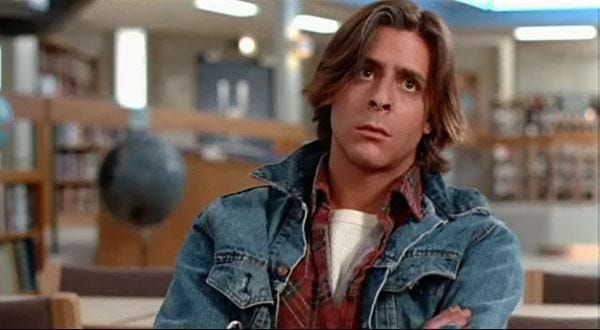
This month we are looking at memorable teenagers in John Hughes movies. Today guest poster Jason Cuthbert considers another iconic character from a Hughes’ film: John Bender from the 1985 movie The Breakfast Club.
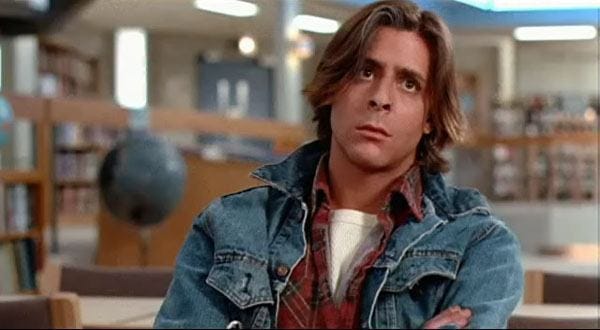
The year of 1985 was actor Judd Nelson’s breakthrough calendar. Nelson was in the Amblin Entertainment (Steven Spielberg, Kathleen Kennedy, Frank Marshall) production Fandango alongside the rising star of Kevin Costner. But there was also a remarkable pair of coming-of-age ensembles with fellow “Brat Packers” Emilio Estevez and Ally Sheedy that would provide a blueprint for Nelson’s powerful performances: the post-college romance St. Elmo’s Fire and John Hughes’ (screenwriter, director, producer) one location and one day contained seven character high school drama — The Breakfast Club.
Judd Nelson’s enraged rebel in The Breakfast Club John Bender smashes threw that somber Saturday morning detention like a bullet train without tracks. Without Bender, The Breakfast Club could have become The Knap Time Club, a whole lot of polite pleasantries and individually written essays. Bender’s black boots and overcoat are not accompanied by caring parents dropping Bender off at school, desires to convey compliments or any school spirit whatsoever. Instead, John Bender is an emotionally wounded brooding teenager blowing off steam, whether you lit the match or you are only trying to defuse his flammable temper.
JOHN BENDER: You couldn’t ignore me if you tried.
The Breakfast Club from IMDB:
Five high school students, all different stereotypes, meet in detention, where they pour their hearts out to each other, and discover how they have a lot more in common than they thought.
Let’s be honest, if the five Breakfast Club students were a sentence, four would be nouns and adjectives and John Bender would be the verb — the “action word.” His aggressive attitude raises the blood pressure of their babysitting adult supervision, turns their wide open door into a privately closed one, instigates the arguments, sends everyone high on a Cloud 9 of marijuana and creates a domino effect of brutal honesty.
JOHN BENDER: Screws fall out all the time, the world is an imperfect place.
But underneath Bender’s anarchy is an aching adolescent, self-aware of his roughneck reputation that prevents any projection of vulnerability. John Bender fights off urges to laugh or relate as much as he fights his peers and authority figures. But deep, deep, deep down, Bender wants acceptance, as any teenager craves. Whether Bender’s alienation is self-imposed or is enforced by other outside “cool kid” hierarchies, Bender is too proud to admit it bothers him.
http://www.youtube.com/watch?v=rnbDA4wKrg0
Claire (Molly RIngwald), the wealthy popular princess, is socially the polar opposite of John Bender’s abusive domestic doomsday experience. She represents everything in life that he feels he has been cheated out of. Claire’s diamond earrings, fancy sushi lunch, and her father’s BMW chariot are all targets for the fiercest effects of his rage, almost guilt-tripping her into asking him out on a date.
http://www.youtube.com/watch?v=jsZkkqLDFmg
Bender’s extremely gradual hidden attraction to Claire is the most precious buried treasure glistening underneath the gymnasium floor of The Breakfast Club. Their parents are in contrasting economic brackets. Their friends would irritate each other at first glance. Also, Bender’s “been there done all of that” demeanor is explicitly beyond Claire’s Disney World virginity.
But they could each offer a view into unexplored territory that their home lives have prevented them from being privy to. Bender’s projection of his own pain with his hurtful predictions of Claire growing up to be obese and his invented conclusions that they could never be friends reveals the social landmines he is detonating to kill their connection before Claire has the chance to potentially deny his desires for a relationship.
JOHN BENDER: You know how you said before, how your parents use you to get back at each other? Wouldn’t I be outstanding in that capacity?
Could Claire’s curious kisses create a revival in Bender’s self-esteem and hopes for his constantly damned future? Bender is a teen-aged self-fulfilling prophecy of every time he was told he had no value. Instead of pouring more petroleum on his blazing bitterness, Claire ultimately “attracts more bees with honey” and Bender lets down his guard long enough to turn it into a victorious fist in the sky. Detention becomes redemption.
For his pent-up pain, his cry-for-help rage and his need to be introduced to the healing power of love — John Bender is a GREAT CHARACTER in the incredible cannon of John Hughes teenagers.
One example of how enduring Hughes’ characters are: For his Halloween last year, my 13 year-old son went as Bender. He’s seen The Breakfast Club at least a half dozen times.
Almost all movies pose this question in some variation or another: Who are you? For adolescents, this is perhaps the most important dynamic at work in their lives, touching everything from personal appearance to sense of self to perception of their future. Hughes knew this. The Breakfast Club takes five types, puts them into a contained environment — it’s almost more like a play than a movie — and delves into each, Hughes doing so with courage, humor and honesty.
Any John Bender fans? Why not stop by comments and share your memories of seeing The Breakfast Club for the first time.
And a special music treat: “Don’t You Forget About Me” by Simple Minds accompanied by a nice compilation of visuals from the movie.
Thanks once again to Jason! You may follow him on Twitter: @A2Jason.
Comment Archive