Great Character: Malcolm X (“Malcolm X”)
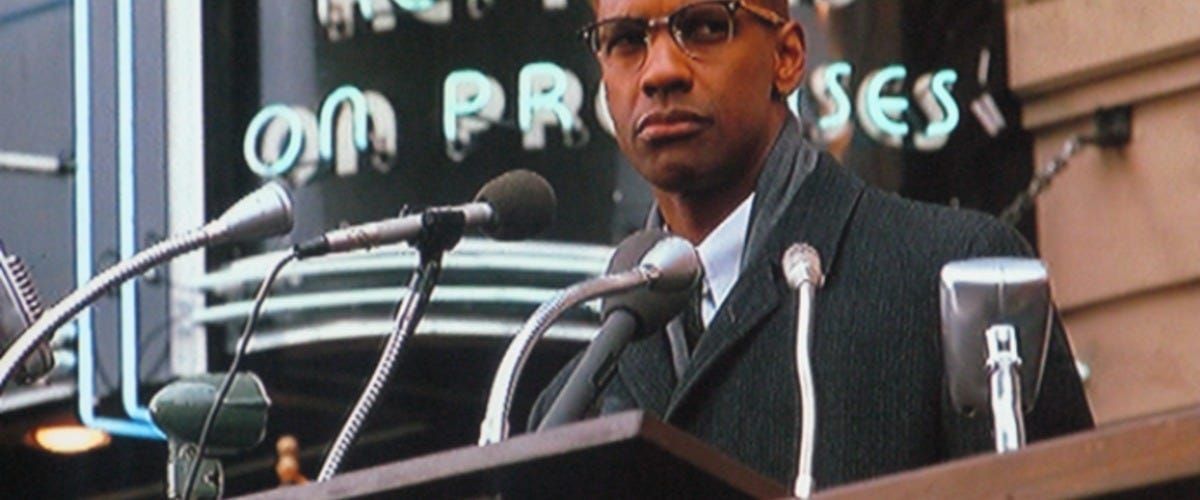
The Great Character theme for the month: Spike Lee. Today: Malcolm X from Malcolm X (1992), screenplay by Arnold Perl and Spike Lee, book by Alex Haley and Malcolm X. Here is Jason Cuthbert’s weekly Great Character post.
The long gestating biographical drama of the African American human rights activist and Muslim minister Malcolm X had plenty of complex obstacles on its complicated 25-year road to production and eventual release in 1992. It all begins with an early Malcolm X acquaintance Marvin Worth purchasing the rights to author Alex Haley’s The Autobiography of Malcolm X in 1967, two years after the bestseller’s publication and Malcolm’s assassination.
The first stop on the Malcolm X story arriving on screen came with the James Earl Jones and Ossie Davis-narrated 1972 documentary Malcolm X (1972), achieving an Academy Award nomination for Best Documentary Feature in the process. This documentary’s director Arnold Perl, along with the celebrated novelist James Baldwin, were commissioned in 1968 by Worth to craft the Malcolm X biopic script, adapted from Alex Haley’s book. Spike Lee eventually revamped the Baldwin/Perl script for his 1992 epic, with James Baldwin’s family asking that Baldwin’s name be removed.
There were previous incarnations of Malcolm X that involved legendary comedian Richard Pryor, director Sidney Lumet and Canadian director Norman Jewison (The Hurricane) was even in line to point cameras at Denzel Washington after their previous collaboration in A Soldier’s Story. Ultimately, the understandable demand for an African American to helm the transformative tale of this huge historical black leader put Spike Lee in the fold, with Denzel Washington representing the metamorphosis of Malcolm Little to “Detroit Red” to El-Hajj Malik El-Shabazz — better known as Malcolm X.
Malcolm X summary from IMDB:
Biographical epic of the controversial and influential Black Nationalist leader, from his early life and career as a small-time gangster, to his ministry as a member of the Nation of Islam.
Spike Lee’s Malcolm X roars onto the screen with an intense title sequence featuring a Malcolm X speech delivered by Denzel, overlapping an American flag burning into the letter X and contemporary videotape of the Rodney King beating by the Los Angeles police that ignited the 1992 L.A. Riots. These heart-wrenching interwoven comparisons of the discriminatory flames that engulfed race relations in the 1960s to those that are still raging in the 1990s intensifies even stronger when re-watching this sequence right now in 2015 and witnessing the deadly instances of police brutality that fuels the collective cry of “Black Lives Matter.”
MALCOLM X: We don’t see any American Dream. We’ve experienced only the American Nightmare!
We meet the young “Detroit Red” version of Malcolm in Boston, involved in behaviors he would grow to reject: crime, dating Caucasian women, straightening his hair in European fashion, drinking and struggling with drug use.
But we also are introduced to an even earlier time when Malcolm Little was in fact little, feeling the heat of hatred from the fire-breathing dragon known as racism.
MALCOLM X: When my mother was pregnant with me, a party of Klansmen on horseback surrounded our house in Omaha Nebraska. They brandished guns and shouted for my father to come out.
Malcolm Little witnessed his home purposely burned by bigotry and later had his Baptist minister father murderously yanked out of his life by the hands of the Ku Klux Klan. Young Malcolm persevered, showing early academic prowess indicated by his ability to thrive in an educational environment. But the harmful racial limitations for future job prospects attempted to push hope right out of the realm of his young mind.
MALCOLM X: The only colored kid in the class. I became sort of a mascot. Like a pink poodle. I was called a nigger so many times; I didn’t think there was anything wrong with it. I thought that was my name.
The Little Family unit was destroyed. Self-hatred was instilled by public perception that being a person of color was some kind of disease. Then the soul-crushing confinement of prison ruptures a hope for freedom — until Islam finds Malcolm. Spike Lee wisely plants many of these formative psychological seeds for the audience that eventually grow into Malcolm’s moral reform, and social responsibility to liberate his culture from the shackles of institutional hate. We get the full-fledged spectrum of Malcolm’s evolution; a man who has lived multiple lives in his 39 years, with each vividly unique version never big enough to completely define him.
MALCOLM X: We didn’t land on Plymouth Rock. Plymouth Rock landed on us!
We also get to experience the seismic power that Malcolm X exhibits with his passionate speeches, his intrinsic ability to inspire self-respect and his rise up the ranks of the Nation of Islam.
Unfortunately, Malcolm’s ambition for justice creates a multitude of enemy’s along the way — white and black alike.
Anxiety, distrust, overwhelming responsibility, fear for his family, the emergence of changing social views and a dark debilitating dread all radiate from Denzel Washington’s poignant and award-worthy presence of Malcolm in his last days. The booming voice is not even needed to indicate these conflicting emotions with Spike Lee’s captivating car ride of Malcolm as he unknowingly rides his Oldsmobile towards his unfortunate demise.
For his deep desire for personal and communal growth, for his confident and continual conviction, and for his embodiment of the classic Sam Cooke tune “A Change Is Gonna Come” — Malcolm X is a larger than life GREAT CHARACTER in Spike Lee’s illustrious 40 Acres and a Mule production house.
A special end note to this week’s Great Character post:
My name is Jason Cuthbert, a GoIntoTheStory.com contributor to GREAT CHARACTERS since June 8th 2012. I’m directing my very first feature length documentary entitled: “COLOURING BOOK: The Mixed Race Documentary” that compares diversity in the United States to Canada, through three generations of my own multicultural family. Academic experts and animated segments will be blended in to enhance the educational value of the core storyline. My team and I are currently raising funds at SeedandSpark.com to finance equipment for “COLOURING BOOK,” as well as future documentaries and scripted narratives. Any support would be incredibly appreciated.
CONTACT INFORMATION:
Website Link: http://www.colouringbook.info
Campaign Link: http://www.seedandspark.com/studio/colouring-book-productions
Jason’s Twitter Handle: @A2Jason
Colouring Book Twitter Handle: @ColouringBk
Here is the most recent news from Jason:
Our “Colouring Book” Seed & Spark Campaign made some AWESOME strides since we last spoke that I am excited to share with you:
1.) Karyn Parsons, the actress who played Hillary Banks on “The Fresh Prince of Bel-air” and is also of Mixed Heritage like I am, donated to our campaign today & tweeted it out to her 14,000+ followers. Super exciting moment!
2.) Marshon Thomas, an Associate Producer on Spike Lee’s most recent film “Da Sweet Blood of Jesus” donated today and has been very supportive of @ColouringBk on his 17,000+ Twitter timeline.
3.) We have raised the percentage of our goal that has been met into the double digits with 10%, $425 were raised Saturday alone.
4.) I was invited by a Twitter pal Shala Thomas and indie film advocate to do an interview on her blog: https://lifebetweenfilms.wordpress.com
There are at two damn good reasons to throw some support Jason’s way. First, this looks like a fascinating and worthy documentary. Second, a show of gratitude to Jason for his steadfast contributions to this blog and to the life of the online screenwriting community with his insightful weekly Great Character posts.
To contribute to Colouring Book, go here.