Great Character: Ralph (“Wreck-It Ralph”)
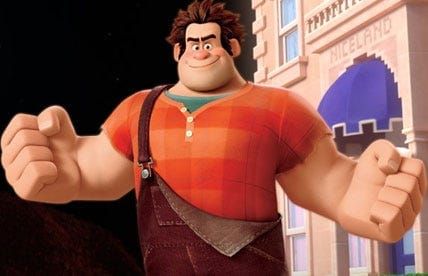
The Great Character theme for the month: Disney characters. Today: Ralph from 2012 movie Wreck-It Ralph. Here is Jason Cuthbert’s recurring guest post.
The Walt Disney storytelling empire has had wonderful success merging their own in-house properties with popular outside licensed characters. What the 1988 animated film Who Framed Roger Rabbit did for classic cartoons and the Toy Story movies did for timeless toy brands since 1995, Wreck-It Ralph did for nostalgic arcade video games in 2012. “Pac-man,” “Q*bert,” “Street Fighter,” “Sonic the Hedgehog” and “Tapper” interacted in a video game world also populated with invented Wreck-It Ralph joystick creations.
There are plenty of scene-stealing original gaming guys and gals inhabiting this arcade environment. There is the cold, blonde, hyper-violent female “Hero’s Duty” game soldier Sergeant Calhoun (voice: Jane Lynch), the super sweet, precocious youngster Vanellope (voice: Sarah Silverman) and crooked ruler King Candy (voice: Alan Tudyk) from the pastel-tinted candy-coated game “Sugar Rush,” and the “Fix-It Felix” Donkey Kong-inspired game characters: Felix (voice: Jack McBrayer) the good guy and Ralph (voice: John C. Reilly) the “bad guy” who longs to get some of that good guy shine.
Wreck-It Ralph plot summary from IMDB:
A video game villain wants to be a hero and sets out to fulfill his dream, but his quest brings havoc to the whole arcade where he lives.
Screenplay scribes and contributors Phil Johnston, Jim Reardon, Rich Moore (also director), Jennifer Lee, John C. Reilly, Sam J. Levin and Jared Stern have an intriguing character in Ralph, the mucho muscular, boulder-sized fist-having smasher in brown overalls. He may be the antagonist in his video game, but he is a dearly endearing protagonist in Wreck-It Ralph. He earns his sympathy instantly in the first few minutes of the film, seeking some self-esteem in a bad guy therapy session. This clever and comedic collection of evil arcade villains assures us that Wreck-it Ralph will not be a strictly kiddie affair.
Ralph lives alone, reluctantly, in an outdoor junkyard while every other character in his game gets to live inside a jazzy snazzy penthouse in a communal family atmosphere. No one throws parties or offers awards to the big hearted, heavy handed Ralph for his awkward demolition duties.
RALPH: The guy with the name Fix-It Felix is the good guy. He’s nice enough as good guys go. Definitely fixes stuff really well. But, uh, if you got a magic hammer from your father, how hard can it be? If he was a regular contractor, carpenter guy, I guarantee you; you will not be able to fix the damage that I do as quickly. When Felix does a good job, he gets a medal. But, are there metals for wrecking stuff really well? To that, I say, ha!
The action and adventure commence with Ralph taking a self-imposed hiatus from wrecking and commits himself to winning a prize metal of honor in another video game to prove the doubters in his own game wrong. But as this fish-out-of-water tale makes it’s big splash, Ralph learns that the 1980s innocence of Fix-It Felix is a rated G bubble gum playground compared to the gothic nightmare menace of contemporary gaming.
RALPH: (in the middle of “Hero’s Duty”) I thought this would be like “Centipede”! When did video games become so violent and scary? Just let me out of here, please!
“Sugar Rush” is the next recreational foreign territory that Ralph finds himself fending for himself in. This candy store crafted village is the polar opposite of the viciously volatile warzone of “Hero’s Duty,” but a surreal, oddly abstract Dr. Seus book of a world compared to his Atari-style home sweet home.
RALPH: What’s going on in this candy-coated heart of darkness?
In true “Beauty and the Beast” fashion, the Wreck-It man Ralph finds a miniscule side kick in Vanellope, an unsupervised orphan looking to become a race car phenomenon.
The complicated friendship between the mature Ralph and the adolescent Vanellope helps challenge his borderline selfish desire for achieving a reward to bring home and gain good guy acceptance. With his decisions revolving around his success, the needs of Vanellope become compromised when she feels like he is using her.
RALPH: (to Vanellope) Well, this may come as a shock to you, but in my game, I’m the bad guy, and I live in the garbage.
With King Candy standing between Ralph and Vanellope’s needs, the callous king also has a divide-and-conquer dilemma activated, pitting Ralph against Vanellope. With Ralph having to choose his loyalties just as he is get closer and closer to succeeding, we receive a much heightened sense of Ralph’s internal need for genuine companionship.
RALPH: Because if that little kid likes me, how bad can I be?
The metal that initially sets Ralph out on his conquest for acceptance proves to be the external journey that leads him directly into his emotional journey — being able to look himself in the mirror and feel proud.
RALPH: I’m bad, and that’s good! I will never be good, and that’s not bad! [He looks at the cookie medal Vanellope gave him: “YOU’RE MY HERO”] There’s no one I’d rather be… than me.
For his engaging loner/outsider struggle to overcome rejection, for his extreme make-over in nurturing his wrecked self-esteem and for his final exam in gaining friends, which is to be a friend worth gaining — Ralph is an incredibility GREAT CHARACTER in the extensive history of Disney Characters.
Thanks to Jason for sharing this analysis. You may follow him on Twitter: @A2Jason. And congratulations to Jason for getting a greenlight from Seed & Spark for his movie project COLOURING BOOK: The Mixed Race Documentary. Thanks to all who contributed to it!