Great Character: The Grinch (“How the Grinch Stole Christmas”)
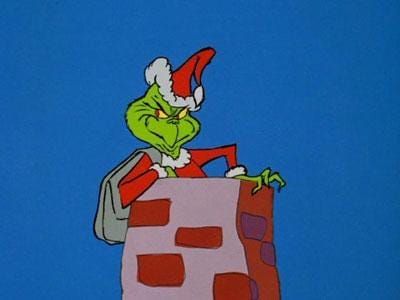
The Great Character theme for the month: Christmas characters. Today: The Grinch from How the Grinch Stole Christmas (2000), screenplay by Jeffrey Price and Peter S. Seaman, book by Dr. Seuss. Here is Jason Cuthbert’s weekly Great Character post:
Theodor Geisel, widely recognized as the PHD of children’s stories, Dr. Seus, wrote a timeless Christmas tale in 1957 in the form of a children’s book for Random House: How the Grinch Stole Christmas. The story of the green furred holiday hater called The Grinch also had his Christmas spirit resurrected in the women’s periodical Redbook during 1957 as well.
Taking the ever-growing commercialized superficiality of Christmas materialism to task, Dr. Seus’ reincarnation of Ebenezer Scrooge became his first villain-driven picture book, and even grew legs that crawled from the publishing world to prime time television via the 1966 animated Christmas classic How the Grinch Stole Christmas. The original Frankenstein’s monster himself Boris Karloff became the booming voice for the cartoon Grinch, while doubling up as the deep baritone narrator, with the Warner Brothers Bugs Bunny animator Chuck Jones handling the directorial duties.
But when The Grinch tackled it’s fourth media medium, from publishing, publication and television to motion pictures, it was A-List director Ron Howard (Splash, A Beautiful Mind) and the animation-savvy screenwriting team Jeffrey Price and Peter S. Seaman (Who Framed Roger Rabbit, Shrek the Third) that reinvented the Grinch for it’s year 2000 holiday release.
How the Grinch Stole Christmas from IMDB:
A creature is intent on stealing Christmas.
“What is The Grinch?” is a question Dr. Seus’ book answers as being a Christmas-loathing reclusive monster in desperate need of love to inflate his underdeveloped heart. But when we are reintroduced to The Grinch of the movie screen, played by the elastic physical humor champ Jim Carrey, the question that becomes more central to the story is “Why is The Grinch so grumpy?” Within it’s 104 minute running time, obviously longer than that of its 26 minute T.V. length, there is more backstory to expand our understanding of how one comes to hate a holiday that celebrates joy. For one, The Grinch lives in utter isolation with no one but his reluctantly loyal dog Max and the echo of his own cackling voice, in a heap of stinky sanitation ejected from happy-go-lucky Whoville.
THE GRINCH: What’s that stench? It’s fantastic.
As young Who’s go on a trespassing trek across The Grinch’s domain, he takes pride in scaring the yuletide smiles off of their ever-smirking Who faces. This establishes The Grinch’s primary motivation for smiling being making others sad and terrified, as well as his desire for attention within his self-imposed exile. But these two inspirations when intertwined lead to a propensity to disrupt the good nature of Whoville with problematic pranks and maniacal mayhem. The Grinch is not above exhaling his ghastly puke-green knock-out gas morning breath on an un-expecting Who salesman, wrapping up the sweet, innocent kiddie Cindy Lou Who into a packaged present and mixing up the Who’s mail with everything but merry Christmas cards.
THE GRINCH: [messing with peoples mail] Jury duty, jury duty, jury duty, black mail, pink slip, chain letter, eviction notice, jury duty.
But in an intriguing expositional twist, the movie version of The Grinch is also offered up in a flashback as a young fluffy green child, getting teased and discriminated against when he attempts to blend in with a rough shaving job and a homemade holiday present for his schoolyard crush Martha May Whovier. Kids can be cruel, and The Grinch’s grown-up sour apple sensibilities were clearly harvested into a rotten spoiled core with worms wiggling within.
http://www.youtube.com/watch?v=0lq1JIWQSlc
Maybe it’s the purity and unconditional affection that Cindy Lou delivers to The Grinch that begins his transformation into a more socially adjusted Grinch. It could be Cindy Lou coming to The Grinch’s defense in relentlessly singular fashion. But it could also be argued that Cindy Lou reminds The Grinch of himself, the younger version that was still nurtured with a kind giving heart until it was trampled at such a young age. Whatever side you identify with the most, The Grinch is unable to diminish her influence in his secluded existence and she plants the seeds that push him to attempt reconciliation with Whoville, until they upset him further. But even stealing their Christmas goodies proves to make The Grinch feel worse about himself than it does the Who’s Who of Whoville.
THE GRINCH: MAX. HELP ME… I’m FEELING.
http://www.youtube.com/watch?v=p8J-YmVs1j0
For his over-sized presence that is like the Darth Vader to Dr. Seus’ The Cat in the Hat, for his childlike need for attention and his ultimate recovery from his “holidaze” and hatred hangover — The Grinch is an unforgettably GREAT CHARACTER among a green and red legacy of Christmas characters.
Thanks, Jason, for a great analysis on a great character, as well as another year of your weekly contributions. Always insightful.
Please join us in comments to discuss How the Grinch Stole Christmas.
You may follow Jason on Twitter: @A2Jason.