Great Character: Thelma (“Thelma & Louise”)

Today’s Great Character post is a guest column from longtime GITS follower Jason Cuthbert.
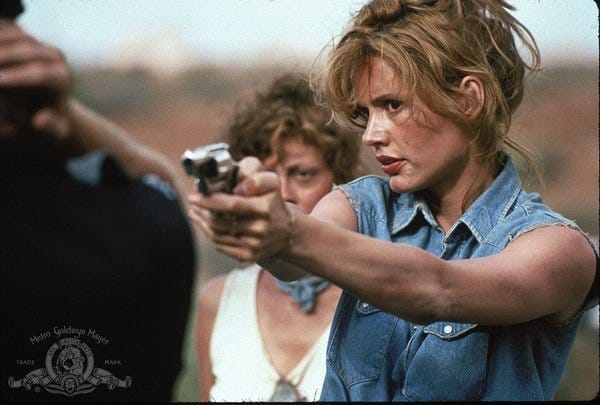
Up until the point when Thelma & Louise rolled out in 1991, most “road trip” and “buddy” movies involved a truck load of male odd couples — whether they were psychedelic stoners (Easy Rider), opposing sides of the law (Midnight Run), complete strangers (Plane, Trains and Automobiles) or musicians on a “mission from God” (The Blues Brothers).
Well, screenwriter Callie Khouri not only reversed the gender on those more predictable pairings with Thelma & Louise, but she also crowded her trophy cabinet with an Academy Award, a Golden Globe Award, a WGA Award and a PEN Center USA West Literary Award in the process.
Thelma & Louise plot summary from IMDB:
An Arkansas waitress and a housewife shoot a rapist and take off in a ’66 Thunderbird.
This Southern American duo consists of Louise, a jaded waitress played by Susan Sarandon and her ready to be freed from repression housewife friend Thelma, starring Geena Davis. Both of these feisty females shine like the glaring daylight blinding their sunglasses during their vacation gone wrong.
But it can be successfully argued that Thelma goes through the much bigger metamorphosis during their run from the law — and in Geena Davis’s capably hands, Thelma embodies a witty and unpredictable symbol of hope for all victims, whether male or female.
After Louise rescues Thelma with a loaded gun from being raped in a bar parking lot — and kills the guy — Thelma’s passive behavior begins to evaporate. This spunky transformation from voiceless follower to loud leader gives Thelma’s story more of a tangible thrust into the spotlight because Louise is already strong, street smart, assertive and organized — attributes Thelma must work really hard to earn.
Part of what makes Thelma so incredibly engaging is her bittersweet childlike naivety. You just want to hop right into the movie screen and protect her from all those cruel creepers that you know are just waiting to take advantage of her kindness. Especially Thelma’s verbally abusive control freak husband who is the only man she has ever been intimate with…well… prior to this road trip.
Thelma explains her Hubby’s stance on parenthood:
THELMA: Yeah, he says he’s not ready yet. He says he’s still too much of a kid himself. He kinda prides himself on being infantile.
LOUISE: He’s got a lot to be proud of.
THELMA: Louise and him don’t get along.
LOUISE: That’s putting it mildly.
THELMA: She thinks he’s a pig.
Thelma’s opinion of her Hubby’s appearance:
THELMA: You could park a car in the shadow of his ass.
Thelma on the thought of returning to her husband:
THELMA: But, umm, I don’t know, you know, something’s, like, crossed over in me and I can’t go back, I mean I just couldn’t live.
LOUISE: I know, I know what you mean. Anyway, don’t wanna end up on the damned Geraldo show.
Although Thelma starts off as the passive victim that Louise has to constantly play guardian over, these two ladies begin to switch roles when Louise’s stoic pride hits rock bottom after her savings are stolen and Thelma realizes that she has been allowing herself to be used and abused for far too long:
Thelma initially is the complete opposite of a gunslinger, and then…
Thelma becomes a protagonist that makes you completely rethink the overly convenient black and white differences between “good and bad” as well as “masculine and feminine” and repaint them with more varied shades of gray. Thelma’s choices may not be always be safe, wise or legal, but we are given plenty of reasons as to why she is embracing her sudden impulses. If you finally set a pet bird free from their cage — it is going to be a wild ride.
Thelma’s changes are just gradual enough to be completely believable and to not feel abruptly forced and contrived. After Thelma, demeaning adjectives for femininity such as “passive” and “submissive” should no longer apply. So for her brave leap into the unknown — and making us feel we are in the driver seat right along with her — Thelma is an extremely GREAT CHARACTER.
An additional thought: Thelma is a fantastic example of what Joseph Campbell says, “Become what you are.” She does through a profound metamorphosis, and there are certainly events in the External World that provoke and prod her to change, but the foundation, even the essence of that transformation comes from within. Otherwise the woman who is holding the gun in that photo up top, her metamorphosis from where she started to where she ends, it would not be credible. “I don’t remember feeling this awake,” a line Thelma says. That is an expression of her Inner Self emerging into her consciousness, her transformation taking root.
Thanks to Jason for this guest post. See you in comments to talk about Thelma & Louise.
Comment Archive