Great Character: Travis Bickle (“Taxi Driver”)
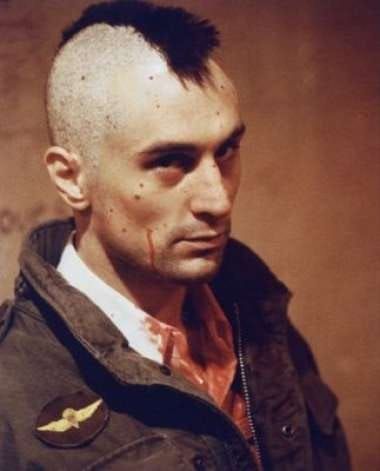
Note: Recently I asked if there were members of the GITS community who would like to participate with guest columns. Today’s Great Character post is provided by longtime GITS follower Jason Cuthbert.
Even in a dense metropolis like New York City, and working as a cab driver, where your job literally consists of filling your car with other people — Travis Bickle still considers himself to be “God’s lonely man” in the 1976 gothic thriller — Taxi Driver.
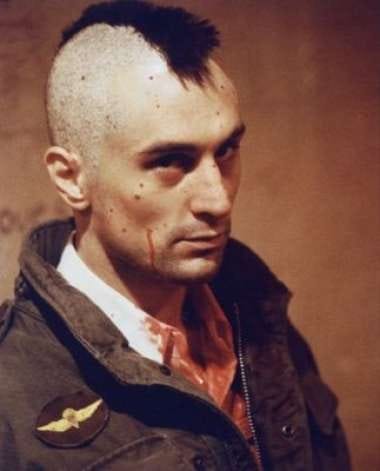
Written by the demigod screenwriter Paul Schrader, Taxi Driver was released in 1976. Actor Robert De Niro was just coming off of a stunning pair of critically-acclaimed supporting roles: his Academy Award-winning turn as the younger Marlon Brando — Vito Corleone — in The Godfather II and his first collaboration with Taxi Driver director Martin Scorsese as the hot-headed hustler Johnny Boy in Mean Streets. The socially sabotaged Travis Bickle became De Niro’s first home-run leading role — and still one of his best.
Taxi Driver plot summary from IMDB:
A mentally unstable Vietnam War veteran works as a nighttime taxi driver in New York City where the perceived decadence and sleaze feeds his urge to violently lash out, attempting to save a teenage prostitute in the process.
Travis Bickle is not some generic nut-job creepy creeper — this guy is equal parts protagonist and antagonist. In a cinematic apartheid of heroes and villains, Travis’ positive/negative duality is something most movie characters are never allowed to possess. This makes Bickle come even closer to the definition of a real human being — capable of good and evil depending on the circumstances.
Travis’ protective do-gooder intentions come across in these dynamic splashes of dialogue:
TRAVIS (V.O.): All my life needed was a sense of direction, a sense of someplace to go. I do not believe one should devote his life to morbid self-attention, but should become a person like other people.
Or…
TRAVIS: I think you’re a lonely person. I drive by this place a lot and I see you here. I see a lot of people around you. And I see all these phones and all this stuff on your desk. It means nothing. Then when I came inside and I met you, I saw in your eyes and I saw the way you carried yourself that you’re not a happy person. And I think you need something. And if you want to call it a friend, you can call it a friend.
The memorable moment of dialogue that merges Travis Bickle’s protagonist image with that of a sketchy antagonist is…
TRAVIS: The idea had been growing in my brain for some time: TRUE force. All the king’s men cannot put it back together again.
Now say hi to the good guy/bad guy…
When being a “hero” goes completely “villain”…
The genius stroke that screenwriter Paul Schrader brought to Travis Bickle is that there is zero spoon-fed sympathy. We are not forced to like Bickle — or even hate him. But Bickle’s unpredictable behavior makes him completely engaging.
Part of the excitement of seeing the world through the eyes of Travis Bickle is that he is full of unanswered questions:
1.) Why was Travis kicked out of the Marines during the Vietnam War?
2.) Why has porn become Travis’ substitute for a real girlfriend?
3.) Why is Travis in New York City? (he has no local friends or family)
4.) Why does Travis lie to his parents about his “success”?
5.) Are his parents even alive?
6.) What caused Travis’ contempt for people to outweigh his love for them?
Travis Bickle = One of the all time GREAT CHARACTERS.
Thanks, Jason, for your guest post on GITS. Please join Jason and myself in comments to discuss one of the most compelling and enigmatic characters in cinematic history: Travis Bickle.
Comment Archive