Great Scene: “Citizen Kane”
Enticing the reader into the story — it’s one of the most critical goals when writing the first few pages of a script. The opening of Citizen Kane achieves that goal by using mystery. Each shot takes us deeper and deeper into the deep, dark shadows of Xanadu, raising one question after another — whose place is this, what the hell happened here — leading eventually to… well, read the set of scenes and find out.
FADE IN:
EXT. XANADU — FAINT DAWN — 1940 (MINIATURE)
Window, very small in the distance, illuminated.
All around this is an almost totally black screen. Now, as
the camera moves slowly towards the window which is almost a
postage stamp in the frame, other forms appear; barbed wire,
cyclone fencing, and now, looming up against an early morning
sky, enormous iron grille work. Camera travels up what is now
shown to be a gateway of gigantic proportions and holds on the
top of it — a huge initial “K” showing darker and darker against
the dawn sky. Through this and beyond we see the fairy-tale
mountaintop of Xanadu, the great castle a sillhouette as its
summit, the little window a distant accent in the darkness.
DISSOLVE:
A SERIES OF SET -UPS, EACH CLOSER TO THE GREAT WINDOW, ALL
TELLING SOMETHING OF:
The literally incredible domain of CHARLES FOSTER KANE.
Its right flank resting for nearly forty miles on the Gulf
Coast, it truly extends in all directions farther than the eye
can see. Designed by nature to be almost completely bare and
flat — it was, as will develop, practically all marshland when
Kane acquired and changed its face — it is now pleasantly
uneven, with its fair share of rolling hills and one very good-
sized mountain, all man-made. Almost all the land is improved,
either through cultivation for farming purposes of through
careful landscaping, in the shape of parks and lakes. The
castle dominates itself, an enormous pile, compounded of several
genuine castles, of European origin, of varying architecture —
dominates the scene, from the very peak of the mountain.
DISSOLVE:
GOLF LINKS (MINIATURE)
Past which we move. The greens are straggly and overgrown,
the fairways wild with tropical weeds, the links unused and
not seriously tended for a long time.
DISSOLVE OUT:
DISSOLVE IN:
WHAT WAS ONCE A GOOD-SIZED ZOO (MINIATURE)
Of the Hagenbeck type. All that now remains, with one
exception, are the individual plots, surrounded by moats, on
which the animals are kept, free and yet safe from each other
and the landscape at large. (Signs on several of the plots
indicate that here there were once tigers, lions, girrafes.)
DISSOLVE:
THE MONKEY TERRACE (MINIATURE)
In the foreground, a great obscene ape is outlined against the
dawn murk. He is scratching himself slowly, thoughtfully,
looking out across the estates of Charles Foster Kane, to the
distant light glowing in the castle on the hill.
DISSOLVE:
THE ALLIGATOR PIT (MINIATURE)
The idiot pile of sleepy dragons. Reflected in the muddy water —
the lighted window.
THE LAGOON (MINIATURE)
The boat landing sags. An old newspaper floats on the surface
of the water — a copy of the New York Enquirer.” As it moves
across the frame, it discloses again the reflection of the
window in the castle, closer than before.
THE GREAT SWIMMING POOL (MINIATURE)
It is empty. A newspaper blows across the cracked floor of
the tank.
DISSOLVE:
THE COTTAGES (MINIATURE)
In the shadows, literally the shadows, of the castle. As we
move by, we see that their doors and windows are boarded up
and locked, with heavy bars as further protection and sealing.
DISSOLVE OUT:
DISSOLVE IN:
A DRAWBRIDGE (MINIATURE)
Over a wide moat, now stagnant and choked with weeds. We move
across it and through a huge solid gateway into a formal garden,
perhaps thirty yards wide and one hundred yards deep, which
extends right up to the very wall of the castle. The
landscaping surrounding it has been sloppy and causal for a
long time, but this particular garden has been kept up in
perfect shape. As the camera makes its way through it, towards
the lighted window of the castle, there are revealed rare and
exotic blooms of all kinds. The dominating note is one of
almost exaggerated tropical lushness, hanging limp and
despairing. Moss, moss, moss. Ankor Wat, the night the last
King died.
DISSOLVE:
THE WINDOW (MINIATURE)
Camera moves in until the frame of the window fills the frame
of the screen. Suddenly, the light within goes out. This
stops the action of the camera and cuts the music which has
been accompanying the sequence. In the glass panes of the
window, we see reflected the ripe, dreary landscape of Mr.
Kane’s estate behind and the dawn sky.
DISSOLVE:
INT. KANE’S BEDROOM — FAINT DAWN -
A very long shot of Kane’s enormous bed, silhouetted against
the enormous window.
DISSOLVE:
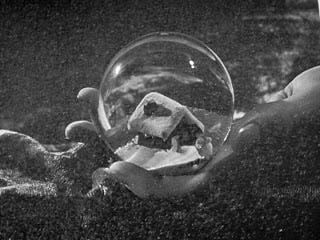
INT. KANE’S BEDROOM — FAINT DAWN — SNOW SCENE.
An incredible one. Big, impossible flakes of snow, a too
picturesque farmhouse and a snow man. The jingling of sleigh
bells in the musical score now makes an ironic reference to
Indian Temple bells — the music freezes -
KANE’S OLD OLD VOICE
Rosebud…
The camera pulls back, showing the whole scene to be contained
in one of those glass balls which are sold in novelty stores
all over the world. A hand — Kane’s hand, which has been
holding the ball, relaxes. The ball falls out of his hand and
bounds down two carpeted steps leading to the bed, the camera
following. The ball falls off the last step onto the marble
floor where it breaks, the fragments glittering in the first
rays of the morning sun. This ray cuts an angular pattern
across the floor, suddenly crossed with a thousand bars of
light as the blinds are pulled across the window.
The foot of Kane’s bed. The camera very close. Outlined
against the shuttered window, we can see a form — the form of
a nurse, as she pulls the sheet up over his head. The camera
follows this action up the length of the bed and arrives at
the face after the sheet has covered it.
FADE OUT:
Of course, Orson Welles is on record as saying that Rosebud was a “rather tawdry device,” but I beg to differ. Tracking the beginning of the script, one eerie shot after the other, ending with that single word of dialogue — “Rosebud” — and its speaker’s death, sucks the viewer into the story’s mystery.
Here’s the opening — the first three minutes and ten seconds of the video.
[Originally posted October 24, 2008]