Great Scene: “Sideways”
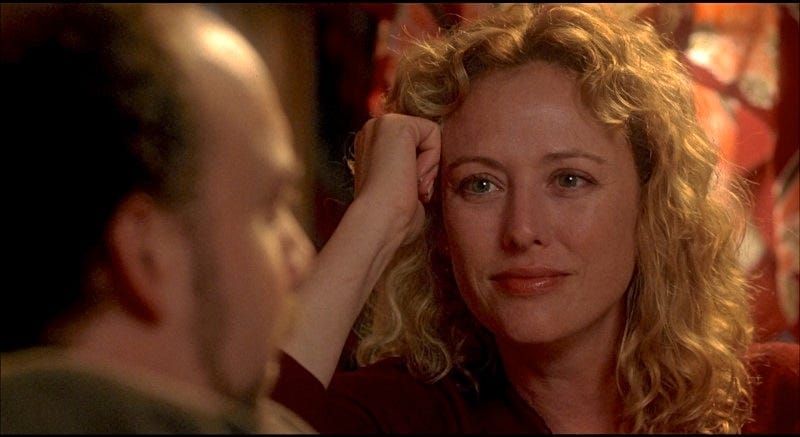
If one of my students can’t quite grasp the concept of “subtext,” often I’ll have them read this scene in the movie Sideways. Written by Alexander Payne and Jim Taylor (based on the novel by Rex Pickett), it’s a great script for many reasons, not the least of which is that Payne & Taylor make us care about Miles (Paul Giamatti), the story’s largely unlikeable protagonist.
In this scene, Miles and Maya (Virginia Madsen) have been sharing a few moments alone together. Up to this point, there have been some indirect ‘messages’ each has sent to the other signaling perhaps a mutual romantic interest. And then Maya asks a question:
MAYA
Why are you so into Pinot? It’s like
a thing with you.
Miles laughs at first, then smiles wistfully at the question.
He searches for the answer in his glass and begins slowly.
MILES
I don’t know. It’s a hard grape to
grow. As you know. It’s thin-skinned,
temperamental, ripens early. It’s
not a survivor like Cabernet that
can grow anywhere and thrive even
when neglected. Pinot needs constant
care and attention and in fact can
only grow in specific little tucked-
away corners of the world. And only
the most patient and nurturing growers
can do it really, can tap into Pinot’s
most fragile, delicate qualities.
Only when someone has taken the time
to truly understand its potential
can Pinot be coaxed into its fullest
expression. And when that happens,
its flavors are the most haunting
and brilliant and subtle and thrilling
and ancient on the planet.
Maya has found this answer revealing and moving.
MILES
I mean, Cabernets can be powerful
and exalting, but they seem prosaic
to me for some reason. By comparison.
How about you?
MAYA
What about me?
MILES
I don’t know. Why are you into wine?
MAYA
I suppose I got really into wine
originally through my ex-husband. He
had a big, kind of show-off cellar.
But then I found out that I have a
really sharp palate, and the more I
drank, the more I liked what it made
me think about.
MILES
Yeah? Like what?
MAYA
Like what a fraud he was.
Miles laughs.
MAYA
No, but I do like to think about the
life of wine, how it’s a living thing.
I like to think about what was going
on the year the grapes were growing,
how the sun was shining that summer
or if it rained… what the weather
was like. I think about all those
people who tended and picked the
grapes, and if it’s an old wine, how
many of them must be dead by now. I
love how wine continues to evolve,
how every time I open a bottle it’s
going to taste different than if I
had opened it on any other day.
Because a bottle of wine is actually
alive — it’s constantly evolving
and gaining complexity. That is,
until it peaks — like your ’61 —
and begins its steady, inevitable
decline. And it tastes so fucking
good.
Now it is Miles’s turn to be swept away. Maya’s face tells
us the moment is right, but Miles remains frozen. He needs
another sign, and Maya is bold enough to offer it: reaches
out and places one hand atop his.
MILES
(pointing)
Bathroom over there?
MAYA
Yeah.
Miles gets up and walks out. Maya sighs and gets and American
Spirit out of her purse.
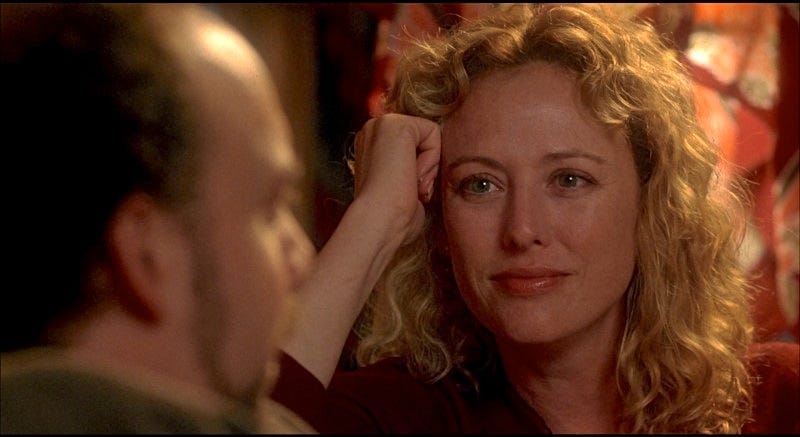
So what is Miles really talking about? In the External World of this screenplay universe, he’s talking about wine, but in the Internal World he’s talking about — himself. “Pinot needs constant care and attention… only the most patient and nurturing growers can do it… tap into Pinot’s most fragile, delicate qualities… only when someone has taken the time to truly understand its potential… coaxed into its fullest expression… the most haunting and brilliant and subtle and thrilling and ancient.” In that moment, this is Miles’ beatific expression of his own self-image, a misunderstood person, unappreciated novelist, and an unrequited romantic.
Now let’s look at Maya’s monologue to see who she’s really talking about: “It’s a living thing… continues to evolve… actually alive… constantly evolving, gaining complexity.” Again these words resonate about the speaker as Maya works as a waitress, however she’s evolving by taking college courses, learning about wine, and has aspirations about taking that up as a career.
In dialogue, subtext is where characters talk about Subject A (in the External World), but mean something about Subject B (in the Internal World). If you find your characters’ dialogue to be too ‘on-the-nose’ or play too much ‘up top’ in scenes, find something completely unrelated to what you want the characters to communicate — washing dishes, changing the oil in the car, playing golf. Give them some bit of business to do — then see what your characters do with that to communicate what they really mean to talk about.
Comment Archive