“Hollywood Should Make More, Not Fewer, Superhero Films”… NOT!
Here’s an article in The Atlantic with which I can safely say I completely disagree:
The rickety Amazing Spider-Man 2 has critics debating just how many superhero movies America can handle. This was the subject of Samuel Adams’s weekly survey at CriticWire, which led RogerEbert.com’s Matt Zoller Seitz to write a forceful essay declaring: “This genre is where imagination goes to drown itself.”
He levels many popular arguments against superhero movies, ranging from valid critique of some action cinematography to easy comparisons with junk food. But the fact that there are real criticisms to be made of the movies the genre has produced doesn’t mean there’s something wrong with the genre, or that we should expect it to peter out soon.
The truth is, there aren’t nearly enough superhero movies available. By historical standards, we’re so deprived of superhero movies that there’s probably a shadow war being fought between paranormal forces of good and evil over the matter.
Here’s what I mean. Seitz smartly compares superhero flicks to other genre fare, like Hollywood westerns and zombie movies. Here’s his argument:
Thirty-six years after “Superman, the Movie,” we still haven’t seen a range of big budget superhero films as tonally different as post-”Night of the Living Dead” zombie pictures, or Hollywood westerns released after Vietnam, when the genre was allegedly dead. What do George Romero’s ghoul films, “Dead/Alive,” the “Rec” series, “Shaun of the Dead,” “Zombieland” and the “Days” movies have in common besides a basic situation? Almost nothing. What do “Little Big Man,” “The Wild Bunch,” “Blazing Saddles,” “Silverado,” “Unforgiven” and “Open Range” have in common besides horses and ten-gallon hats? Almost nothing. What do modern superhero movies have in common? Entirely too much. Once in a great while you get an outlier like “Hellboy” or “Watchmen” or “Kick-Ass.” There’s a reason why anybody seeking to counter gripes of superhero film sameness brings up “Hellboy” or “Watchmen” and “Kick-Ass”: because most superhero movies are not “Hellboy” or “Watchmen” or “Kick-Ass.” They’re “Thing Crashing Into Other Thing 3.”
In other words, other box-office-dominating, pulpy, male-oriented movie trends of the past produced better, more inventive, and more diverse ranges of works than the superhero boom has. Hence, the superhero boom is, creatively and perhaps soon commercially, a bust.
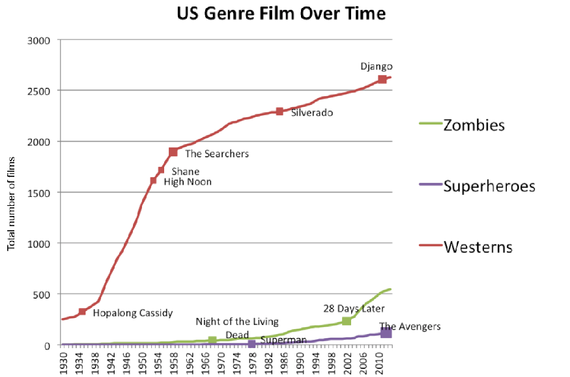
The author of the article crafts an argument for more superhero movies based primarily on this chart:
The argument pretty much is some classic Westerns have emerged over time because there have been so many movies of this type produced. Conversely there are not that many great Superhero movies because there have been so few of them made. Hence the author’s point: We need more Superhero movies in order to generate some truly classic ones.
Just a few problems with this rationale.
The movie industry today is a radically different one than during the studio system era of the 30s-50s. Back then, there were many more big movie studios and dozens of smaller ones, churning out on average over 1000 movies per year combined, many of them Westerns which were particularly popular at the time. Currently there are just six major studios, the only entities which can afford to make Superhero movies, and most of them are scaling back the number of scripted projects they produce each year.
Why is that the case? In large part precisely because of big special effects movies, due to their ginormous production and marketing budgets. At this rate, even if there were 20 Superhero movies produced annually, we are talking at least a century of to aggregate anything near the number of Westerns that have been produced.
Would that lead to an equivalent amount of classic Superhero movies? I doubt it. Why?
Because there is a serious inherent obstacle for anyone undertaking a Superhero movie: The sheer scope of the story tends to overwhelm the characters. For every Dark Knight and Iron Man, both wonderful movies in part because they spend a lot of time delving into the Protagonists’ psychological lives, there are dozens of other Superhero movies where even when the filmmakers try to pay attention to the characters, those attempts at creating a genuine emotional connection with the audience gets lost amidst a pervasive CGI-laden eye-storm assaulting us at nearly every turn.
This problem is inherent to the Superhero genre. Check out what Damon Lindelof had to say last year in this article in Vulture:
“We live in a commercial world, where you’ve gotta come up with ‘trailer moments’ and make the thing feel big and impressive and satisfying, especially in that summer-movie-theater construct,” says Lindelof. “But ultimately I do feel — even as a purveyor of it — slightly turned off by this destruction porn that has emerged and become very bold-faced this past summer. And again, guilty as charged. It’s hard not to do it, especially because a movie, if properly executed, feels like it’s escalating.”
That escalation can be felt across the entire film industry this summer, a season of unparalleled massiveness: more blockbusters released, more digital demolition per square foot, and more at stake than ever. The first tentpoles out of the gate did breakneck business, but a late run of expensive flops (and even respectable also-rans) has industry watchers reexamining Steven Spielberg’s prediction, in June, that Hollywood is headed for an “implosion”: An industry that makes only megamovies, prophesied the father of the megamovie, will die of its own gigantism.
But Hollywood’s gigantism, Lindelof points out, is practically algorithmic — and the effect tendrils all the way down to the storytelling level. When ever-larger sums are spent to make and market ever-fewer, ever-bigger movies, and those movies are aimed at Imax screens, then world-shattering comic-book I.P. and gigantic special effects are expected, with larger-than-life characters wielding those effects. No one necessarily asks for it; it just kind of happens. It’s what Lindelof calls Story Gravity, and dealing with it — whether that means resisting it or simply surfing it skillfully — is the great challenge of writing this new breed of tentpole blockbuster. The question used to be: How do we top ourselves? The new one seems to be: How do we stop ourselves?
“Once you spend more than $100 million on a movie, you have to save the world,” explains Lindelof. “And when you start there, and basically say, I have to construct a MacGuffin based on if they shut off this, or they close this portal, or they deactivate this bomb, or they come up with this cure, it will save the world — you are very limited in terms of how you execute that. And in many ways, you can become a slave to it and, again, I make no excuses, I’m just saying you kind of have to start there. In the old days, it was just as satisfying that all Superman has to do was basically save Lois from this earthquake in California. The stakes in that movie are that the San Andreas Fault line opens up and half of California is going to fall in the ocean. That felt big enough, but there is a sense of bigger, better, faster, seen it before, done that.”
“It sounds sort of hacky and defensive to say, [but it’s] almost inescapable,” he continues. “It’s almost impossible to, for example, not have a final set piece where the fate of the free world is at stake. You basically work your way backward and say, ‘Well, the Avengers aren’t going to save Guam, they’ve got to save the world.’ Did Star Trek Into Darkness need to have a gigantic starship crashing into San Francisco? I’ll never know. But it sure felt like it did.”
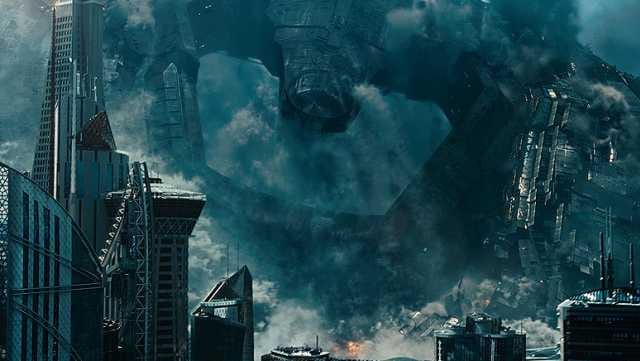
Honestly, as much money as writers like Lindelof make, I feel sorry for them in this respect: They are trapped by the big budgets, big expectations, the whole Bigness of these type of movies. As Lindelof says, “You can become a slave to it.”
Circling back to the Atlantic article, compare the whole mental ethos as elucidated by Lindelof above to that apparent in Westerns like High Noon, Shane, The Searchers, Unforgiven, The Wild Bunch, and Butch Cassidy & the Sundance Kid. In these classic movies, it is the characters who make each story distinctive and compelling. Not “gigantism,” but rather, I would argue… “humanism”. In films such as these, the life or death of one person can be much more powerful emotionally than the destruction of a planet, as played out as that narrative dynamic has become in the Superhero genre.
The thing is, it doesn’t matter. The studios have their business models which seem to prove that big budget franchise movies are the most profitable… maybe not per ROI, but certainly in terms of sheer revenue. That income is largely fueled by the international audience which apparently can’t get enough of visual bombast on screen, well-developed characters or not.
Meanwhile all those $100M-200M budget movies crush what used to be a sweet spot for the studios, not much more than a decade ago: Mid-budget dramas, thrillers, comedies. If it weren’t for financiers, we likely wouldn’t be seeing any of those in theaters nowadays even though good ones like American Hustle and The Grand Budapest Hotel find a reliable audience and sizeable profits..
So no, we don’t need more Superhero movies. What we have now already on movie studio slates stretching out for the next decade is plenty enough. If the hope is for better ones, everyone involved has got a steep hill to climb because (A) due to their “gigantism,” the stakes have to be apocalyptic, but (B) stories can only threaten the existence of the Earth or universe so many times before moviegoers offer up a collective yawn — been there, seen that — © which means the underlying jeopard is pretty much negated before the plot even gets rolling (D) forcing the filmmakers to hope the characters’ individual stories are such that they are compelling to viewers except that (E) the sheer scope of putting $100M spectacle on-screen will almost invariably swamp the characters in terms of the meaningfulness of their puny concerns.
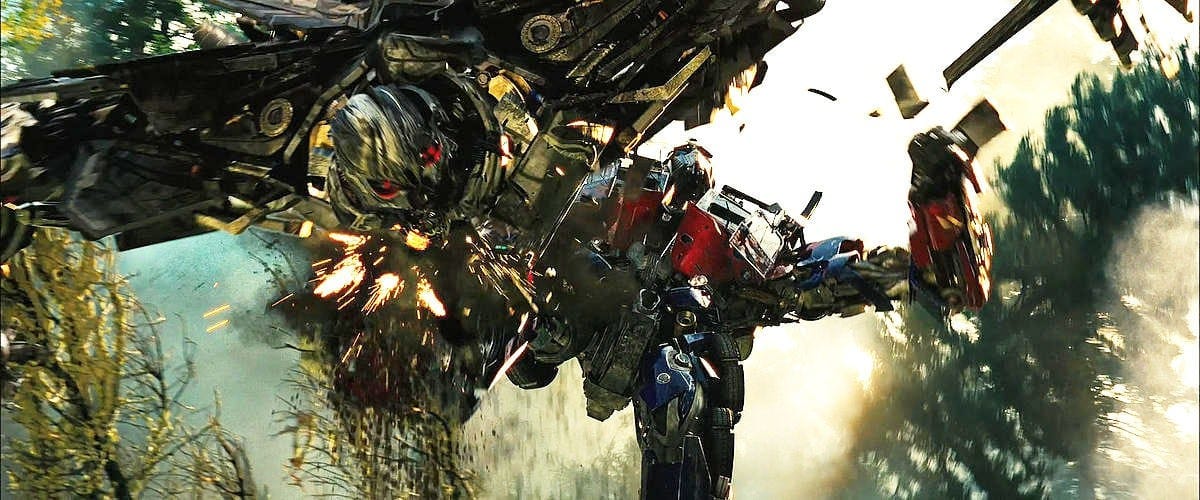
My humble advice for Superhero filmmakers? Think Pixar. One key to their success is they pay as much attention to the movie’s Small Story as they do to the Big Story. Like Joss Whedon did with The Avengers. Here once again, the fate of the whole world lies in the balance, but that Big Story is grounded in a completely relatable Small Story: The collection of superheroes as a dysfunctional family. Viewed through this lens, the entire story, all of the plot machinations and visual eye-candy services the metamorphosis of this disparate group of individuals, used to working on their own, learning how to function together as a group. People think that post-credit schwarma scene is just for kicks? No way! It’s a fitting capstone on the movie’s Small Story, the superheroes now so comfortable with each other, they can eat together in utter silence. No need for nervous chit chat. No impulse to try to impress each other. They just are. And they are together… as a ‘family.’
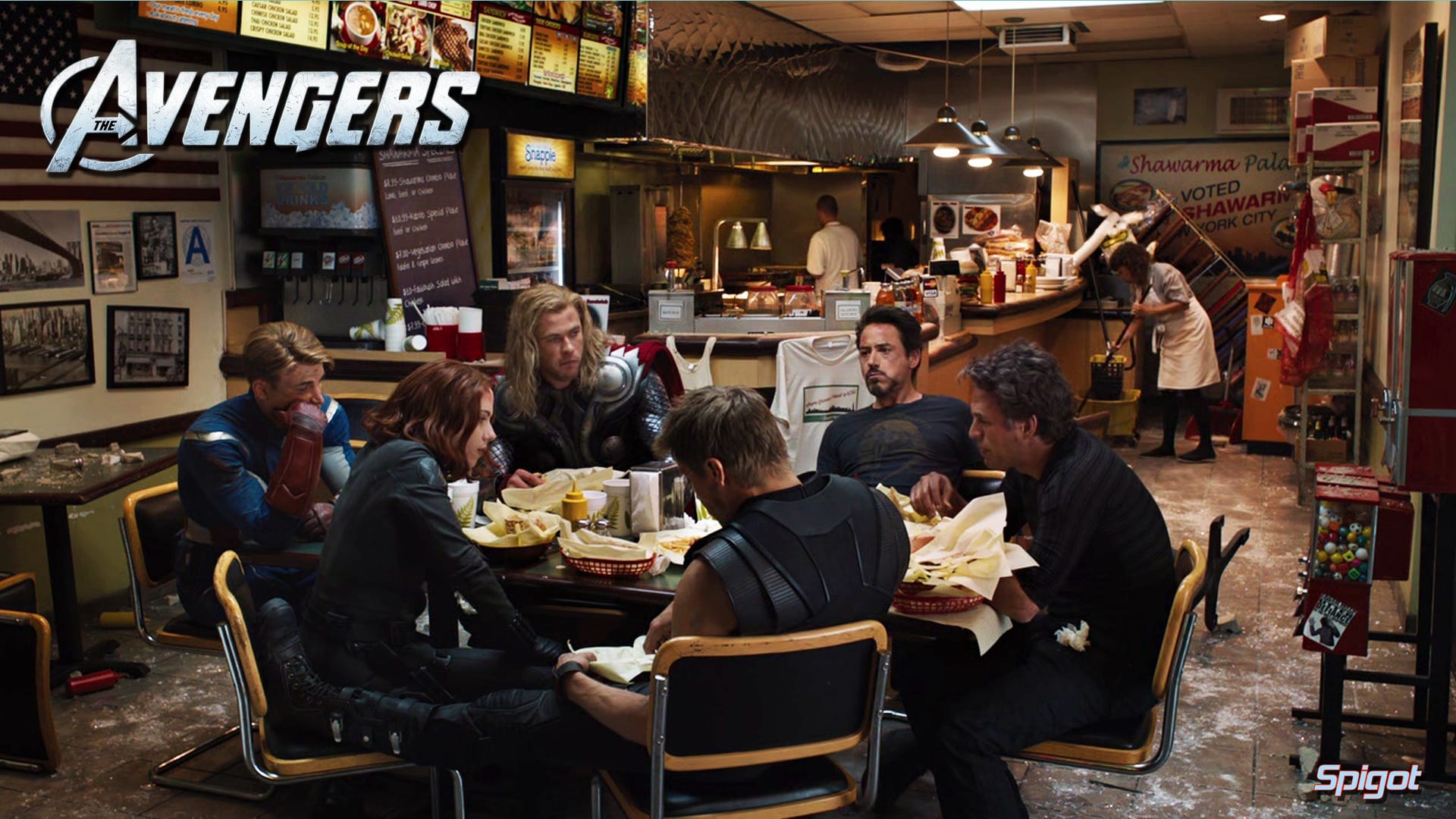
We don’t need more Superhero movies. We just need better ones. Stories that give as much attention to the Small Story as they do the Big Story.
For the rest of The Atlantic article, go here.
Comment Archive