How They Write A Script: Charles B. Griffith
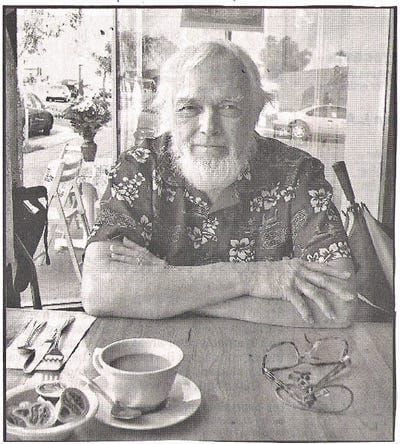
You may not recognize these movie titles: Attack of the Crab Monsters, A Bucket of Blood, and Beast from Haunted Cave, but Little Shop of Horrors should ring a bell. All are Roger Corman movies, all written by Charles B. Griffith (1930–2007), among many more.
These interview excerpts are taken from the excellent “Backstory 3: Interviews with Screenwriters of the 1960s”, one of a 4-part series edited by Patrick McGilligan.
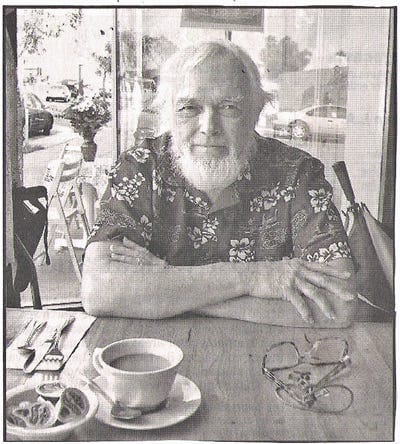
ON WORKING WITH ROGER CORMAN
My roots were in show business, since my mother was an actor; my father, when a young man, was in vaudeville; and my grandfather was a tightrope walker in the circus. It was automatic that I would go into the business. I went to military school but nothing else really interesting ever happened to me. I got into the picture business as a result of some scripts I did for the 1951 soap opera Myrt and Marge. My grandmother played Myrt, and my mother played Marge.
I was out here with my grandmother, writing TV scripts, which were never made, and trying to break in as a screenwriter. I had written about seven screenplays and a friend of mine, [the actor] Jonathan Haze, took them all over to Roger. Haze was already working with [the actor] Dick Miller and [the writer] Bobby Campbell and a lot of other people — they were all crazy schlubs in the early fifties. Anyway, Roger called me and hired me to write a western, which I did, and which was never made. Then I wrote another western, and it wasn’t made either. Then Corman taught me about budget. My third try was Gunslinger, and that one was made in 1955.
Roger came to me and said, “I want to make a picture called ‘Attack of the Giant Crabs,’ “ and I asked, “Does it have to be atomic radiation?” He responded, “Yes.” He said it was an experiment. “I want suspense or action in every scene. No kind of scene without suspense or action.” His trick was saying it was an experiment, which it wasn’t. He just didn’t want to bother cutting out the other scenes, which he would do.
We didn’t cut much in those days because pictures always came in short. So that’s what happened. There was always something going on in that picture, but it was dumb. I mean, in the script, [the actor] Mel Welles says, “Strange, there’s no sign of life on the island,” and Roger cuts to seagulls taking off from the cliff. Caw, caw.
I had the worst time with titles. I hated some of those titles they put on the films. I did one called Teenage Doll, where every page of the script was rejected by the censors, and I had to write it over again during the weekend. I once wrote a script in twenty-four hours called Rock All Night.
One day Roger said, “I want you to do a Bridey Murphy picture.” Bridey Murphy [i.e., The Search for Bridey Murphy, 1956] was being done at that time as a big-budget picture, and the book was still relatively popular. [The book and the film were about a woman who, when hypnotized, remembered her past lives.] I thought it would be dead by the time we could get anything out, but I wrote this story which I initially called “The Trance of Diana Love.” Curiously, I separated all the different things with sequences with the devil, which were really elaborate, and the dialogue in the past was all in iambic pentameter. Roger got very excited by that. He handed the script around for everybody to read, but nobody understood the dialogue, so he told me to translate it into English. The script was ruined, but The Undead [the final title] was a fun picture to shoot, because it was done in ten days at the Sunset Stage, which was a supermarket on Sunset Boulevard. We filled it with palm trees and fog, and it was the first time Roger had used any of that stuff. He didn’t like to rent anything. You could see the zipper on the witch’s dress and all the gimmicks were very obvious and phony — Roger deliberately played to skid row, a degenerate audience.
ON “BUCKET OF BLOOD”
[Note: Griffth wrote the script in 5 days.]
We did Bucket of Bloodfirst, which was not meant to be a comedy, according to Roger. It became one because of me. It was the same situation where these sets were going to stand for another week. Roger asked me, “How do you shoot comedy?” and I told
him to shoot it just like anything else. That was that, and it worked. We got applause on the set during the reading of the beatnik poetry, and that got Roger very excited. It was the first time anybody had ever liked anything. So we had to do it again right away. We sat down during shooting, and he insisted that it had to be the exact same picture, scene for scene, with just some of the names changed and so on. And I figured, “Oh, well, I’ll just go from satire to farce, and he’ll never know the difference.”
Bucket of Blood is one of the few films that chronicles something of the beatnik era. The beatniks in the coffeehouse scenes were all my friends. I didn’t know too many of the poets, but everybody went to coffeehouses in those days. And the thing is, those were the sets that were there to shoot, the ones from High School Bride. Roger said, “Write a horror picture for those sets.” There was a beatnik coffeehouse, a jail, a funky pad with nothing in it, and the lumberyard was the studio lumber department. So there really wasn’t much of a choice. That’s what dictated it being a comedy.
ON “LITTLE SHOP OF HORRORS”
[Note: The movie was shot in two days and three nights.]
Roger shot the interiors in two days on the stage — fifty pages a day — and I did the exteriors all around town, which took four days and nights. Mel Welles, who produced second unit on Little Shop, helped out, but that was about the entire crew. Everybody else we got from skid row. We gave them ten cents a shot to act in the picture and got all kinds of good stuff. We got fifteen minutes of picture for $1,100, which was not too bad. The whole picture cost $27,000.
Actually, I played four parts — the guy who runs out of the office with his ear bitten; the gangster that sticks up the flower shop and gets eaten by the plant; a shadow on the wall; and the voice of the plant, which was supposed to have been dubbed, but I did it on the stage, so Jonathan Haze would have something to react to. We just left it in because to dub over would have been a little too much money and trouble.
All my relatives were in that picture too. My father was the guy in the dentist’s chair who got the mirror broken in his mouth. My kid brothers and sisters were in the crowd scenes. At that point, Roger and I were getting along very well, and I got away with a lot. I got away with rehearsing the cast ahead of time. Roger wouldn’t let you do that later. It would take too much time.
Now you can’t change anything unless he orders it changed. You can’t try anything. The director of Deathsport [Henry Suso] came up to me and said he had a fabulous idea of shooting at night. I said, “You’d better tell that to Roger.” He had worked out how he could use filters to get “day-for-night.” Roger told him no night and no day-for-night. That was it. Anything you’d suggest to him, he’d say no. Anything. Ask anybody who works for him now. He’ll gather people together and tell them nobody in his company knows how to make a picture.
The talents that worked for Roger got their chance because they were willing to work for nothing. These days everything is stolen. The ideas are stolen, the money is stolen from the people doing the work, the medical benefits are stolen, the residuals are stolen — there’s no pension or welfare — and then the final picture is stolen from the audience because it’s a piece of crap. That’s low-budget exploitation picture-making.
Getting back to Little Shop of Horrors . . . I didn’t even know it had been released. I had moved to Israel and then to Rome after making Atlas. When I was in Rome, Michael Reeves phoned from Montreal, but he said he had to get off the phone because Little Shop of Horrors was on television and everybody in town was watching it. That was the first news I’d heard that Little Shop was going to be a cult picture.
ON “BARBARELLA”
[The actor] John Phillip Law was a friend of mine, and [the director] Roger Vadim was looking for another writer for Barbarella. John recommended me and [the producer Dino De Laurentiis] hired me. I stayed with Vadim and Jane Fonda in their house outside of Paris and worked on the script. They’d already shot some of the picture when I was called to work on it and had even temporarily scored it with Beatles music. It was really bad.
He took the material from the French comic strip, but that’s all he did. Then they hired fourteen other writers before they finally got to me. I didn’t get credit because I was the last one. I guess I rewrote about a quarter of the film that was shot, then reshot, and I added the concept that there had been thousands of years since violence existed, so that Barbarella was very clumsy all through the picture. She shoots herself in the foot and everything. It was pretty ludicrous.
The stuff with [the actor] Claude Dauphin and the suicide room were also part of my contribution to the film. But the most fun was staying at their house and talking all night with Vadim about politics — it was during the Pueblo — including and talking with Jane all day about movies. At that time, she wasn’t known for her politics or for being a good actress. The military invited her to entertain the troops in Vietnam, but she was planning to defect and entertain the Viet Cong. Everyone was looking at her and imagining her plowing through the jungle with the Viet Cong and what would have happened to her.
ON ROGER CORMAN
Deranged, yes. Genius, no. The genius that he might have had is gone. He used to be full of ideas and Freudian concepts, and he’d throw these things out to the writers and get them all hot. They would work like crazy, but he would have forgotten what he wanted to do. He was only interested in saving money, so his intellect ground down to almost nothing. When you see some of his crap, there are a few moments of interest. That wasn’t true of some of the other shockers that were being made at the time. Those producers knew what they wanted, and that was pure garbage and no great loss. Roger’s stuff was 99 percent garbage and I percent is of interest.
Comment Archive