How They Write A Script: Philip Dunne
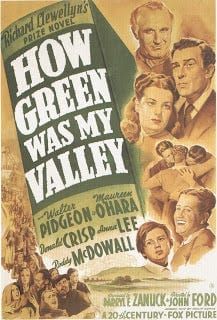
Today some words of wisdom from screenwriter Philip Dunne. A veteran of the Hollywood “studio system”, Dunne had a long and prolific screenwriting career from 1932 to 1965. Writing credits include The Count of Monte Cristo (1932), The Last of the Mohicans (1936), The Ghost and Mrs. Muir (1947), and The Robe (1953). My favorite Dunne movie has to be How Green Was My Valley (1941). When they opened the AMC 14 Theaters in Century City, the first weekend they screened all 20th Century Fox movies — Century City used to be Fox’s backlot — for a dime. So I got to see How Green Was My Valley on the big screen. Wonderful experience!Writers in the studio system churned out material, so it should be no surprise to hear them talk about screenwriting, like Dunne does, as a “craft,” not an art. These quotes are excerpted from the great “Backstory” book series edited by Patrick McGilligan.
ON HOW HE GOT HIS START IN HOLLYWOOD
“I moved out here (Los Angeles) because I had sinusitis, and the doctor recommended a warm climate… The people I knew here were the people I played polo with in the East before the Crash. I was unhorsed by the Crash. Actually, I tried to get a job in a bank or with an oil company, anything. But, of course, in 1930 there was nothing. I also had letters to studio heads. I had a letter from… Quinn Martin, who had been the movie critic at the old New York World, where my brother worked. The letter… was to [the West Coast studio executive] Winnie Sheehan at Fox, and Winne gave me a job as a reader at $35 a week. I thought it was good pay.”
ON WHAT HE THOUGHT OF MOVIES AT THE TIME
“I liked to go to the movies. I liked to take a girl to the movies on Sunday. It was just something you did. But I thought movies were quite frivolous. The older generation of my time had no feeling of respect for movies. You have to pay respect now; it’s an art. But to my parents and their friends, the movies were low-down popular entertainment.
“The only time I had movies treated seriously was when a Harvard professor of mine, a fine arts professor, took his class of six — it was a class in Renaissance sculpture of all things — to see Flesh and the Devil (1927) at the Paramount Theatre in Boston so we could look on Garbo as a perfect classical face. Very interesting. It was the first I could imagine a professor being interested in the movies. It had never occurred to me.”
ON WHAT BEING A READER TAUGHT HIM
“I hate to admit this, but we got nothing but the worst stuff; all the good books and plays went through the New York readers’ department. We got the pathetic originals written by out-of-work screenwriters. I kept seeing ways that I thought I could improve them. I’d write a synopsis, and I’d make it better. I couldn’t help it. It would be an obvious thing that the guy had missed. And when you learn to synopsize a story, you learn to construct it. At the same time, I was moonlighting writing short stories, so all these things came together.”
ON THE CRAFT OF SCREENWRITING
“I agree with my old friend Jo Swerling, one of the earliest screenwriters, who said screenwriting is not so much an art as like fine cabinetmaking. I think that’s right. Nunnally [Johnson] used to use that analogy, too. He picked it up from the same source I did, I’m sure. We never claimed to be artists, but we thought we were good craftsmen.
“Except in a very few exceptional cases, moviemaking is a collaborative art or craft, whichever you prefer. Of my thirty-six-odd screenplays, only four count as originals, so I was really tailoring other people’s work to the screen… I don’t think there’s anything wrong with fine cabinetmaking, but I wouldn’t pose as an artist.”
ON WRITING VS. DIRECTING
“Directing is a lot more fun, but, of course, the writing is more important. The architect is more important than the contractor. I’m not saying the writer is more important than the director, I’m saying the writing is more important than the directing. Directing is only interpretation.”
ON HIS WRITING HABITS
“I always had spotty hours. I used to get up sometimes at three or four o’clock in the morning and write. And I usually worked at home… Being at home encouraged me to work odd hours. If you get an idea in the middle of the night, it’s a good idea to get up and write it down, or it’s gone. There’s a famous story about a writer who always swore he got up and wrote his ideas down. He had a wonderful idea in the middle of the night once, got out his pad and pencil, and wrote it down. He went back to sleep — slept like a baby. He woke up, and he had written: boy meets girl.”
ON WRITER’S BLOCK
“The block’s a terrible thing. I don’t know of any writer who doesn’t suffer from it occasionally. There’s another thing I used to suffer from — the writer’s nightmare. I still get it. The dream is: a story you’re trying to solve and it just keeps eluding you. There’s no solution. The great relief is when you wake up and realize there is no story. You don’t have to solve it.
“I usually found that resolutely going to a party, having a bit too much to drink, and getting a hangover was an awfully good un-blocker. I don’t know why. The other thing is to take a drive. It’s probably a bad idea. You should concentrate more on your driving. But if you go out on a long dull highway with no distractions…”
ON STAGE DIRECTIONS
“I could make the script a little longer than they liked by leaving description out. It gave me a little more elbow room… Shakespeare rarely used stage directions, you know, and his plays are understood by everybody. You don’t need a lot of stage directions.
“Now I have read stage directions that I admire. I remember Ben Hecht for Viva Viva! had wonderful stage directions, undoubtedly thinking of Wallace Beery. One stage direction was, “Villa sweats like a horse.” I know just what he means. Or when he was trying to write a letter: “Groans with literary frustration.” And Nunnally Johnson wrote beautiful stage directions, although he couldn’t photograph them. He would have two teenage girls looking at each other “with the innocent eyes of a couple of Beale Street madams.” That’s wonderful. Though you couldn’t photograph it, it would convey something to a very good actor.”
ON WHAT IS THE MOST DIFFICULT PART OF THE SCREENPLAY TO WRITE
“The ending. The beginning is a cinch. The world is full of great openings, not so many great third acts.”
Comment Archive