“I am not what happened to me, I am what I choose to become.”
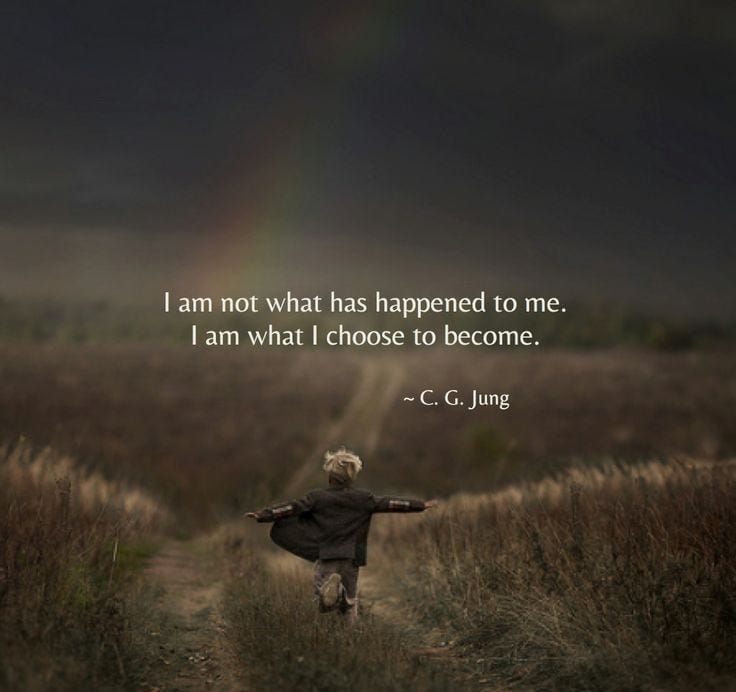
Yet another reason why if there is any individual worthy of being considered a screenwriting ‘guru,’ I think it’s Carl Jung. This simple statement — “I am not what happened to me, I am what I choose to become.” — describes the Protagonist’s story to a tee.
Life leading up to FADE IN: What has happened to the Protagonist.
Life after FADE IN: What the Protagonist chooses to become.
The Protagonist exists in their story universe. They have lived there 24/7/365 for their entire life.
Everything which has happened to them, I call their personal history, the entire litany of events, reactions, actions, and associated feelings, emotions, and passions.
But personal history is too big for the constraints of a Story. For that, we need to drill down into that which carries forward into the narrative after we type FADE IN.
What of the Protagonist’s personal history comes into play in significant ways in the Story we write?
What specific events in the past continue to hold sway over their psychological being?
What unresolved feelings do they have at work in their conscious and unconscious levels of being?
That is a narrower arena of a character’s personal history.
That I call backstory.
Back Story: I am what happened to me.
This Story: I am what I choose to become.
A screenplay is This Story.
All of the challenges, tests, roadblocks, and reversals that happen in the Plot in some way service the transformation-journey of the Protagonist where at each step, they choose who they are to become.
In the end, a screenplay tells the tale of a Protagonist confronting the most existential question of all: Who am I?
In most movies, it’s a positive arc. And per Jung what we are saying is this: “I am more than the sum of things which have happened to me. I have the free will to choose who I am.”
As you work with your story and you dig into your Protagonist’s personal history, when you zero in on the key events and significant dynamics which are at play in your narrative, you are — in effect — forcing your Protagonist to confront their backstory. To face their shadow. To deal with their shit.
Every plot point. Every scene. Every moment. Creates that interpersonal confrontation. And represents a choice.
Am I what happened to me? Or am I what I choose to become?
Name a movie. The Wizard of Oz. Casablanca. It’s a Wonderful Life. The Apartment. Lawrence of Arabia. The Godfather. Taxi Driver. Jaws. Star Wars: A New Hope. Back to the Future. Tootsie. Aliens. The Silence of the Lambs. Unforgiven. The Shawshank Redemption. Pulp Fiction. Gladiator. Good Will Hunting. Toy Story. Almost Famous. Juno. Avatar. The Dark Knight. Gravity. The King’s Speech. Moneyball. Whiplash.
That question as elucidated by Jung — Am I what happened to me? Or am I what I choose to become? — lies at the heart of the emotional and psychological life of these stories.
And I will bet… at the heart of your story as well.
Comment Archive