Interview: Damien Chazelle
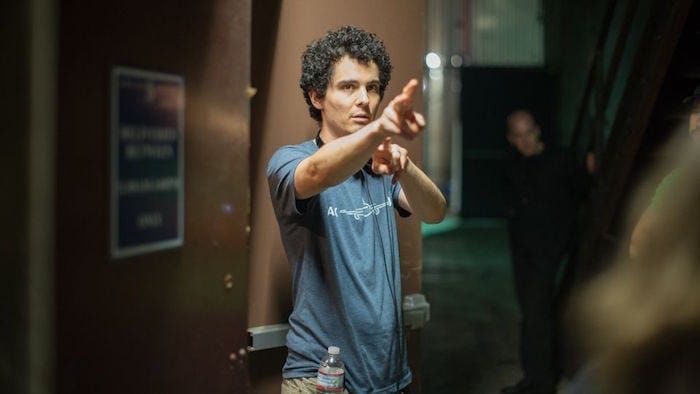
Damien Chazelle is the talented young writer/director of Whiplash, the intensely rhythmic story of a young drummer (Miles Teller) and a — let’s call him “harsh” — music teacher (J.K. Simmons). We caught up with Damien at the New York Film Festival earlier this month to ask him about his writing process.
GITS: I’d love to start by hearing how the project came together. Did you have a feature-length script before you made the short?
DC: Yeah I did. I wrote it, sent it around town, and everyone and their mother passed. Finally there was someone I’d met through writing work beforehand, this guy Couper Samuelson who works with Jason Blum. He read it, and was the first person to see something in it. He didn’t know how it could fit into the Blumhouse model, so he had the idea of bringing his friend Helen Estabrook, Jason Reitman’s producer, on board. She liked it.
So, once it became this sort of Blum/Reitman, Cooper/Helen thing, the challenge became: we have a good producing team, but getting the money’s still not quite obvious. It was their idea to take a scene from the script and shoot it as a short, to serve as a sort of sizzle for the feature.
GITS: I’m curious to hear about your process writing on spec with the music obviously very much in mind. It’s something that spec writers are told to stay away from, but you clearly made it work.
DC: Hmm. I wrote it with certain charts in mind that I’d played in my jazz drumming days. Two of the most important were Whiplash, the title track, and Caravan — but I put a bunch of other tracks into the script as well. We had to replace everything but those two with original music. So, certainly we decided not to go the licensing route on everything. Yes, theoretically I could have found alternatives to Whiplash and Caravan, if I’d had to. But they were so personally important to me. They’re charts that I’d played so much, charts that I love, charts that gave me a lot of anguish and stress and anxiety as a musician. That love/hate thing is so part and parcel to the story. Whiplash even made sense as a title. Originally the script was called “The Drummer,” and then there was going to be a movie about a Beach Boys drummer called “The Drummer,” so it became “Whiplash”.
http://www.youtube.com/watch?v=VnuImW1dWAk
GITS: This was a very personal movie. How did you go about developing your characters?
DC: You know, writing can bring a lot of joy — but most of it is utter torment. I’m a very skilled procrastinator when it comes to anything writing related. I think that this was, at least in terms of a first draft, the easiest thing for me to write because it’s so personal. A lot of it is almost beat for beat autobiographical. The stuff that isn’t is still steeped in certain jazz anecdotes from history, or experiences friends have gone through. There was fodder for everything. So there was no such thing as writer’s block on this script.
But, the first draft was a bit of a mess. I wrote it in about ten days, but then revised it for about a year. I stepped away from it, came back to it. You have to get some distance. That helped me hone it down, to a point where I was finally convinced by a few of my trusted creative confidantes to actually send the script out there. I wasn’t really sure what I had. All I knew is that it was personal and raw and might reflect a little poorly on me. [Laughs].
GITS: Now before you wrote the first draft, when and how did you first start prepping the story?
DC: I remember I got the initial idea, and then a few weeks later I was sitting in a movie theater. A movie was playing that — I won’t name which one — but I was utterly bored out of my mind. I decided I didn’t want to pay attention about fifteen minutes in, but I didn’t walk out because I was with somebody. Also I hate walking out of movies, I tend not to do it.
So I just decided to use it as thinking time. I started thinking through the structure and the story, and I beat out the basic plot beats during the hour and a half of that movie. Then I started writing. So the whole thing was pretty organic, compared to other scripts I’ve written that required a Herculean effort. This was from the gut.
GITS: Ten days is pretty incredible.
DC: Well, don’t get me wrong. If you could have seen that first draft — it read like a ten day draft.
GITS: It sounds like you’re a pretty flexible worker. I’m curious to know your process more generally. Do you work at certain times of day? Does it have to be quiet? Obviously you can work in a movie theater…
DC: I know my strengths, and I know my weaknesses. You mentioned the movie theater — I’m very good at the thinking stage. I’m very good at sitting around and brainstorming, thinking up ideas and mapping them out in my head. What I’m not good at is getting them onto a piece of paper (or a computer screen, I guess).
Everything is a little more perfect in your head. Once you have to start making concrete choices — one word over another or one name over another or one color over another — then suddenly everything gets worse.
The process of actually putting stuff onto paper is almost always a really, really tough one. There are moments of exhilaration when you’re shooting on set, and while editing. Editing is maybe my favorite part of the entire process. Writing is the worst. I do that in order to be able to get on set.
I also come at it from the point of view of someone who’s going to direct, so it’s a little bit different. The end goal is always in my mind. I think truly great writers — whether they’re screenwriters or novelists or poets, it doesn’t matter — are able to make something that stands alone. You can read a William Goldman script and have as full an experience as you would watching the movie that results. I aspire to that level of craft as a writer, but I don’t think I quite achieve it.
GITS: I’d like to ask about J.K. Simmons’ character, with his insults and ferocity. How much of that was worked out on set, versus in the script or from your own experience?
DC: There wasn’t much improv on the movie. Almost all the insults were written. It’s fun to write a character like that, because it was just a matter of imagining the worst possible things to say. You put on the opposite thinking cap from the one you wear in real life. You try to say the things that reflect most poorly on you as a human being. It was a bracing exercise.
In a way though, the content was less important than the rhythm and the tempo. It was important that the dialogue have a real percussive quality to it. I don’t like getting too precious with the dialogue, and when you have someone like J.K. Simmons you want to give them the freedom to change things. Even if it’s just changing a single word, or dropping a comma, you want to give them that freedom.
At the same time, it was very important to me that Fletcher’s dialogue be a character of its own and have a musicality to it. At the end of the day, Fletcher’s instrument is what he says. Andrew doesn’t say that much, he says everything with his playing. And then ditto with the other musicians in the band. They’re all silenced by their instruments, their instruments are their voices. But Fletcher gets to use the English language as his instrument, and that’s a really fun character to write.
GITS: I’d like to ask about theme. This is so based in your experience — did you know what you wanted to say about art and training first, or did the theme just arise naturally from the characters and your memories?
DC: No. I feel like you can tell when movies start from a theme or intellectual question, and they’re not that interesting. I wanted to start from a sensory experience, an emotional experience. What I want something to sound like or look like, or what kind of motion I wanted to create.
Films are not essays, they’re not pieces of writing. They’re things that move and flicker and make noise. I just started with the emotion I wanted to create in an audience, the emotion that a great drum solo can create for me. This out of control but also hyper-controlled blend of total anarchy and utter precision. The awe-inspiringness of a great Buddy Rich or Joe Jones drum solo. Then I had to find the filmic equivalent of that. And, with a movie about drums, make it as personal as possible. Really pulling out stuff from what I felt as a drummer under a very tough conductor. The fear I felt. The exhilaration I felt in moments of triumph, and the stress and anguish I felt during the rest of the time.
That’s the way to get a taste of what you want your movie to be. I knew this was not going to be a subtle, quiet movie. This needed to be a movie that moved like a bullet train and hit the audience in the gut. From there, you can extrapolate the thematics or the moral questions you want to grapple with. But those things should emerge organically from the images and the sound. That’s what movies are.
GITS: What have been the reactions of other musicians who have seen the movie?
DC: It’s been really interesting, I remember even with the script. When we sent it to a bunch of producers and people in Hollywood to try and get money, people would react to the monstrous behavior, the abhorrent behavior that’s on the page. How horrible Fletcher is, and the darkness of the storyline.
Then I remember we sent it to a drummer, to help us with some of the practicalities of putting the music together. We were speaking to this jazz drummer, one of the Lincoln Center guys. I’ll always remember this: his reaction was the polar opposite. It was, “Oh yeah, you know. That’s what it takes.” I’ve even had musicians who complained that the cruelty onscreen didn’t go far enough. It’s just a whole world that I’m constantly reminded that most people don’t know. Most people who aren’t in the higher echelons of musicianship aren’t aware of the less savory side of that world. We’re a little more accustomed now to the dark side of sports or even the dark side of dance, but pure instrumental music? Everyone knows that Juilliard is tough, everyone knows that playing in the Philharmonic is “tough.” But I don’t think tough begins to describe what it’s actually like.
GITS: Thanks. I’m seeing we’re almost out of time. Last question: do you have any advice to aspiring writers, aspiring directors?
DC: The thing I learned here, especially after having written a bunch of stuff that wasn’t personal, was that the more personal the better. Sometimes that’s misunderstood as being literally drawn from your life. I think a movie set on Mars can be just as personal as this movie was to me. You find your own way into it, you find your own emotions even if the exterior circumstances of the story don’t match up with your own.
I really do believe that fiction film is about emotion, and it’s hard to write about emotions that you’ve never felt.
Thanks to Tim Wainwright for conducting the interview for Go Into The Story. Tim is a writer. He tweets here and blogs here.