Interview (Part 1): Jon Spaihts
A 6 part series featuring one of Hollywood’s most sought after screenwriters.
A 6 part series featuring one of Hollywood’s most sought after screenwriters.
I have been a fan of Jon Spaihts and his writing for years, so I was excited to have the opportunity recently to spend an hour talking with him about his career, his movies, and the screenwriting craft. His movie credits include Prometheus, Doctor Strange, and his latest Passengers, along with the upcoming films Van Helsing and The Mummy among many others.
Today in Part 1, Jon relates how he found his way into screenwriting and a burgeoning career in Hollywood, and shares some insights into the world-building process for the movie Prometheus.
Scott Myers: I’ve read where you were really into books and that’s where you got inspired to be a writer. What was it that propelled you into thinking you wanted to be the person writing the words instead of just reading them?
Jon Spaihts: Honestly, it was automatic. From the moment I knew that books had authors, I didn’t even make a decision: I knew that I was going to write books, too. I can’t explain it. From the moment I could scribble letters in a row, I was writing stories. It’s always what I’ve wanted to be. I just took a long time to figure out how to do it.
Scott: What type of books were you drawn to reading when you were young?
Jon: Very fantastic stuff when I was a kid. A lot of fantasy and science fiction. A lot of great short fiction on the sci‑fi side, which tends to be very high-concept. I was reading the post-war space-opera from the golden age of sci‑fi, and the short fiction of the cold war, which is a great time because it deals with such colossal themes.
That was a world living in the legitimate fear that science could obliterate us all and end civilization, but at the same time the golden age notion persevered — that we might leap from planet to planet and spread civilization through the galaxy. Those two things, the aspiration and the fear, waged a war on the page that I found fascinating.
Scott: They’re both in play in Passengers, aren’t they?
Jon: Absolutely.
Scott: You attended Princeton.
Jon: Yes.
Scott: What was your major there?
Jon: I began as a physics major with the intention to get a double major in English Lit, but Princeton had a tokamak fusion reactor at that time and was attracting the best physics candidates from around the world. I quickly realized that, if I was going to keep up with those kids and be good at physics, there wasn’t going to be room for writing in my life, and I wasn’t willing to give it up.
I ended up in the politics department, getting a political philosophy degree, with the intention of eventually being a novelist.
Scott: Originally, you were thinking more about novelist. When did you segue into thinking, “I might be more interested in writing screenplays”?
Jon: A few years after I graduated from college I started a little company with a friend of mine in New York City. We were a production company making multimedia and documentary video, mostly for museums.
Working for that company for the first time, I shot, edited, directed video. I operated a camera. I worked in the editing system. The vernacular of film opened up to me. I’d always loved movies. Instantly, my writing aspirations swung from the printed page to the screen, and I started researching screenwriting.
Scott: Was it the visual storytelling that you found compelling?
Jon: Yeah, I think it’s a combination of things. I’m an avid photographer. Especially in 35mm, I speak the language of the optics. I know what a 35mm lens, or a 50, is going to do. I know my f‑stops pretty well, so it’s a good window into the craft of capturing the moving picture. I’d been thinking a long time about composition, about light and shadow.
Thinking about film allowed my storytelling interests to dovetail with my photography interests, and held up the promise of a writing career that would also be collaborative, and not just me alone in a room all the time, because I’m pretty social. Screenwriting has collaborative phases, which I love.
Scott: You didn’t have any formal training in screenwriting.
Jon: That’s right.
Scott: How did you go about learning the basics of the craft?
Jon: I tried to read screenplays, which in the ’90s was not easy. In New York City there used to be guys in Times Square who would set up folding tables and sell bootleg, photocopied screenplays. These were screenplays you couldn’t get anywhere else at the time. They weren’t in bookstores. The Internet resources weren’t there yet. I’d buy them there and read what I could and try to understand the format.
Scott: None of the ‘guru’ books?
Jon: No, I came to those late, actually. I’ve probably read most of them by now, but I read them when I was already a working writer. What I really wanted then was company. Those how‑to books offered me a chance to listen to somebody else thinking about the kind of problem-solving I was doing every day.
Scott: It sounds like one piece of advice you’d offer people is read scripts.
Jon: Read scripts, watch movies, more than anything.
Scott: Your first script was “Shadow 19.”
Jon: That’s right.
Scott: What happened after you wrote that?
Jon: I wrote it. I polished again and again. It was the first screenplay I’d written; I took a lot of time on it. I spent a year revising it. I showed it to the one industry contact I had, a guy named Richard Brick I had worked with, who used to be Film Commissioner of New York and Woody Allen’s line producer.
He’d done some consulting at the dot‑com where I was working at the time. He loved the script and showed it to a friend of his, Ira Deutchman, who founded Fine Line Features. Ira showed it to the guy who became my manager, at Circle of Confusion. I got repped.
Scott: Once you set that up, everything else that you’ve written has pretty much been on assignment.
Jon: Yeah, I don’t have anything in a drawer. “Shadow 19” sold to Warner Brothers, and I moved to LA. The next thing I wrote was Passengers. While Passengers circled endlessly, I did a bunch of other projects, many unproduced, as is the way for all screenwriters.
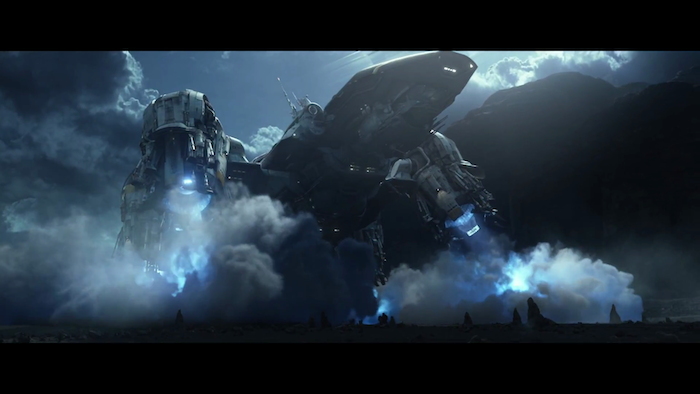
Scott: Before we get to Passengers, let’s jump into some of these projects you’ve worked on. Starting with Prometheus. What were some of the challenges of world building that you did when you were writing Prometheus?
Jon: It was getting to extend the fictional canvas beyond the borders of the frame of the original Alien movies. Scott Free Production wanted to go back and look at doing a prequel to the original film. That meant returning to Ripley’s original film and looking at what doors had been left propped open that I could go through and explore.
Obviously, the origin of the Alien, the Xenomorph, was going to be the critical question. It was found in a derelict spaceship wherein we see the cadaver of an alien giant with an elephantine face, who’s clearly fallen victim to a Xenomorph himself.
That was the vector. Whatever that giant alien was, the “space jockey,” he and his kind were how this thing got here. That meant the prequel really ought to be, in some respect, the story of the space jockeys, but I didn’t think it would be easy to make a popular film [laughs] starring a bunch of 15‑foot elephant giants.
I quickly decided that for the story of the space jockeys to be meaningful to us, it also had to be our story, the story of humankind.
Given the age of the wreck as it’s characterized in the first Alien movie, my first thought was that these ancient giants must have been the von Daniken‑style aliens who some believe helped to shape ancient civilizations, and raise our early monuments, and, perhaps, even to shape the development of the species itself.
I imagined them as the Engineers who fomented sentient life on earth and then schooled that life into their own image, both cognitively and physically. I suppose the closing idea was that that elephantine alien face of the space jockey was merely a mask. Underneath it, to our astonishment, it would be revealed that they looked like us. Or, perhaps more accurately, that we looked like them.
Tomorrow in Part 2, Jon shares some thoughts about writing Doctor Strange, The Mummy, Van Helsing, and the inspiration for the movie Passengers.
Passengers, which stars Jennifer Lawrence and Chris Pratt, opens in North America on December 21.
Visit the movie’s website here.
Jon is repped by CAA and Circle of Confusion.
Twitter: @jonspaihts.