Interview (Part 1): Rachael Prior — Big Talk Productions
One of the delights about spending time on Twitter is having met and gotten to know Rachael Prior. Whip smart and passionate about movies and storytelling, Rachael is Head of Film at Big Talk Pictures, a U.K.-based film company overseeing movies such as Attack the Block, Cuban Fury, and the excellent romantic comedy Man Up (2015), written by Tess Morris, directed by Ben Palmer, and starring Lake Bell and Simon Pegg. Previously Rachael worked in development at Working Title where she was involved numerous movies including Edgar Wright’s ‘Blood & Ice-Cream Trilogy’ — Shaun of the Dead, Hot Fuzz, and The World’s End.
Recently I had a wide-ranging hour-long transatlantic conversation with Rachael. Today in Part 1, Rachael talks about her path into the movie business:
Scott: Let’s start at the beginning. Where did you grow up?
Rachael: I was born in the north of England, in Yorkshire and lived there for about four years before my dad got a Head Teacher job further down the country, so the majority of my childhood was spent in a small industrial town in the Midlands. I grew up with my mum, my dad, sister and a couple of hamsters.
Scott: Was your family into movies at all?
Rachael: Well, in a word, no. We didn’t have a VHS player in our home until I was about 12 years old, so the movies I saw up to that point were whatever got screened perennially on the TV. There were occasional trips to the cinema, but on the whole, TV was where I was finding movies, or at friends’ and neighbors’ houses. I saw Grease and Poltergeist that way, arguably way before I should have.
So I grew up on all those Ray Harryhausen films like Jason and the Argonauts and The 7th Voyage of Sinbad, and family favorites like The Wizard of Oz and Mary Poppins.
Getting a VHS player was a door opener. As a family, we started to watch a lot more, and it became a weekend ritual to go to Blockbusters. One of the first movies I remember renting was Hannah and her Sisters, simply because my sister’s name is Hannah. I had no idea who Woody Allen was, so I got introduced by a stroke of luck.
But my love of stories started with being a huge book nerd. I read voraciously as a kid. My parents were both brilliantly bright and incredibly loving — they gave me every resource that I needed to explore my interests and creativity, but I don’t recall anyone else in the family reading at the clip and range I did. Their interests lay elsewhere. My sister was more likely to be found buried in her chemistry set.
So I always had this love of long-form stories — of fiction — and being able to escape into different worlds. Getting into movies was an extension of that for me. I liked long-form, complete narratives. Movies are like novels in that way. They have a beginning, middle and end and that always appealed to me more than the episodic narratives of comic books or TV did.
Scott: You went to Southampton University and got a BA in English Literature?
Rachael: Yeah, that’s right.
Scott: A direct correlation between your interest in books and story.
Rachael: Absolutely. I mean, I remember going to the cinema, but I didn’t go as much as other kids seemed to, so books were the main influence growing up and they are what lead me to that degree, for sure. That said, I recall seeing some movies as a kid that had a massive impact.
I remember my parents taking me… I must have been about five years old, to see Watership Down and being absolutely… I remember my entire body being taken over by that experience. It’s a pretty harrowing film to see [laughs] as your first movie in the cinema. But it was my first experience of what it meant to be able to project a story in that way into people’s imaginations, which was very different to reading a book.
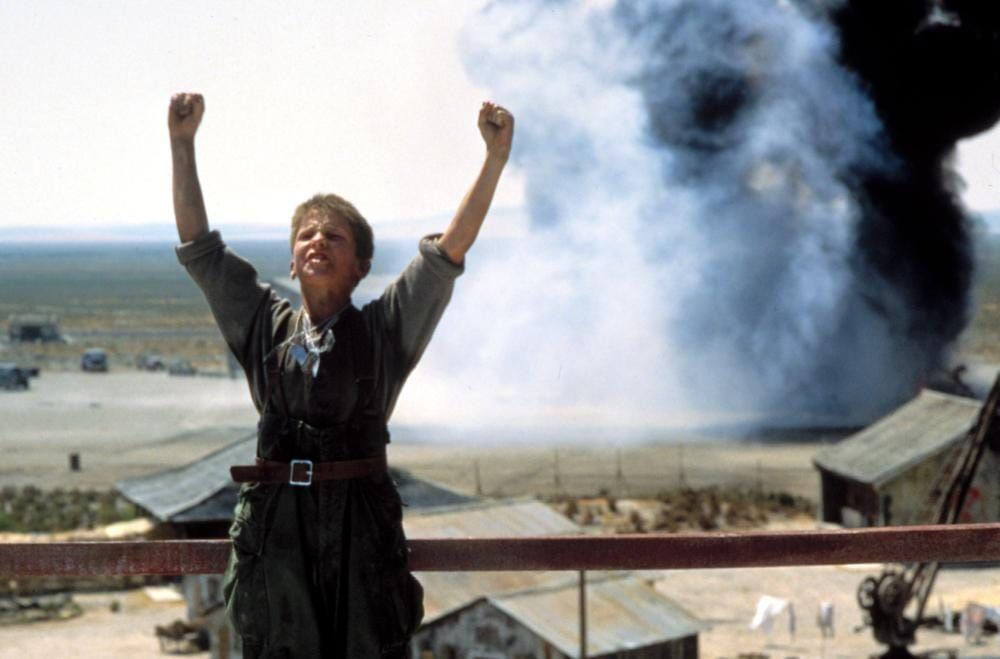
The other film that really affected me as a kid was Empire of the Sun. I had such a visceral reaction to it. We were up in Liverpool visiting friends. The adults dropped the four of us kids at the cinema. It was the first movie we’d been allowed to watch on our own. I don’t know if they quite knew what they were [laughs] sending us in to. That film is brutal, emotionally, particularly for a kid.
A young Christian Bale in the 1987 movie Empire of the Sun
I remember coming out and being… almost… I didn’t want anyone to talk to me because everything that I’d experienced was so emotional and intensely private. I didn’t want anyone to ask me how the movie was. I was looking at the other kids around me. Had they had the same experience?
Those moments, yeah, definitely got me hooked into film and its potential to move people and make them feel something in a way that other mediums can’t.
When I got to university, my interest really took off. I started to consume more movies outside of the mainstream because I had that freedom to do and watch whatever I wanted, without permission [laughs]. Yeah, I was maybe a little later starting than other people who ended up making it their living.
In my earlier years working in the industry, I used to be quite self‑critical of the fact that certain details about movies and movie making — the process — the facts and figures — those details that people can reel off and come over like a real film buff, I just didn’t have them at my fingertips.
I don’t have the best memory for what won which Oscar whichever year, because I’m just not that interested in that side of things. I don’t remember random Box Office figures. I can’t always tell you which DP shot which movie, because my entire entry point into working with film, my obsession, comes from loving storytelling, so those tend to be the elements I hold in my brain. It’s quite nice that as I’ve got older and become more relaxed and confident in my skill set, I don’t give myself such a hard time over the other stuff. I’m not a facts and stats person, and that’s OK. [laughs]
Scott: So you graduate from Southampton, and you land a gig at The Royal Court Theater. What was that about?
Rachael: When I left university, I knew absolutely that I wanted to work in story in some capacity. Like most graduates, you have a dream idea of what you might do, and you also have a reality plan. I was at that age and level of experience where you’re willing to take whatever job you can that gets your foot in the door in a creative industry. I remember going home that first summer after graduating (and this was pre-email), and taking the Central London Yellow Pages out of the local library. I wrote to over a hundred theater, TV and film companies, begging for a job, [laughs] because I knew I needed to be in London. The only interview that I got was for a Stage Door job at The Royal Court Theater.
So that’s how I got in. I was essentially a receptionist at a really busy and vibrant new writing theatre. I wasn’t on the desk too long before they gave me an incredible opportunity. They created a job for me, with what I thought at the time was a very cool, grand title: Artistic Assistant.
Essentially, it was a second assistant to Stephen Daldry’s PA, who was the Artistic Director of that theater at the time. I also helped the Casting Director and all the other associate directors (one of whom was Rufus Norris). It was a great entry point job. I was in this space with all these amazingly talented people soaking up every aspect of how you put a piece of visual storytelling together. Obviously, it’s a different discipline to film, but the crossover is substantial in terms of producing an idea from first draft to production.
It was a fantastic way for me to break in and I loved it from the off. The pay was not great. I was earning about £10,000 a year and living in a house with about six boys who played their music until 3am and let’s just say, weren’t quite taking their careers as seriously as I was at that point.
I was lucky to get that job at the Royal Court, which led to working with Stephen Daldry, which led to everything, but I did sit and write a hundred handwritten [laughs] letters in order to try and open up that opportunity for myself. I worked there for maybe two years with Stephen before he announced he was leaving. He did a deal with Working Title Films to make his first movie. He let me know that Working Title were looking for a Development Assistant and he thought I should go for the job. I, being completely honest, Scott, had no idea how films got made. I didn’t.
It didn’t occur to me that it would be a similar process, necessarily, to getting plays on the stage. That level of ignorance would be quite rare to find in a 23 year‑old now that we have the internet and Twitter, and information is at everyone’s fingertips. But if you’re coming from the Midlands and your parents are schoolteachers, and it’s the early 90’s, I think it’s forgivable. I hope it’s forgivable.
But yeah, I remember saying to Stephen “Oh, I don’t think I want to go for that job,” because in theater, development means fund‑raising. [laughs] I was like, “I don’t want to do that for a living.” He’s like, “No, no ‑‑ it’s working with scripts.”
I went and had the interview with a woman who’s now one of my best friends, Natascha Wharton. She’s a Senior Executive at the BFI now. All told it was like six weeks and three interviews [laughs] before I got offered the job. Tim Bevan smoked a cigar all the way through my final interview. Like a proper Hollywood producer. They really made me sweat before letting me know.
There’s no doubt the fact that I had all that experience with new writers at the Royal Court was a huge part of them employing me, ’cause I had no film experience whatsoever. That’s how I found myself in film.
Tomorrow in Part 2, Rachael provides her take on producer as “facilitator” and how she intersected with the spec script Man Up.
Twitter: @ORachaelO.
For the Big Talk Pictures website, go here.
For my June 2015 interview with Man Up screenwriter Tess Morris, go here.
Comment Archive