Interview (Part 2): Don Winslow (“The Cartel”)
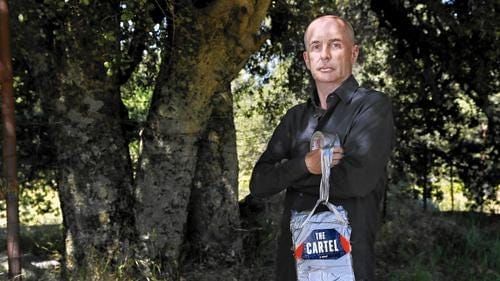
One of the joys of having hosted this blog for over 7 years and being an active Twitter participant is getting to know writers I would never have met if I were just shut up all day in my office. I am particularly glad to have become acquaintances with Don Winslow, novelist and screenwriter.
Don is a New York Times bestselling author who has written 17 novels including The Kings of Cool, Savages, The Winter of Frankie Machine and the acclaimed epic The Power of the Dog. A Raymond Chandler award recipient, his latest novel is The Cartel which has been receiving fantastic reviews. For example, here is a quote from the New York Times: “‘The Cartel’ is a big, sprawling, ultimately stunning crime tableau.”
The Cartel went on sale yesterday and Don is embarking on a nationwide book tour, but I was fortunate enough to grab him for an interview.
Today in Part 2, Don talks about his unique partnership with Shane Salerno and answers a number of questions about the craft of writing:
Scott: I saw an interview in which you described how you changed to writing some of your novels from the past tense to the present tense, as you’ve done with “The Cartel”. What is your rationale for that and was this choice influenced by your experiences writing screenplays which are also in the present tense?
Don: My rationale is that I got bored (and boring) writing in the past tense. I switched to the present years before I ever wrote (or maybe even read) a screenplay. I was writing the book on the train and was just flat out bored. I deleted it and started over again, writing in the present tense. Bam. It was a revelation and a revolution. All of a sudden I was having fun again. Here’s the thing — the present tense stands the narrative up, so it’s vertical, in your face. Now the events unfold in front of you and you can’t see what’s behind them. It has an immediacy and a suspense that the past tense doesn’t. The present tense doesn’t assume inevitability, as the past tense has to do. Anything can happen. Also, the reader isn’t hearing about something that already happened without him or her, the reader is coming along with you for the ride. That’s a huge difference. Now sometimes I find stories that are better written in the traditional past tense, but for the most part, I like to stand the story on its feet.
Scott: At some point, you intersected with Shane Salerno (Armageddon, Savages, Avatar 4) and you have done several projects together. Could you talk about your partnership and what The Story Factory is?
Don: The Story Factory is Shane’s company. I’m only a client and a very happy one. Shane is primarily known as a writer and producer but he is also involved in the careers of some major authors and played an instrumental role in a number of bestsellers, here and around the world. He is a guy who loves books. He wrote his own, his first in 2013, a wonderful biography of J.D. Salinger (with David Shields) that was a big bestseller. He reads five books a week and has a personal library of over 20,000 books. He’s co-writing Avatar 4 now with James Cameron who he worked with previously on another project and he works with Michael Mann on various projects. He’s working on something now I can’t talk about that I think is going to really blow people’s minds.
Shane and I have been friends for seventeen years. We were introduced by a smart agent at CAA name Joe Cohen. Joe thought we would hit it off and he was right! He sent Shane my novel California Fire and Life and he sent me a script Shane wrote about Sonny Liston that William Friedkin was directing and Tom Cruise was producing. It was a remarkable script. I called Joe right up and said I want to work with this guy and Shane told him the same thing and seventeen years later we’re still at it. We co-created the NBC television series, UC: Undercover together. Shane served as showrunner. I was a writer and EP. Shane also has a fantastic eye for talent. He found and gave a young writer his first job on that series name Stephen Adly Guirgis who went on to become a celebrated playwright and last month he won the Pulitzer Prize for drama! No one wanted to hire him. Shane fought for him, hired him and after just a few weeks said he’s too good to be a staff writer and promoted him on the spot to story editor. Shane also fought for Vera Farmiga. The studio wanted another actress and Shane said “then find another showrunner” so they hired her and she’s obviously gone on to have a terrific career. There were other examples.
Scott: You and Shane set up your novel “Satori” at Warner Brothers and Appian Way with Leonardo DiCaprio attached to star and produce the movie adaptation. What’s the backstory and current status of that project?
Don: It is in active development at Warner Brothers. John Lesher who just won an Academy Award for producing Birdman is the producer and Shane is the executive producer as he was on Savages. Shane and I wrote the script and it was very well received but it is a very expensive period film and all the pieces have to come together perfectly for a picture like to happen and in this blockbuster climate of reboots and remakes and frankly we knew that when we set it up. DiCaprio is a brilliant actor, really gifted but he is also extraordinarily selective when it comes to directors so finding the right person who he also approves and then aligning schedules and budget — that’s a lot of challenges.
Scott: You’re active on Twitter (@donwinslow). Is that strictly as a social media platform to promote your work or do you get something else from those interactions online?
Don: I live way out in the country most of the year. It isn’t uncommon for me to not talk to another person than my wife for a week at a time. So it’s nice to reach out, get away from the current book a little, and interact with people with a lot of interesting people I would otherwise have no conversations with and, most importantly, I try to encourage aspiring writers. I tell them my first book was turned down by 14 publishers. I tell them to persevere. I want to encourage aspiring writers. I want them to succeed. We need new voices.
Scott: I’ve read where the longest stint you’ve had without writing after finishing a book is 5 days. In fact, you’ve describe writing as an “addiction”. Could you unpack what you mean by that?
Don: It’s pretty simple — sometimes I try to stop writing and I can’t for very long. That sounds like addiction. On the biochemical level, I’m sure that there’s a release of dopamine that comes from writing well — it’s a real high, isn’t it, when it’s going great. And there’s an awful letdown — not unmixed with relief — when you finish a book. That fun’s over, you’ll never get to do it again. So I think you do look for that next rush. Also, storytellers are storytellers — it’s been that way since our cavemen days, and it’s not going to change.
Scott: What is your typical writing day like?
Don: Very routine. I start work at 5:30 AM, work until about 10, go out and walk or run or a combination of the two for 4–6 miles, come back, have lunch (usually at my desk) and then work until 5:30 PM. Exciting, huh? But that’s the way I have to do it, that’s the way I’m most productive. I’m not saying that every writer has to work that way, or even should, but I will say that almost every successful writer I know has a routine and is very disciplined.
Scott: I’ve also read where you prefer to work on two books at the same time. Could you describe how that process works for you?
Don: I like to have more than one horse in my corral. When one gets tired, I can jump on the other and ride it for a while. I think it keeps me fresh. Having said that, when I’m coming to the final stages of a book, I drop everything else and just work on that. This was especially true of a huge work like The Cartel, which was all absorbing. I simply couldn’t afford to lose my focus on it.
Scott: Some more craft questions for you. How do you come up with story ideas?
Don: There’s an old saying in surfing — ‘Sometimes you ride the wave, sometimes the wave rides you’. I think that sometimes you tell the story and sometimes the story tells you. I’m sure there’s a more prosaic explanation for this — something has been working in your subconscious for a long time and then shows up in your awareness as something completely new and you wonder, “Where did that come from?” Other times, I’m more intentional — I want to write a novel about a certain subject or place and then it’s a matter of finding the characters. Sometimes it’s the reverse — I’ll start thinking about a character and then build a novel around him. To tell the truth, and butcher grammar, I think writing a book is like getting married — you shouldn’t do it unless you can’t not do it.
Scott: How much time do you spend in prep-writing (i.e., brainstorming, character development, plotting, research, outlining)? Which of the aspects of prep do you tend to devote the most time and focus to?
Don: A lot of time on research. Research, research, research. Then more research. As a writer in the crime genre, I have to get the details right, and they can vary from the evolution of a drug cartel to the preservation of DNA samples. You can really screw up a story by getting one of those things wrong. You screw something up on page 16 and I guarantee it will come back to bite you on the ankle on page 263. I’ve had it happen. It’ like that old carpenter’s cliché ‘Measure twice, saw once.’ As for brainstorming, I think that usually happens pretty naturally and starts long before I’m really planning a book. Characters, or story, or dialogue starts popping into your head and then it’s sort of a matter of paying attention and storing it away. If a book is meant to be written it will come up again.
Scott: How do you go about developing your characters? Any specific tips or tools?
Don: Details. Character comes from detail, because detail makes things real. I need to know everything about a major character, even if I don’t use most of that knowledge in the book. They inform my awareness of that character and affect what he or she would or wouldn’t do. Also, characters have to want something — humans beings always want something, even if it’s a glass of water or the next breath. In crime fiction it’s sometimes handed to us — the character wants to solve the crime — but it should be better and deeper than that. I the best of what we do, that character wants something inside him or herself as well, and that’s what makes them really interesting.
Scott: What about dialogue? How do you go about finding your characters’ voices? How can a writer develop their ability writing dialogue?
Don: It’s the hardest thing we do. By far. First of all, I listen. I go the places I’m writing about, sit, be quiet and listen. After I’ve written dialogue, I read it out loud to myself, and/or I repeat it many times in my head, refining each time. Then I read it out loud again. If it sounds awkward or phony, it is. Then I cut, reducing it to its essentials so that it has pace and immediacy. But it’s tough.
Scott: How would you define theme? How important is it? Do you start with themes or do they arise in the context of developing and writing the story?
Don: I never start with theme. If I started with theme, I’d be writing characters to fit that theme, and then they’d be chess pieces, not people. For me, the theme has to emerge from the characters and the story. If they’re real, if they do real things, then a real theme will emerge. Doing it the other way around, I’m really writing an essay with some crappy stereotypes.
Scott: What do you think about when writing a scene? What are your goals?
Don: This is going to sound glib, but I don’t mean it that way. I don’t do a lot of thinking, I try to let the characters do the thinking and get out of their way. I want something natural, organic, without the author intruding himself into it. My goals? Write a good damn scene.
Scott: When you finish a first draft, you are faced with the inevitable rewriting process. Are there some keys you have to rewriting your stories?
Don: I rewrite as I go. If I’m not being particularly creative with new material, I’ll go back and rewrite the older stuff. A lot of times, that kick-starts me into the new. The original writing is about the author, rewriting is about the reader. Is the work clear? Vivid? Understandable? Am I using the fewest words possible? Have I set the scene for the reader? Have I been redundant? Does the dialogue flow naturally to the reader’s ear? Do characters sound like who they are? (Would I know who’s talking without identification?) As a basic rule I like to write fast and rewrite slow.
Scott: What do you love most about writing?
Don: The writing itself. Maybe that begs the question, but it’s the truth. I love the physical act of creating, making things up. I like the empty page.
Scott: “The Cartel” has received glowing reviews. Do you have plans down the road to write another sequel in this ongoing saga?
Don: Thank you. At this point I don’t have plans to do that, but I said the same thing after ‘Dog’ and Shane convinced me to do it. He was really nagging me about it constantly and finally I agreed to do it. So never say never, I suppose.
Scott: Finally what advice can you offer to aspiring writers about the learning the craft and breaking into the business?
Don: Before it’s a noun, it’s a verb — writers write. You can talk about it, think about it, fantasize about it, plan it, organize it — but at the end of the day writers sit down and do it. And if you do that — if you sit and struggle with the written word — you are a writer and don’t ever let anyone — editors, publishers, agents, writers, friends, family — tell you that you aren’t. You are.
As for breaking into the business. Write first. Finish something. Then kick the door down.
For Part 1 of the interview, go here.
Twitter: @donwinslow.