Interview (Part 2): Eric Heisserer (2012, 2014 Black List)
This weekend, the horror movie Lights Out rolls out in movie theaters across North America. Starring Teresa Palmer and Maria Bello, directed by David F. Sandberg, the screenplay was written by Eric Heisserer. I thought it was a good opportunity to reprise a 2013 interview I did with Eric and reach out to him with some questions about Lights Out.
Today in Part 2, Eric discusses Nightmare on Elm Street, Final Destination 5, The Thing, and his movie Hours, which he both wrote and directed:
Scott: I want to touch on three movies you were involved in writing. Nightmare on Elm Street which came out April 2010. Final Destination 5, August 2011. And The Thing, October 2011. That’s three movies released within a period of about 18 months. Must have been quite a whirlwind.
Eric: Well. You know what, it felt like a few years of steady work for me, and then it was just that the release schedule timed out so that I seemed to be working faster than I really was. [laughs] But, yeah, 2011 was a pretty big year.
Scott: How did you handle the weight of expectations that came with these well‑established movies and franchises?
Eric: Honestly, not very well. [laughs] I took on a lot of these projects because I am a fervent fan of the genre, and particularly these characters or these worlds. I was hopeful that I could do them justice, at least in my part of the chain that creates movies. I found out as a relative newcomer to the studio system that, as a writer on a studio property, I have a limited sphere of control, and I was also unaware of how many of the decisions get made farther down the road that I probably could have been better at communicating back in the script stage.
So, I would say, of those films, some I feel are victories and some are sort of failures. And certainly I take responsibility for some of that. But as a studio writer, you have to accept the fact that 90 percent of the dialogue in that kind of film isn’t yours.
Scott: Were you working on these simultaneously?
Eric: Well, I normally stack projects. That’s how I work. I work on two projects at once. I can’t do more than two, but doing two allows me to bounce around whenever I get stuck on one. So, I wasn’t a stranger to that. But when it comes to the actual writing services for those movies, they were back to back, they never really overlapped.
Scott: Each of the projects is either science fiction, horror or thriller. So presumably, at some point, you got put on those writer’s list in Hollywood. Had that been a conscious decision on your part and your representatives to pursue those specific genres? Or did that happen because these were just the type of stories to which you naturally gravitate?
Eric: I would say it’s sort of a happy accident. When I was put on Nightmare on Elm Street, I had probably a half a dozen specs, and other unproduced assignment work, rewrites and other stuff that I had done over the past five years, but only that one horror spec. It was because the “Dionaea House” stood out as a piece of horror writing that a lot of executives loved, I was brought in to pitch on Elm Street. When that took off, I think I just carried the horror writer banner around for a little while, and I was seen as someone who could get a horror movie greenlit. That’s what paid the bills for me, so I was happy to do that. I didn’t expect it to be the one genre that I would live in for the next two to three years, but that’s kind of how the business works. You get seen as this or that type of writer, and the only way to sort of break out of that or change gears is to deliver on spec, usually, a piece of writing in another genre.
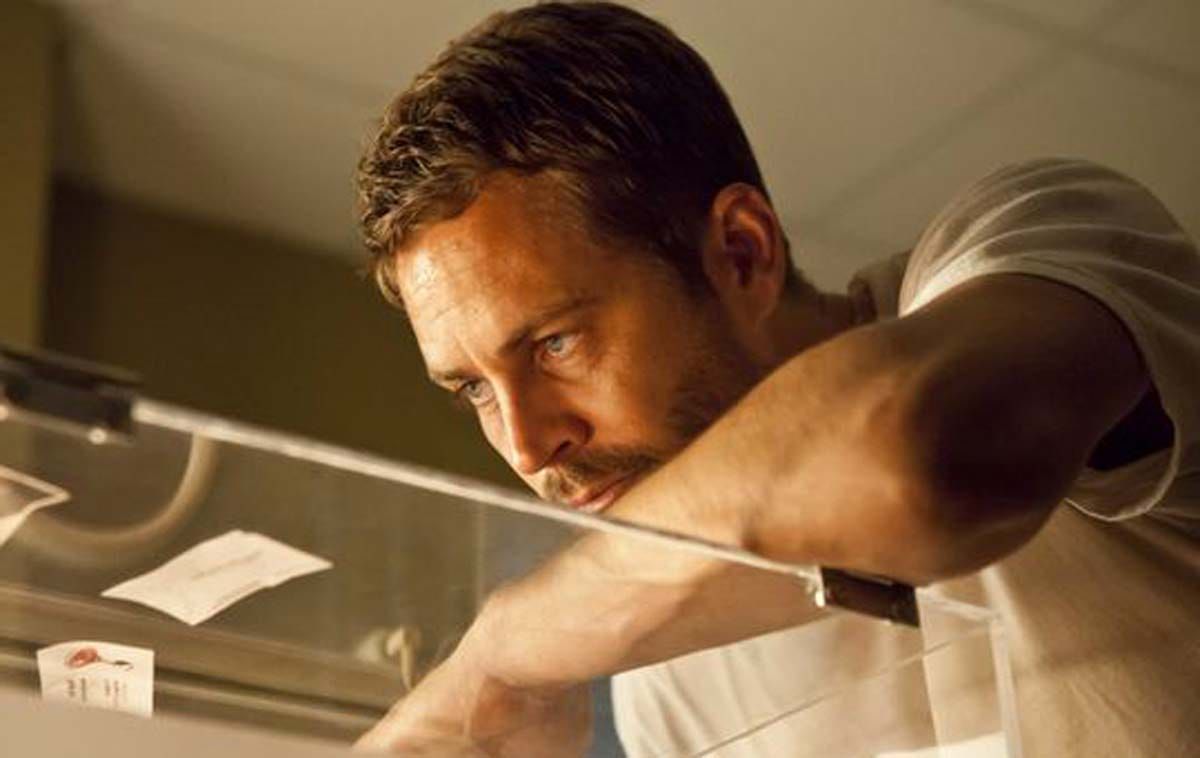
Scott: That’s a nice segue to Hours, your new movie, which you wrote and directed starring Paul Walker. The plot involves a father who struggles to keep his hospitalized newly born daughter alive in the wake of Hurricane Katrina. And while it’s a thriller, it’s reality‑based. There’s no science fiction to it. There’s no horror, at least in the traditional movie sense of the word. Moreover, it’s based on a short story you wrote and published. So why did you write this type of story as compared to something in the sci‑fi horror thriller. Were you trying to expand out of that, or was this just a story that you needed to write?
Eric: I’ve been keen to work new muscles as a screenwriter, and every year, I at least attempt to write a screenplay in a genre that I haven’t done before. Because I find I learn a lot of new lessons and things that I can apply to writing and genres that I am normally comfortable in, like science fiction and horror. So, that was part of my choice…to write Hours. The other is that I was moved emotionally by a lot of the stories and a lot of the research I had done from Katrina survivors. Having lived in Houston for a long time and taking vacations and trips over the New Orleans area, I had personal memories there. And I felt like it was a natural arena to sort of tell a story of the father and newborn daughter inspired by a lot of real‑life stories.
Paul Walker, Hours
Scott: What was the very first component of the story concept that came to you?
Eric: The thing that started it all was the story about the doctors and nurses at Charity Hospital, who manually worked the hand‑crank generators on the ICU equipment in order to keep the patients alive. That idea, that visual, stuck in my head for a long time. And when I realized that I didn’t want to be a doctor or a nurse, the character in my movie, that I wanted it to be a father keeping his own child alive, the rest of it started to fall into place. So that was sort of the crux of it.
There was also this dread, this horrible leash of the equipment…a lot of the time, a ventilator or a piece of ICU equipment has a backup battery that can power the device in case of a total blackout, and when generators fail, you’ve got something that keeps the patient alive.
But often those batteries have to be replaced every few months, because they can just sort of drain out on their own, or they lose all their capacity. And I realized that if we had a case of a piece of equipment that had an old battery in it, that gave my character a leash where he had only a certain amount of minutes in order to go and leave his baby’s side to try and get help, or get food or resources or anything else he could try and do to make contact with the outside world.
But he would always have to come back and crank that generator again. And that allowed me to tell what was in part I guess an episodic story, but also a very powerful and emotional story about the endurance required to love someone who constantly needs you. Which is basically what fatherhood is, you know?
Scott: How did you end up making the transition from short story to script to movie?
Eric: I wrote the short story first, because I hadn’t worked in that medium in a long time, and I wanted to make sure that I could still do it. But also, short stories, for me, have become like guinea pigs for ideas that might have the potential to be movies. And I wrote Hours first as a short story, to see if it had the right sort of architecture for something bigger. I was on the fence for a long while, actually. Some friends of mine finally convinced me to turn it into a movie. I wrote the first half of the script over the course of a few months in 2010, and it took me nearly half a year to get back to it and write the rest of it, because it scared me, honestly. It was very new to me, writing this type of material. It was emotional, and it tapped into my fears as someone who could theoretically be in Nolan’s shoes. And that worry that you aren’t good enough or strong enough or have the endurance required to be a parent.
So, there…where was I going with that? It took me a while to get the script. Once I did, I knew I couldn’t just hand the script over and make a spec sale and let it go at that. I had gotten very emotionally invested in the story and the character, to the point where I could close my eyes and see how the movie was supposed to look and sound.
And I shared that with my reps, who agreed that it was time to direct, to become a hyphenate. Thankfully, because it’s a contained thriller, and it doesn’t have a sprawling cast or a bunch of special effects, it felt like a good first effort.
Of course, it does have three things that they say you should avoid at all costs, which is children, animals and water. So… [laughs] I certainly made things hard on myself in that regard.
Here is my second question to Eric about Lights Out and his response:
Scott: The short film is basically a one trick pony: At night, a woman discovers a weird female entity in her home which only appears when the lights are off. Compare to the plot summary provided by STX Productions:
“When Rebecca left home, she thought she left her childhood fears behind. Growing up, she was never really sure of what was and wasn’t real when the lights went out…and now her little brother, Martin, is experiencing the same unexplained and terrifying events that had once tested her sanity and threatened her safety. A frightening entity with a mysterious attachment to their mother, Sophie, has reemerged. But this time, as Rebecca gets closer to unlocking the truth, there is no denying that all their lives are in danger…once the lights go out.”
How did you go about developing the backstory and plot to expand the short film into a feature length motion picture?
Eric: As I mentioned, David [Sandberg] actually approached me with the core characters and story structure for the feature. From there, he and I (along with Lawrence Grey and, later, James Wan) met and discussed the film in more depth, and finally I felt like I had enough ingredients to go into the metaphorical kitchen and cook this up. Since we wanted to make sure the heart of this movie had a compelling family drama, I tried something a bit unconventional: I wrote just the drama story first, making sure the characters grew and had arcs, and got some proper resolution. That draft (let’s call it draft zero, since I shared it with no one) clocked in at around 70 pages. From there, I built all the horror elements on top of it, finding the places where the dramatic tension was already high and exacerbated it with Diana. That brought the script up to the mid-90s in page count.
Here is a trailer for the movie Lights Out:
Go here for the Lights Out movie website.
Tomorrow in Part 3, Eric digs deeper into his movie Hours and answers another question about Lights Out.
For Part 1 of the interview, go here.
Eric is repped by UTA and Art/Work Entertainment.
Twitter: @HIGHzurrer.